
|     |

|
| |
 e-mail: srjan.bbsr@gmail.com Anant Mahapatra - A dialogue with the maestroExploring the Soul of Theatre and FilmsPhotos: Baban BidOctober 22, 2025 Art, when pursued with devotion, transcends the boundaries of time and place. On the morning of October 15, 2025, the Shruti Building of Sri Sri University became a living testament to this truth when it hosted an extraordinary event titled "A Dialogue with the Maestro: Exploring the Soul of Theatre and Films." Organized by the School of Languages and Social Sciences (SoLSS) under the Faculty of Arts, Communication and Indic Studies (FACIS), the session brought together the academic and artistic communities of the University to celebrate the timeless dialogue between stage, screen, and spirit. The distinguished guest and speaker of the day was Anant Mahapatra, one of Odisha's and India's most respected theatre and film personalities. A nonagenarian whose life and work have spanned more than six decades, Mahapatra is revered as a visionary who not only chronicled but also shaped the evolution of Indian theatre. His presence at the University infused the atmosphere with rare gravitas and serenity, embodying both the wisdom of experience and the curiosity of perpetual learning. 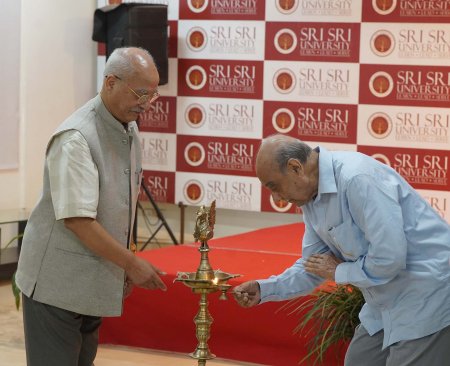 Anant Mahapatra lighting the lamp in the presence of Prof Tej Pratap The session was inaugurated by the Vice-Chancellor, Prof. (Dr.) Tej Pratap, whose opening remarks reaffirmed the University's unwavering commitment to nurturing creativity, critical thought, and cultural literacy. He spoke of how FACIS, as one of the pioneering faculties of Sri Sri University, continues to serve as a confluence of tradition and innovation, bridging classical forms with contemporary sensibilities. Prof. Tej Pratap's consistent and inspiring participation in FACIS initiatives has been a source of motivation for both faculty and students. His presence throughout the session reflected not only administrative support but also an authentic belief in the transformative power of art. The morning commenced on a note of devotional harmony with a soulful bhajan rendered by Dr. Devi Debyani, Assistant Professor of English, FACIS and a professionally trained classical vocalist. Her serene voice filled the auditorium, creating an atmosphere of calm reflection and reverence-a fitting prelude to a discourse on art as a spiritual journey. 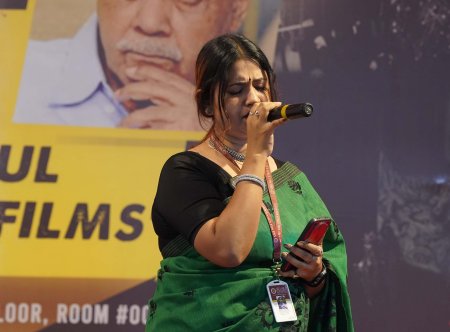 Dr. Devi Debyani 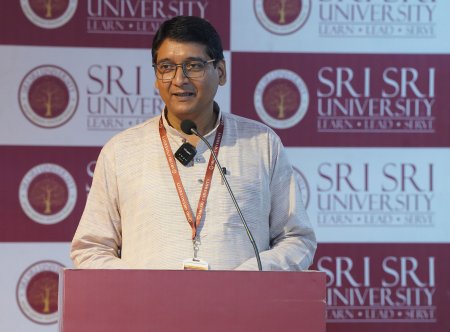 Dr. Rakesh Kumar Tripathi Dr. Rakesh Kumar Tripathi, Associate Professor, Head of SoLSS, FACIS and an accomplished writer, delivered the welcome address. He reminded the audience that theatre and cinema, beyond being instruments of entertainment, are mirrors to the human psyche-mediums through which we confront ourselves, our societies, and our evolving moral consciousness. His words set the intellectual tone for the morning, situating the event not merely as an interaction with an artist but as an encounter with ideas that continue to shape human expression. 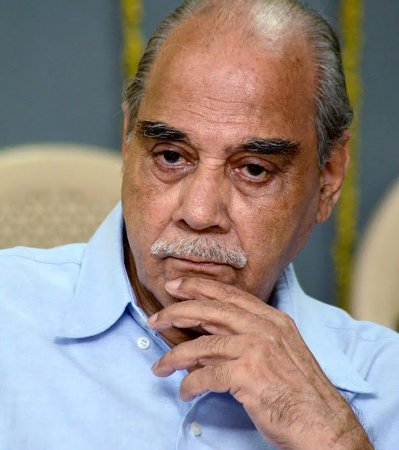 Anant Mahapatra When Anant Mahapatra took the podium, there was a perceptible shift in the energy of the hall. With quiet authority and luminous clarity, he began tracing the journey of Indian theatre-from the sacred ritual performances of ancient temples and village squares to the dynamic, multifaceted narratives of modern times. He spoke of theatre not as a profession, but as a living organism that absorbs and reflects the changing ethos of civilization. He reminded the audience that theatre is, at its core, a conversation with truth. In one of the most striking moments of his address, he observed, "Theatre begins where words end." Through this poetic assertion, he captured the ineffable dimension of performance-the moment when gesture, silence, and emotion transcend language and awaken shared consciousness. 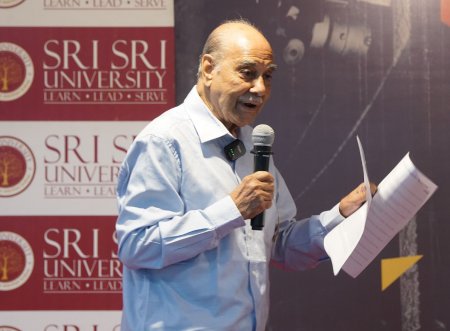 Anant Mahapatra Drawing parallels between theatre and cinema, he described both as vessels of emotional authenticity. While theatre is immediate, pulsating, and ephemeral, cinema immortalizes that essence through the lens of technology. For Mahapatra, both art forms are united by their pursuit of truth-not the truth of the external world, but that of the human spirit. Through anecdotes drawn from his own creative journey, he offered glimpses into the golden era of Odia theatre, recalling the camaraderie of artists, the struggles of building a stage movement in the post-independence decades, and the joy of crafting characters that spoke to the conscience of society. He also reflected upon the role of the artist as a seeker-one who constantly questions, doubts, and discovers. He emphasized that true creativity cannot flourish in isolation; it must emerge from empathy and social engagement. Theatre, he suggested, is not merely an art of performance but a practice of truth-telling-a moral responsibility to hold up a mirror to human frailty and courage alike. The audience, comprising students, faculty members, and visiting scholars, listened with rapt attention, often moved to silence. Many described the experience as one of listening to time itself speak-for Mahapatra's narrative wove together personal memory and collective history with rare finesse. 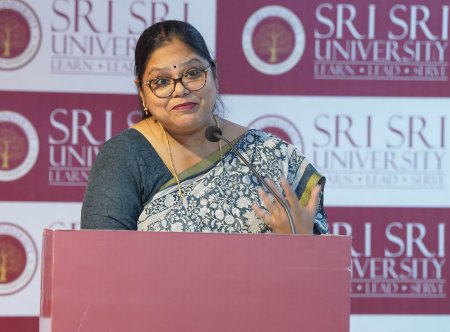 Dr. Madhumita Das The evening drew to a dignified close with the Vote of Thanks delivered by Dr. Madhumita Das, Assistant Professor of English, who expressed heartfelt gratitude to the guest speaker, the University leadership, and all contributors. She acknowledged the tireless efforts of Trinath Mazumder, Assistant Professor of Fine Arts, whose striking visual creatives for the event captured the contemplative spirit of the lecture and enhanced its outreach. The audience left the auditorium in quiet reflection, their hearts stirred by the depth of what they had witnessed. For the students, it was far more than an academic engagement-it was a revelation, a journey into understanding art as both a spiritual awakening and a moral compass. As the lights faded and hushed conversations echoed through the corridors, it was evident that something timeless had unfolded-an experience that transcended performance to touch the essence of being. Anant Mahapatra's words lingered like an afterglow, reminding all that true art is not a pursuit of grandeur but a humble offering of truth. His dialogue illuminated creativity as a sacred bridge between thought and feeling, life and spirit-an experience that reaffirmed the University as a vibrant sanctuary where art, intellect, and consciousness converge in harmony. 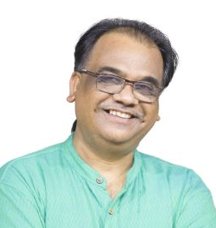 Ratikant Mohapatra, as Director of Srjan and Dean of the Faculty of Arts, Communication, and Indic Studies at Sri Sri University, stands as a distinguished figure in Indian classical dance. With a career spanning over 40 years, his artistry as a dancer, choreographer, and educator has profoundly shaped Odissi's journey. Under his guidance, Srjan has earned national and global acclaim, merging neo-classical innovation with traditional grace. Honoured with the Central and State Sangeet Natak Akademi Awards and a Guinness World Record for orchestrating 555 Odissi dancers, his legacy reflects a steadfast dedication to the evolution and timeless beauty of Odissi. Post your comments Please provide your name and email id along with your comment. All appropriate comments posted with name and email id in the blog will also be featured in the site. |
