
|     |
|
| |

REVIEW / REPORTAn evening of Stillness and Fire - Malhaar Ananta Arts Festival- Priya Josephe-mail: priyamjo@yahoo.com November 11, 2026 On the evening of October 25, at the Ananta Arts Festival organised by Malhaar, Shana Mohan, the anchor, opened the programme with a verse from the Abhinaya Darpana: "Where the hand goes, the eyes follow; where the eyes go, the mind follows; where the mind goes, feeling arises; and where there is feeling, rasa is born." Over the next few hours, I watched those lines step off the page. 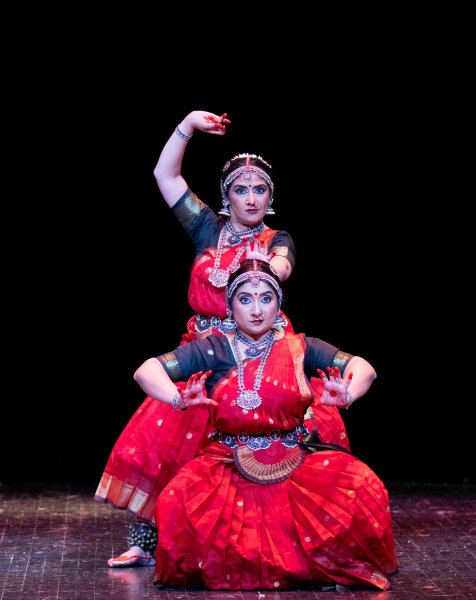 Sreevidya Vijayan and Varsha Vijayan The evening began with two sisters, Sreevidya Vijayan and Varsha Vijayan, both in deep red. There is something particular about watching siblings dance together: the ease of two people who seem to know each other's next step before it comes. That doesn't come from rehearsal alone. It comes from a childhood of shared rooms, shared toys, the same mother's voice calling them home. When one turned, the other seemed already there to meet her; when one grew still, the other leaned in to hold her steady. Watching them, I thought of the old Malayalam phrase 'thaangum thanalum'. A sibling is both: the hand that holds you up when you falter, and the shade you rest in when the sun is too much. It showed in the space they left for each other, in the way neither tried to outshine the other. Without quite meaning to, I found myself thinking of my own sisters. It was a warm, full-hearted beginning! 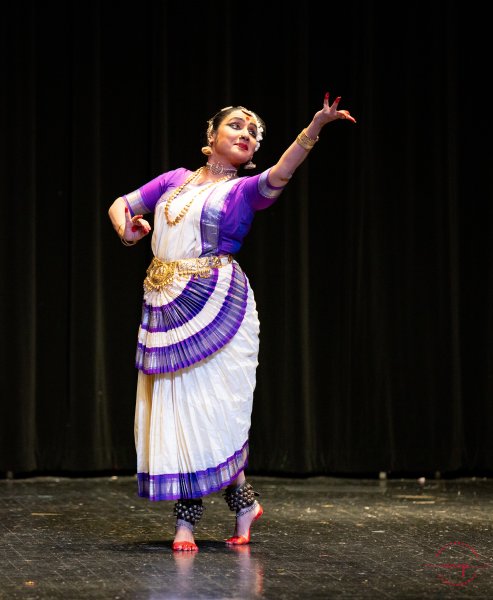 Neena Prasad Then came Dr. Neena Prasad and Mohiniyattam, an art that does not know how to hurry. Like a palm frond stirring in a light breeze, like small ripples moving across the backwaters, she swayed in white, purple and gold, slowly, unhurriedly, in the gentle grace of lasya. She danced with a full pakkamelam: Changanacherry Madhavan Nampoothiri on vocals, Kalamandalam Arundas on the edakka, Shyam Kalyan on violin and Ramesh Babu on mridangam. Here in America, where most performances are set to recorded tracks, that is a luxury we have almost forgotten. Live music carries a life no recording ever can. What stays with me even now are the small things: a glance held a beat longer than expected, and the pull of that glance! A wrist that turned, then paused! The way her eyes arrived somewhere before her hands did, quietly drawing the whole hall along with them. Restraint is the hardest thing to perform. She made it look as natural as breathing. My favourite of her pieces was 'Maathe Ganga Tarangini', in raga Kambhoji. On that stage, she became a river. Movement spread through her the way a current spreads through water. When it ended and the audience rose to their feet, I was still somewhere inside it. 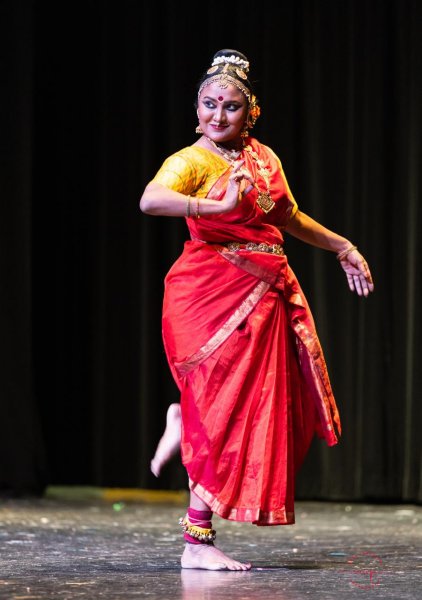 Sreelakshmy Govardhanan Then Sreelakshmy Govardhanan and Kuchipudi, and the evening changed its weather. Where Mohiniyattam murmurs, Kuchipudi speaks aloud. She brought us Kannagi from the Chilappathikaram. Not the Kannagi who ends in the flames of Madurai, but the one Kerala keeps: the wronged wife who walks on to Kodungallur and becomes the goddess there. When a dancer whose mother's home is in Kodungallur dances 'Kodungalluramma', there is something of a homecoming in it too. Running through the story was a folk refrain, 'thaanaaro thannaaro', the kind of syllables we have all hummed without a thought. The brilliance of the choreography lies in splitting it open: Thaan aaro? Who are you? Thann aaro? Who am I? A meaningless chant becomes the central question of the story. A woman the world had made small asks who she is, and the answer she arrives at is: "I am the Devi." It echoes the old 'aham brahmasmi' - the self-discovering was never separate from the divine. All along, a song we hummed without thinking had held the oldest question of all. But there is a difference. The Advaitic "I am That" is calm and serene, while Kannagi's awakening comes through fury and fire. The Shakta tradition embraces exactly that: the Devi as shakti, power, including the power of anger at injustice. Sreelakshmy's dance brings the two together, the philosopher's quiet recognition arriving through a woman's rage. Her footwork was quick and clean, almost conversational, and there was a lightness in her, a playfulness that never tipped into display. She danced like someone who knew we were listening. Her face told half the story; her feet told the rest. I don't think I have ever heard a simple vaythari mean so much. Placing the forms side by side was the quiet intelligence of the programme. One drew us inward, the other drew us out, and between them we were given both the stillness and the pulse.  Priya Joseph is an award-winning Malayalam author based in the United States, whose debut short story collection, Maneem Indiragandheem was published by Mathrubhumi Books in 2025. A two-time recipient of the Grihalakshmi Award and winner of the Samskrithi C.V. Sreeraman Award, she writes about human relationships, identity, and experiences across cultures. |
