|     |
|
| |

REVIEW / REPORTRevisiting the teachings of Pt. Birju Maharaj at Kathak Kendra- Kiran Javae-mail: kiran@kiranjava.com Photos: Kathak Kendra, New Delhi Archive November 7, 2026 It was in 1977 that Dr. Nandkishore Kapote first walked down the hallowed halls of Kathak Kendra, then situated at Mandi House on Bhagwandas Road, New Delhi, different from its present location at Chanakyapuri. He had arrived from Maharashtra on a Ministry of Culture scholarship, and his selection interview was conducted by an illustrious panel comprising the stalwarts Dr. Mohanrao Kallianpurkar, Dr. Kapila Vatsyayan, Damayanti Joshi, Dr. Kumudini Lakhia and Pt. Birju Maharaj. The next ten years were to shape his life as a Kathak dancer, with Delhi becoming his home. He first completed his specialization course at Kathak Kendra and then continued his advanced training under his Guru, Pt. Birju Maharaj. After his years of training, he returned to Pune, Maharashtra and in 1987 he was called back to Delhi to rehearse for two productions that Pt. Birju Maharaj was planning. One for 'Ektaa ki awaaz' which was telecast live on Doordarshan National and second for a ballet performed at Festival of India in Russia. His association with his Guru continued over the decades, and he became Maharaji's first doctorate (Ph.D.) student with opportunities to learn special choreographies even in the later years. And now, in October 2026, after almost five decades, Dr. Kapote had returned to his alma mater. This time he was invited as an accomplished Kathak exponent, to conduct a workshop and perform at Kathak Kendra for the first time. The special workshop and performance on October 1, 2026 was hosted by Kathak Kendra, constituent unit of the Sangeet Natak Akademi under the Ministry of Culture, Government of India and India's premier national institution for training in Kathak classical dance. As an alumnus of the institution and a senior disciple of Pt. Birju Maharaj, Dr. Kapote came to share some of the traditional compositions and choreographies that he had learnt from his Guru during his formative years in Delhi. The morning workshop, held from 11am to 1pm, was attended by approximately 100 advanced students of Kathak Kendra, including Diploma Honours and Post Diploma students. Students and gurus representing different Kathak gharanas, including Jaipur and Lucknow, were also present. The participants were divided into two groups, and Dr. Kapote taught a variety of traditional compositions, all set in Teentaal, the 16-beat rhythmic cycle. 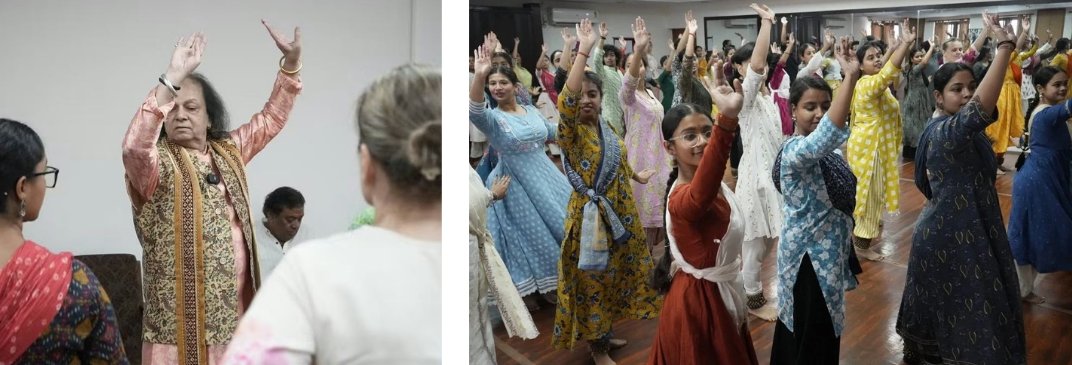 Workshop at Kathak Kendra He began with a Tishra Jati Farmaishi Paran which was a forceful composition danced with energetic movements and the syllables fell on exact pre-defined beats. The dance syllables are based on sounds of the pakhawaj, a barrel-shaped two-headed drum. This was followed by a Parmelu which cleverly blended various sound syllables and a paramparik bandish (traditional composition). Among the compositions taught were the 'Tava Thunga Takita Thunga' tukda (multi-cycle rhythmic composition made of those dance syllables) and the 'Kirtak Thunga Thun' bol bandish. Dr. Kapote also taught an interesting composition based on the repeated use of the syllable 'Dheta', explored in several rhythmic variations and developed into a Chakkradhar Toda. This type of rhythmic pattern is derived from chakra (cycle or rotation) and dhar (to hold or carry), signifying that the pattern spirals through the rhythmic beats before resolving. The huge variety of rhythmic arrangements taught by Dr. Kapote allowed students to understand the intricate possibilities of bols (dance syllables) and their application in Kathak classical dance. Some of these were special choreographies that Dr. Kapote had been performing since the past fifty years. It was particularly valuable for the students to learn a repertoire that has been preserved and performed by a disciple who received it directly from the Kathak maestro. The advanced level of the participants made it possible for Dr. Kapote to transmit the material with ease. The students were skilled and could grasp the teachings with considerable confidence. The workshop was accompanied by live music, with tabla, harmonium and sarangi providing an authentic performance environment. The accompanying artists were Yogesh Gangani on tabla, Sami Mulla on harmonium and Mohammad Ayub on sarangi. 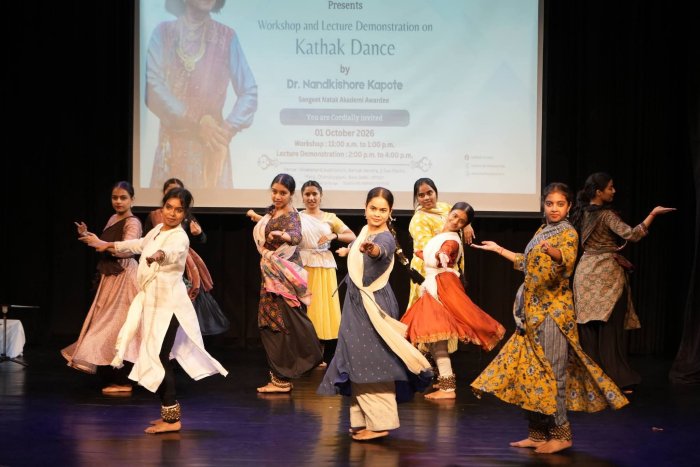 Kathak Kendra student presentation The workshop was followed by a combined lecture and performance by Dr. Kapote, held from 2.30pm to 4.30pm at the Vivekanand Auditorium at Kathak Kendra. Dr. Kapote began by sharing his personal journey and his association with Kathak Kendra. It gave the audience a glimpse into the circumstances under which he entered the world of Kathak. He recalled that, during those days, it was not easy for a male dancer to pursue dance as a profession. He did not come from a family of dancers either. His grandfather was an IAS officer and Assistant Commissioner, and choosing dance as a career was definitely not encouraged. At Kathak Kendra, he underwent training under the guru-shishya parampara. He spoke about the days when students would learn from Maharaj ji and then go to the various auditoriums in Delhi to watch performances by leading artistes and performers. These opportunities to observe the art form were an important part of their education. In the late 1980s, Dr. Kapote returned to Pune, Maharashtra, where he established his own Kathak academy. However, his association with Pt. Birju Maharaj continued to grow. Maharaj ji later invited him to accompany his group on performances in Russia and in the United States. Even after leaving Kathak Kendra, the guru-shishya relationship remained strong. Dr. Kapote shared that during the Covid period from 2020 to 2022, Maharaj ji had taught him special compositions and choreographies tailored specifically for him. As he narrated these experiences, it seemed as if his life story was unfolding right before our eyes. After the lecture, Dr. Kapote presented a performance featuring several compositions from Pt. Birju Maharaj's repertoire. He began with an abhinaya expressive piece on the devotional song 'Govind Gopal Murari'. This was composed by Pt. Birju Maharaj and played as a recording in the maestro's own voice. Hearing Maharaj ji's voice at Kathak Kendra was a particularly special experience. It brought an emotional ambience to the auditorium and created a connection with the Guru whose teachings formed the foundation of the workshop and lecture presentation. 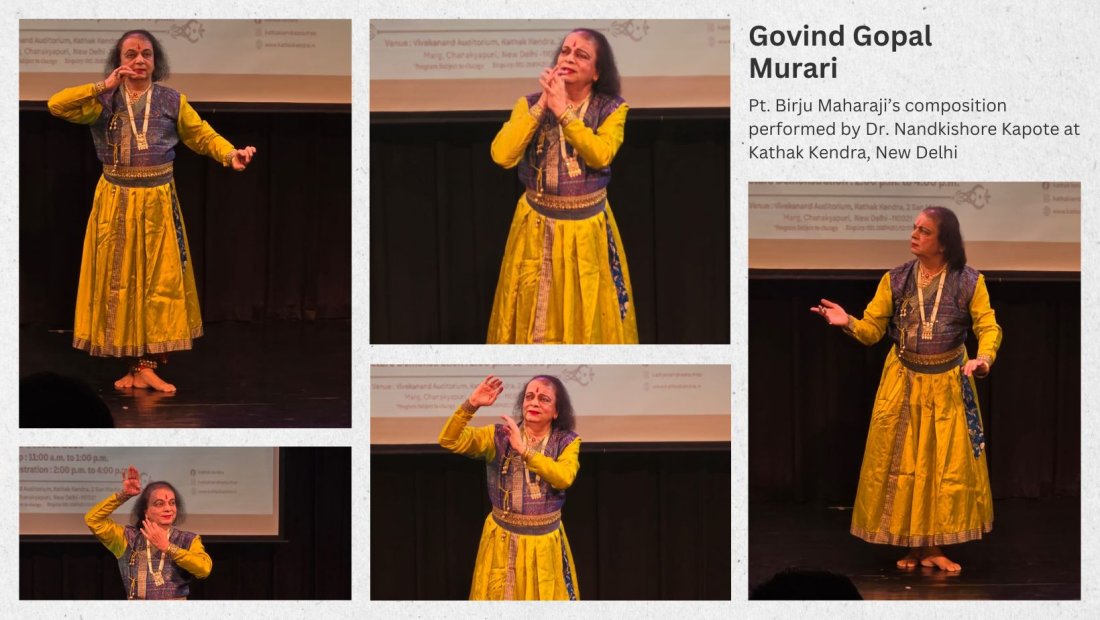 'Govind Gopal Murari' composition performed by Dr. Kapote Dr. Kapote presented four Parans and Parmelu compositions, each demonstrating the rhythmic richness and variety of the traditional repertoire. Among these were 'Dha Taka Thunga', special bol (dance syllable) arrangements and a 'Gardan ka Dora' tukda (a gentle, horizontal side-to-side movement of the neck), which he executed with great finesse. He presented the 'Dheta' bandish he had taught earlier in the workshop giving students a final opportunity to see it performed on stage. Dr. Kapote also showcased the composition 'Dhage Tita Dhage Din Din Nage Tita', which combined intricate footwork with rhythmic precision. This was followed by two impressive Tihais, a rhythmic phrase or composition that is repeated three times consecutively to land sharply on the sam creating a strong sense of climax. One was the Aroh-Avroh ki Tihai which showcased a rising and falling progression of dance syllables. The second was the Lamchad Tihai which has an exceptionally long, and extended rhythmic phrase. The Lamchad Tihai in particular was designed to demonstrate to the students' speed, physical stamina, and rhythmic mastery. This Tihai also demonstrates the mathematical acumen and precision required to bring the composition to a perfect conclusion. Dr. Kapote's clear padhant or recitation of the dance syllables, followed by their execution through footwork, helped the audience admire the complexity of these compositions. One of the highlights of the performance was a Dadra Chhand footwork which was performed as a jugalbandi with the tabla. The Dadra Chhand refers to a 6-beat rhythmic cycle (taal) split evenly into two parts or divisions of 3 beats each. The rhythmic exchange between the dancer and the tabla player created an engaging musical dialogue. It was fascinating to witness that a composition taught almost 50 years ago still held a magnetic rhythmic appeal even till this day. Dr. Kapote then presented the traditional 'Paanch Ghunghat', demonstrating five different ways of portraying the veil. Through subtle changes in movement and expression, he portrayed five different characters. The presentation was a reminder of the traditional repertoire that requires both technical proficiency as well as a deep understanding of characterisation and abhinaya. Throughout the performance, Dr. Kapote demonstrated the clarity of execution and rhythmic command that comes from years of dedicated training. The afternoon was also an opportunity to witness the continuation of an artistic legacy. It was a fortunate coincidence that I happened to be in New Delhi during this period for my Preventive Conservation internship and study tour at the Indira Gandhi National Centre for the Arts (IGNCA). This gave me the opportunity to be present and document this significant moment in Kathak's living history. This was a rare opportunity for students to understand the lineage of the compositions they learn and perform. It was admirable that Kathak Kendra provided a platform for one of its distinguished alumni to share his learning with the present generation of students. This programme was made possible through the efforts of Dr. Sandhya Purecha, Chairman of the Sangeet Natak Akademi, Raju Das, Secretary of the Sangeet Natak Akademi, Dr. Y. Theba Devi, Director of Kathak Kendra and Sunita Yadav and her team who coordinated Dr. Kapote's visit. Their efforts not only enabled students and gurus to benefit from this valuable interaction but also to establish a connection between the institution's past and present. 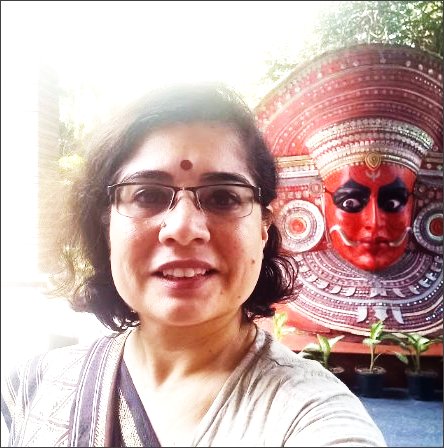 Kiran Java is a published author and independent researcher specializing in Indian art and culture. She guides on documentation and care of heritage collections. She has a Master's degree in Mass Communication, a diploma in Preventive Conservation, Natyashastra and formal training in Kathak. For more information: kiranjava.com |
