
|     |
|
| |

REVIEW / REPORTKudiyattam lec-dem in Delhi- Kasturika Mishrae-mail: kasturikafeministpoetry@gmail.com November 6, 2026 It's not easy to navigate the psyche of an urban audience when your sensibilities are deeply rooted in classical text and its idiom. Kudiyattam, Sanskrit theatre is one such art form attached to its strict roots and performative rituals. Guru Margi Madhu Chakyar demonstrated this in his own way in a lecture demonstration for students of Shaheed Bhagat Singh College for Women. His wife Indu G lectured on the initial concept note and simplified the imagination for a narration of the opulent Sanskrit text used for the classical theatre of Kudiyattam. She gave two examples of how a king walks and then fire gesture. Later she queried the audience to give the meaning of the gestures with drums. Kudiyattam is performed in precincts of Hindu temples, coated with a theatrical language of netra abhinaya (eye expression) and hasta abhinaya (hand movement and gestures). Based on the four tenets of Abhinaya Darpan, there are four types of tools and devices used - Angika, Vachika, Aharya, and Sattvika. These are effectively used in any Kudiyattam performance. 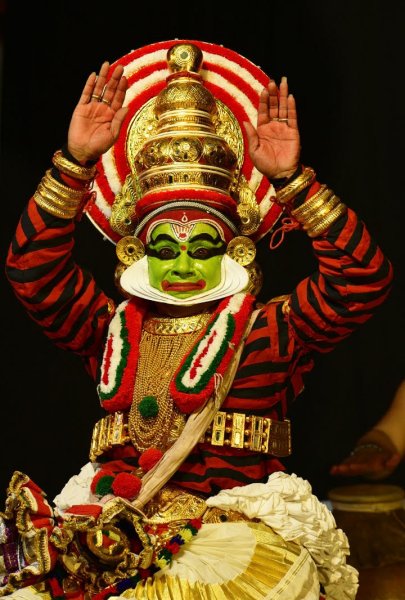 Margi Madhu In the next segment, Margi Madhu narrated an epic performance on Bhima based on the classical text Kalyanasaugandhikam. Bhima lures Draupadi into a garden with an amorous love play and gets besotted with a wild fragrant flower. Enamored by the amorous advances of her husband Bhima, she implores him to get more flowers. Bhima sets out into the jungle and encounters the gory death of a big elephant. Margi Madhu's expertise in expressing the elephant's hunt for food, breaking branches of the tree, plucking fruits and then having a sweet nap after solid eating was a scene to remember. Every nuance of an animal that rules the jungle and Bhima as an onlooker was vivid in only the facial expressions. On witnessing the giant prey in slumber, a python draws its fangs out and strikes. While the elephant wriggles in pain, a lion nearby also joins to get his share of the easy prey. Eventually, Bhima watches from a distance, this gruesome killing episode and wanders inside the jungle to look for the favorite flower for Panchali. Kudiyattam repertoire is replete with such tales around mythological characters written in Sanskrit language. In ancient times, the royals and rich were allowed inside temples. They were high caste community. Hence the art form never became accessible for the common masses. But with time patronage ended, dynastic structures collapsed and Kudiyattam travelled to rural and urban settings and their content became accessible. Margi Madhu's performance was accompanied on drums (mizhavu) by the extremely dexterous Kalamandalam Manikandan and Nepathya Jinesh. Even a small movement and twitch of the eyebrows was shown with specific beats and not missed even for a second. The crescendo of the enactment left everyone in rapture. Owing to time constraints, longer texts which would normally take almost four to five hours are now abridged to shorter durations. Makeup for each character is another dimension of Kudiyattam that requires expert skills. In this performance, Kalanilayam Sreejith Sundaran did the makeup for Bhima, the main protagonist. The tradition draws from everyday life of the common man and weaves in mythology as a central space. For the connoisseurs, this art form is a revelation on complexity and greatness of Indian culture.  @Kasturika Mishra is a poet, writer, and dance critic. |
