
|     |
|
| |

REVIEW / REPORTTradition reimagined: Poetry, devotion and the expressive body in MohiniyattamText & Photos: Dr Shyam Prakash Me-mail: smattumm@gitam.edu November 4, 2026 Mohiniyattam is a classical dance form that articulates Kerala's cultural identity and the aesthetic expression of the body through the subtle idiom of lasya. Shaped by gentle steps, rounded bodily movements, Nethrabhinaya (the art of expression through the eyes) and the semantic density of Mudras (codified hand gestures that convey meaning), it is far more than a visual experience of beauty. It is also a complex field of expression in which body, emotion, music, and cultural memory speak to one another. The lasya of Mohiniyattam does not reside in the softness of the body alone. It emerges through the continuity of movement, the flow of talam and the subtle exchange of bhavas. Here the dancer's body becomes at once a medium of narration, a site of feeling and an instrument for the making of meaning. A critical approach to a Mohiniyattam performance must therefore look beyond the technical accomplishment of steps and gestures. It must ask how the dancer's bodily language produces meaning, and how the performance addresses the relationship between tradition and contemporaneity. 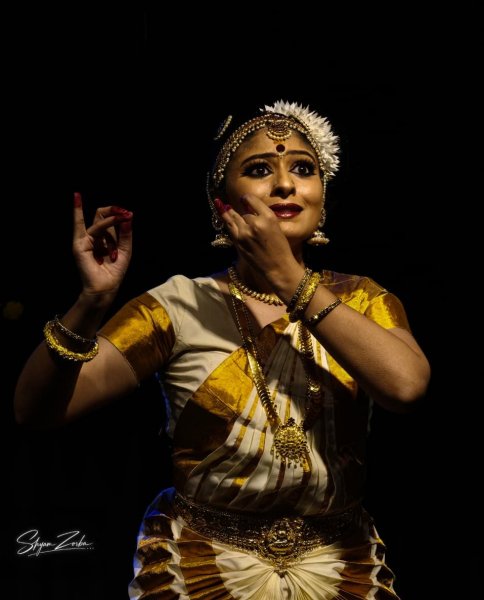 Kalamandalam Aparna Devi The Mohiniyattam recital presented by Kalamandalam Aparna Devi under the auspices of Auratels, Hyderabad, was a notable artistic experience, achieved through a synthesis of laya, lasya and bhava. The program brought together devotional compositions, a narrative piece based on Malayalam poetry, and the rhythmic movement language of the Thillana, thereby showcasing the form's varied expressive possibilities. Its structure unfolded through the Ganapathi Sthuthi, the Mahalakshmi ashtakam, a presentation based on Sugathakumari's poem "Krishna nee enne ariyilla" ("Krishna! You do not know me"), a Thillana and a Mangalam. It can be read as a journey from devotion to personal emotional experience, and from there to the pure beauty of movement. Including musical compositions set at the Kerala Kalamandalam, the performance also offered an opportunity to observe the relationship between the discipline of tradition and the dancer's individual Bhava. The performance opened with the Ganapathi Sthuthi. As a prayer to Ganapathi, remover of obstacles, this item gave the recital an auspicious beginning. Set to music in Puraneeru ragam and adi talam, it rests on the traditional character of Mohiniyattam, which gives visible form to devotion through bodily language. As the opening section of the dance, the Ganapathi Sthuthi serves not only a ritual function but also a structural one, gently leading the spectator into the artistic experience that follows. The laya of the music, the controlled flow of movement, and the dancer's presence together created a distinctive atmosphere of appreciation. Devotion here is not a mere repetition of gestures representing a deity. It is also the artistic expression of an inner state formed through the body's controlled movement and its sense of laya. The Mahalakshmi ashtakam that followed further extended the devotional character of the performance. Composed in Ragamalika and Talamalika, the piece may be read as presenting Mahalakshmi not only as the goddess of prosperity but also as a conception that offers strength and hope in confronting life's adversities. When Mahalakshmi is approached as a symbol of feminine power and survival, beyond her traditional representation as the goddess of wealth and abundance, the work acquires wider layers of meaning. The musical variety of the Ragamalika and the structural possibilities of the Talamalika provide room to express different registers of devotional bhava. The theme also serves as a reminder that the beauty of devotional dance is not confined to its ritual setting and can speak to the experiences of the contemporary spectator. A dancer who represents the divine through the body does more than tell a story. She creates a visual language that connects the idea of the divine with human emotional experience. The depth of this connection depends on the dancer's bhava, on the body's responsiveness to the music, and on the semantic precision of mudras and movements. For this reason, the question most relevant to criticism is less whether devotion is presented as a subject than whether it takes shape as an experience in the spectator. The most striking conceptual element of the recital was the choreography based on Sugathakumari's poem "Krishna nee enne ariyilla". This item leads the spectator into an emotional world in which devotion and love cannot be told apart. The poem centers on the silent love of an ordinary girl of Ambadi. While the other girls play with Krishna and vie for his attention, she keeps her love within herself. Amid the playful chatter of girls who, on the pretext of fetching water or some other errand, try to catch a glimpse of Krishna, her love takes on a distinct character. She does not join their revelry. Instead, she draws her feeling away from the gaze of others and keeps it within a private world of her own. When the sound of Krishna's flute drifts through the village, she withdraws into her hut. To the world outside, her love is invisible, yet it is within this invisibility that the intensity of her feeling endures. Love that cannot be expressed in the presence of others turns into tears in solitude. Here the tears are not merely a sign of sorrow. They express a complex emotional state in which joy and surrender are felt at once. This character's existence is formed not in declaring her love but in keeping it unspoken. The drama of the poem lies not only in its events but in the feelings that go unspoken. What makes it emotionally complex is the subtle movement between the presence and absence of love, between desire and withdrawal, between hope and despair. The Nethrabhinaya, facial expressions, hand mudras, and soft bodily movements of Mohiniyattam have particular potential to make such inner conflicts visible. The duration of a glance, a faint change of expression on the face, the hesitation or hope shown in the movement of the hands, the body's swaying forward and back: all of these can express the character's inner world. In a narrative where silence matters more than words, the body itself becomes language. What sets this character apart from the others is also her social invisibility. Among the many girls who love Krishna, she goes unnoticed because she does not display her love. Her affection has no witnesses, and her waiting has no recognition. In this way, the poem develops beyond a story of personal love into a story of feelings that go unrecognized. In human relationships, visible presence often receives attention, while silent love and cherished longings go unnoticed by the outside world. In this context, the character's solitude can be understood not only as the beauty of devotion but also as the experience of a person seeking space for her own feelings. At the end of the poem, Krishna's chariot halts before the girl's hut, and he looks at her. Her love, which has so far remained unrecognized by anyone, arrives at a divine moment of recognition. In the astonishment of "Krishna, do you know me?", her waiting and her joy converge. This moment is the emotional culmination of the poem. After a long silence, a glance becomes the reply: a recognition that needs neither words nor promises, an acknowledgment made possible by presence alone. This moment need not be read merely as the divine answer to a devotee's prayer. It can also be interpreted as the inner longing of a human being who waits for another's acknowledgment. To be seen, to be recognized, to find a place for one's existence in another's consciousness: these are fundamental needs of a person's emotional life. In this reading, Krishna becomes less a divine presence than a symbol of recognition and acceptance. At the same time, this moment, in which the boundary between devotion and love blurs, is deeply connected with the traditional bhava world of Mohiniyattam. The subtle difference between loving God and wishing to be loved by God becomes an emotional experience here. It is here that the literary power of the poem and the expressive possibilities of Mohiniyattam meet. Love, expressed in the language of devotion, extends into the individual's private emotional experience. Yet the successful choreographic realization of such a theme does not depend solely on the intensity of the dancer's bhava. It is equally crucial how the character's silence and inner conflict are reflected in the measure of bodily movement, in the pauses of the talam and in the direction of the gaze. In particular, when the contrast between the girl's private world and the emotional change brought about by Krishna's arrival becomes evident through the dance's movement language, the narrative gains greater depth. It is when the dance can convey the character's experiential world to the spectator that it goes beyond retelling a story and becomes an independent artistic experience. There is a further distinction in presenting this poem through Mohiniyattam. When the linguistic beauty of Malayalam poetry is transposed into the visual language of the body, what is recreated is not only the meaning of the words but also the silence and imagination that lie between them. This dialogue between literature and dance does not reduce one art form to an appendage of the other. Rather, it reveals the distinct possibilities of each medium. The inner images the poem creates through words become, in dance, a visual experience through the body's presence and movement. In this process, the spectator does not merely hear or watch a story. He or she also connects the character's emotional state with his or her own experience. 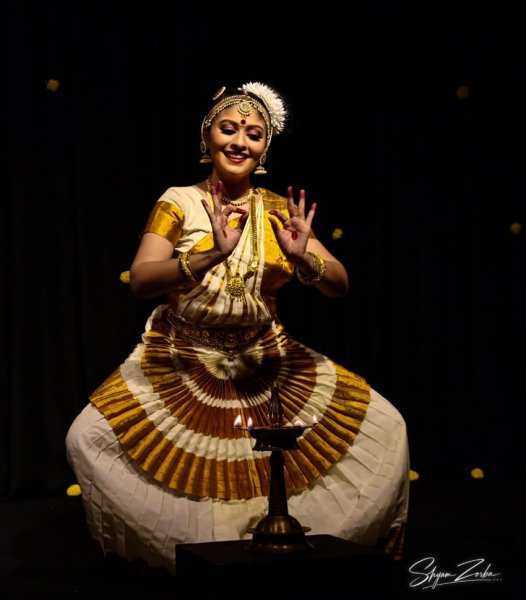 Kalamandalam Aparna Devi The Thillana, presented towards the end of the program, offered a rhythmic experience distinct from the devotional and emotional atmosphere of the preceding items. Set in Kalyanavasantham ragam and adi talam, it gives prominence to the beauty of movement in Mohiniyattam and to the body's sense of laya. Releasing the body from the weight of narrative and turning attention to the musicality of movement and the energy of talam, the Thillana is an occasion to savor the pure movement language of dance. Here, the body is not only a medium for representing a character. It stands as an aesthetic experience in its own right. As narrative meaning recedes, talam, precision of movement, bodily control, and the repetition and variation of steps assume greater importance. At this level of the dance, the spectator's attention shifts from the character's emotions to the structure of movement and the relationship between music and body. The placement of the Thillana at the end of the program is therefore structurally apt.. The presentation then concludes with the Mangalam. This journey, from devotion to emotional interiority and then to the celebration of movement, gives the program's structure a natural completeness. The inclusion of Sugathakumari's poem, in particular, encourages Mohiniyattam not to remain confined to presenting traditional compositions but to engage with the emotional and imaginative worlds of Malayalam literature. This dialogue becomes possible not by abandoning tradition but by expanding its expressive possibilities. The contemporary relevance of a traditional art form is determined not only by its antiquity or formal stability but also by its capacity to connect with the experiences of a new generation and to allow for new readings. In this respect, the effort to bring literature into dance opens the possibility of broadening appreciation for Mohiniyattam. Academic art criticism, however, does not end with the relevance of a theme. The dancer's bodily control, the precision of steps, the clarity of mudras, the subtlety of Nethrabhinaya, the coordination of music and movement, and the emotional growth of the narrative are also principal criteria of assessment. Likewise, the arrangement of the stage, the use of lighting, and the sound design shape the overall experience of a performance. The artistic success of a dance presentation depends less on how accomplished each of these elements is individually than on how meaningfully they work together. Since detailed observations of specific movements and expressions in the live performance are unavailable, an evaluation based on the conceptual structure and thematic variety of the presentation is more appropriate here than a final judgment on the individual merits of these elements. The beauty of Mohiniyattam lies not in its softness alone but in the complexity of the emotions concealed within that softness. A glance, a small movement of the body, a pause in the music: any of these can carry the weight of an untold story. At times the absence of movement is more meaningful than overt movement, and at times a character's silence reveals her inner world most powerfully. It is when the spectator is invited to read these subtleties and to discover meanings in the language of the body that Mohiniyattam moves beyond visual beauty and becomes an art of experience and thought. Approached in this light, what stands out in Kalamandalam Aparna Devi's presentation are the artistic relationships that form among devotion, love and lasya. The devotee in search of God, the girl waiting for her beloved's attention, and the dancer's body set free in talam, each open a different experiential world on the same stage. What binds these experiences together is the body's expressive capacity. The body here is not merely an instrument of a story. It is a living space of memory, longing, devotion and beauty. It is in recognizing this potential that the lasya idiom of Mohiniyattam moves beyond a mere visual feast, leading the spectator into reflection and dialogue on human experience.  Dr. Shyam Prakash M is an Assistant Professor, Department of Fine and Performing Arts, GITAM University, Hyderabad. He can be reached at shyam.zorba@gmail.com |
