
|     |
|
| |

REVIEW / REPORTColourful palette of dance festivals- Satish Surie-mail: satishism@yahoo.co.in Photos: Prof K.S.Krishnamurthy October 28, 2026 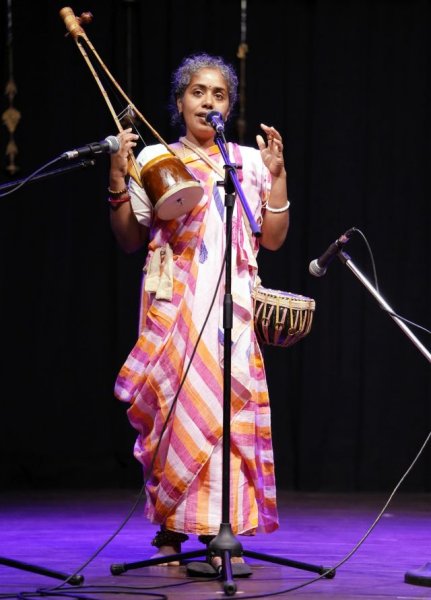 Shanthipriya The Leela Festival of Arts curated by Shashank Kiron Nair under the banner of the Nandanam Arts Foundation, featured three artistes at Seva Sadan, Bangalore, on the 20th of September. The first to take the stage was Shanthipriya, who regaled the audience with Baul singing, offering wisdom through the poetry of the masters Narayana Guru, Kabir, Basavanna and Meera. PURVADHANASHREE'S VILASINI NATYAM Purvadhanashree opened her Vilasini Natyam performance with a gesture of deep reverence, acknowledging the Devadasi (Kalavantulu) community whose custodianship has kept this ancient art form alive across generations. It was a fitting note on which to begin, situating the evening's dancing within its rightful lineage before a single step was taken. The recital began with a Swara Pallavi set in Arabhi, composed and sung by Sudha Raghuraman, with Shriganesh shaping the rhythmic architecture through solfa syllables. From the very first phrases, Purvadhanashree's flowing hand gestures and kinetic body movements brought forward the distinctive vocabulary that sets Vilasini Natyam apart: a softer, more rounded style marked by characteristic dips, the pointed toe Samapada, front bent knee stances, flat-footed footwork, and fluid bends of the torso. These elements, drawn from the temple and court traditions of the Telugu hereditary dancers, emerged with a maturity and unforced ease that spoke of her long years of training under Swapnasundari. The pure dance passages that followed drew on the style's engagement of the whole body, unfolding through short, interlinked jathis and nadai variations. The Carnatic musical foundation lent itself equally to the lyrical passages and to the rhythmic intricacies, giving the sequence both flow and structural clarity. Throughout, Purvadhanashree's command of the form's distinctive hastas, its particular stance, and its expressive vocabulary lent the opening piece real weight, a tribute, in movement, to a tradition she carries forward with evident care. 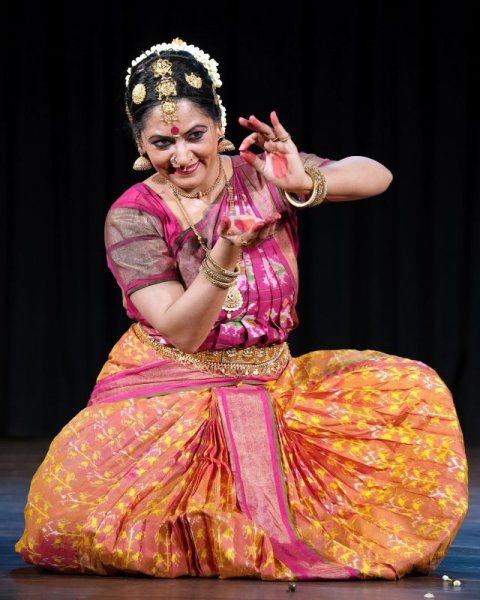 Purvadhanashree She followed this with a Padam whose inspiration traced back to a Pablo Neruda poem, one that speaks of a love carried inwardly, like a plant that never flowers outwardly yet holds the fragrance of blossoms within itself, its quiet perfume seeping into the earth and, through that love, into the body itself. Composed and sung by Sudha Raghuraman, the Padam translated this meditation on hidden, interior devotion into a dialogue between a Sakhi and her Nayika, rendered in the line "Karpooram manakindradi en udambu," the Nayika describing a camphor-like fragrance upon her own body, one she likens to the scent that lingers after union with her husband. She distinguishes it from every other fragrance, insisting it rises only in those who carry genuine love and devotion. Marked, too, by the ash from the cremation ground where he resides, she speaks of seeing him, of experiencing his presence directly. Purvadhanashree navigated this shift in register with sensitivity, moving from the outward-facing nritta of the opening piece into the interior, abhinaya-driven world of the Padam, where longing, memory, and the traces of union had to be conveyed through subtler means: the eyes, the angika, the stillness between gestures rather than their accumulation. She then moved into a rendition centred on Sadashiva Brahmendra's composition "Gayathi Vanamali madhuram," a piece that paints Lord Krishna, here addressed as Vanamali for the garland of forest flowers he wears, singing sweetly along the banks of the Yamuna. The composition surrounds him with a fragrant breeze, flowers in bloom, and the praises of sages gathered nearby. Adorned further with a Tulasi garland, he is described as the destroyer of sins, one praised even by Brahma, the lotus born, and celebrated as a reservoir of every noble virtue. The composition dwells, too, on the joy he brings to the hearts of enlightened souls, the Paramahamsas, as he holds a flute overflowing with the sweetness of music. Purvadhanashree brought this devotional imagery to life through unhurried, lyrical abhinaya, allowing each attribute of Krishna - his garland, his flute, his riverside setting - to unfold as a distinct visual before moving to the next. Her portrayal favoured suggestion over emphasis, letting the sheer accumulation of Krishna's virtues build a picture of divine sweetness rather than reaching for any single dramatic gesture. The Bhakti at the heart of the composition came through clearly in her unforced, contemplative rendering, marking a graceful continuation from the introspective mood of the preceding Padam into this more expansive vision of divine beauty. Purvadhanashree closed her performance with a composition from Ananda Lahiri, one carrying a deeply personal resonance as a piece gifted to her by her late mother. The composition describes a Bhakta awakening to an extraordinary vision: swans at play alongside Saraswathi, Lakshmi, and Lalitha. Saraswathi is absorbed in her own Leela of writing, Lakshmi occupies herself adorning the Kalpavriksha, and Lalitha juggles three balls representing creation, preservation, and destruction. Set against the arrival of spring, the scene finds the Bhakta gazing upon the lotus-like eyes of the Devis, each of them fully engaged in her own act. The composition closes on a note of quiet conviction, the Bhakta affirming that were this vision to remain fixed in memory, every trouble would simply dissolve. The piece was vocalised by K. V. Venkateswaran, with violin support from Raghavendra Prasad. Purvadhanashree brought a particular tenderness to this final piece, the image of the three Devis, each absorbed in her own cosmic task, etched out with clarity and calm, allowing the composition's closing sentiment, that this single remembered vision could dissolve all trouble, to land with quiet conviction. It was a fitting close to an evening that had moved from communal homage, through interior longing, to divine sweetness, and finally to this deeply personal offering; each phase carried with the same assured technique and emotional intelligence that marked her training under Swapnasundari. KAVYA KASINATHAN'S BHARATANATYAM Kavya Kasinathan's solo recital found its emotional and technical centre in Poochi Srinivasa Iyengar's pada varnam "Dani korikenu niraverchutakide," rendered in raga Vasantha and set to misra jhampa tala. The choice of composition, a classic sringara bhakti piece in which a sakhi mediates between a longing nayika and her divine nayaka, gave Kasinathan ample scope to move between the architectural demands of nritta and the interior world of abhinaya. The pallavi opened with the sakhi's appeal to Vishnu as tamarasakṣa, the lotus-eyed one, urging him toward union with the heroine before her pangs of separation deepen further. What distinguishes this genre of varnam is the layering of voice: the words are the friend's, but the longing they carry belongs entirely to the nayika, so the dancer must inhabit two emotional registers within a single line, at once an advocate pleading a case and a lover whose suffering the advocate is only relaying. The anupallavi and charanam sustain this plea for compassion: dayayunci dani, dayadoochi dani, the friend pressing the case for a delay that must not be allowed to continue. 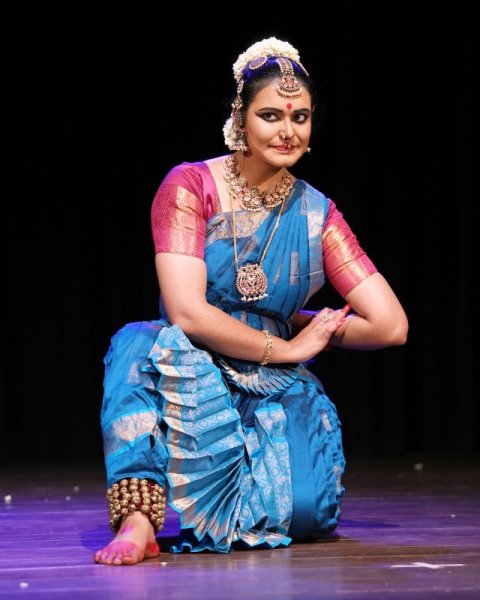 Kavya Kasinathan Kavya Kasinathan handled this dual register with assurance. Her nritta passages were crisp and architecturally sound, giving the piece its rhythmic scaffolding, while her abhinaya carried the varnam's slower emotional argument. There was a discernible arc in her expressive choices: an early urgency in the sakhi's entreaty, giving way to a more inward, almost embarrassed tenderness as the nayika's private ache surfaced beneath the friend's public pleading, and finally a quiet, gathering relief as the nayaka is shown making his way toward her. It is this last shift, from anxious mediation to anticipatory stillness, that tends to separate a merely competent rendering of the varnam from an affecting one, and Kasinathan's pacing through it held the audience's attention without hurrying the sentiment. The recital's closing image was its most striking articulation of this nuance: Vishnu's arrival rendered as a deep embrace, both arms wound around the dancer as she posed with her back to the audience. The choice to withhold the dancer's face at this culminating moment was itself an interpretive decision, turning what could have been a straightforward depiction of divine union into something more private and unresolved, an embrace the audience witnesses rather than one performed for it. The ensemble matched her with distinction. Mithun Shyam's nattuvangam gave the piece its rhythmic spine, Rajeev Rajagopalan's vocal rendering carried the raga's emotional weather, Dhanush Natampalli's mridangam anchored the misra jhampa's cross currents, and Raghu Simha's flute lent the Vasantha melody its lyrical undertow. Kavya Kasinathan closed the recital on a lighter note, with a sprightly Thillana composed by Rajeev Rajagopalan himself, a fitting coda that let her nritta reassert itself after the emotional density of the varnam. REBEL RANIS: FOUR WOMEN, FOUR VOICES, ONE RIGHTEOUS RAGEKeelaka Dance Company's "Rebel Ranis" is a sharp, emotionally charged work of dance theatre that gives agency back to four mythic and historical women, Kaikeyi, Draupadi, Sita, and Karaikal Ammaiyar, by letting them speak and move on their own terms. The play, directed by Jyotsna Shourie and written by Aneesha Grover, was performed in a packed Medai Auditorium, Bangalore, on the 23rd of September. Rather than revisiting familiar epic narratives through the experiences of their male protagonists, Rebel Ranis examined mythology through a female gaze. The production brought the interior worlds, motivations, conflicts and choices of its four protagonists to the foreground. These were not women merely responding to the actions of men; they were presented as women attempting to reclaim authorship of their own narratives. 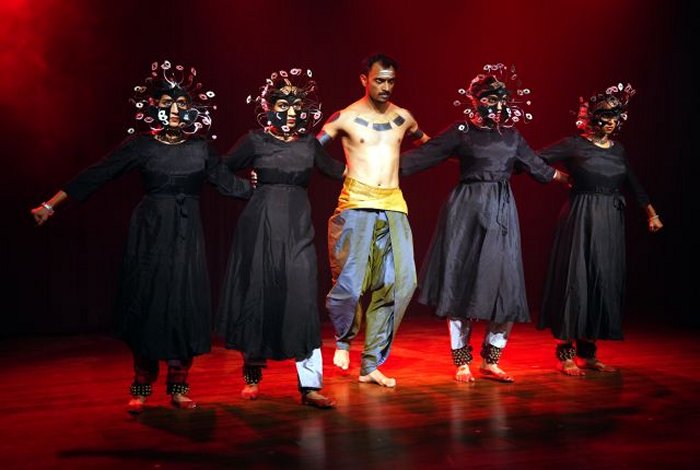 Rebel Ranis The production unfolded through four confessional narratives, each woman stepping forward to inhabit and narrate her story before the protagonists eventually converged in a powerful closing sequence. The theatrical device was simple but effective. The women were often seated together, addressing the audience directly, thereby breaking the fourth wall and creating an immediate sense of intimacy. Kaikeyi appeared first, not as the scheming queen of conventional retellings, but as a woman whose political identity had been progressively erased after marriage and motherhood. Her earlier training in statecraft and her capacity for political agency stood in sharp contrast to the diminished identity imposed upon her as wife and mother. The portrayal encouraged a reconsideration of a character whose actions had traditionally been judged without sufficient attention to the circumstances that shaped them. The second narrative turned to Sita. Drawing upon the Adbhuta Ramayana, the production presented her through a more radical and unsettling lens. Her grief and anger culminated in her emergence as Mahakali, transforming the traditionally idealised image of Sita into one of formidable power. The transition was particularly effective because it suggested that beneath the familiar image of feminine endurance lay an immense reservoir of strength that could erupt when pushed beyond its limits. The third narrative belonged to Karaikal Ammaiyar, the sixth-century Tamil poet-saint. Her story was presented as a gradual renunciation of bodily identity and a movement towards divine grace. The episode involving the two mangoes was handled with considerable dramatic sensitivity. Her husband had given her two mangoes, but after she had eaten one, he asked for the other. She had already given it to a mendicant. Faced with his demand, she prayed intensely to Lord Shiva, who answered her prayer by providing another mango. This miraculous intervention became the turning point in her spiritual journey. The experience deepened her surrender to Shiva and led her away from worldly identity and attachment to the physical body. Applying sacred ash to her forehead, she symbolically renounced worldly life and moved towards a formless spiritual existence. The choreography captured this transition from the human and domestic to the devotional and transcendent, making Karaikal Ammaiyar's rejection of conventional beauty and bodily identity an expression not of defeat but of radical spiritual liberation. The final narrative, and perhaps the most theatrically charged, was that of Draupadi. The sancharis depicting the game of dice brought the Mahabharata episode alive with considerable dramatic intensity. Benjamin Jacob as Yudhishthira, Ravi Yadav as Shakuni, the king, and Sagar Vashist as Dushasana contributed to a vividly enacted sequence in which the fatal game became a metaphor for the moral downfall of the Pandava kingdom. The gradual escalation of the dice game conveyed more than the mechanics of gambling. It revealed the erosion of judgement, responsibility and dharma, culminating in Draupadi's dishonour. The episode was presented not simply as an act of personal humiliation but as a profound moral collapse within the kingdom. Draupadi's suffering consequently became the emotional and ethical centre of the sequence, transforming a familiar epic episode into an indictment of the structures that permitted her degradation. Her confrontation with the fragile male ego behind the violence gave the episode a contemporary resonance without diminishing its epic dimensions. The production allowed Draupadi to move beyond the position of a wronged woman and towards one who recognised the larger implications of what had occurred. 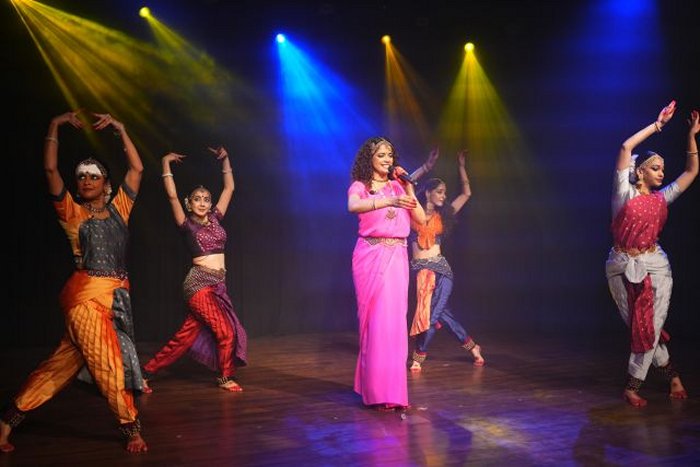 Rebel Ranis The dance vocabulary throughout was an assured hybrid of Bharatanatyam, Kathak, Chhau and contemporary movement. Classical technique was not used merely as ornament but was demystified and redirected towards psychological and dramatic expression. Geometric precision and abhinaya coexisted with grounded contemporary phrases, angular movements and moments of explosive physicality. Importantly, the work did not appear to be fusion for its own sake. The different movement languages were employed in service of the narrative. The individual sections gave each protagonist a distinct physical and emotional identity, while the group passages gradually accumulated a sense of collective strength. The performers negotiated their dual roles as dancers and actors with confidence. English dialogue, often infused with contemporary idiom, flowed naturally into the movement vocabulary. The contrast between the modern language and the traditional costumes further reinforced the production's dialogue between past and present. Music was among the production's strongest assets. The recorded score brought together Tamil jazz, Carnatic elements and hip-hop textures to create an aural landscape that felt simultaneously rooted and contemporary. The music supported the movement and text without overwhelming them. The production also acknowledged the tremendous contribution of Dr Himanshu Srivastava and O. S. Arun, whose musical inputs helped enliven the aural landscape. Costumes, lighting and set design remained relatively spare, allowing the performers' bodies, faces and voices to command attention. This restraint suited the production's theatrical vocabulary. The overall emotional tone was not one of unrestrained fury but of controlled anger, thoughtfulness and reflection. The recurring call to nurture righteous rage became less a slogan than an invitation to transform anger into awareness and action. The final section brought the four narratives firmly into the present. As Draupadi sang, each woman stepped forward to speak in the language of contemporary reality, with statistics replacing mythological narratives. Sita referred to dowry deaths, while Kaikeyi addressed the continuing problem of women dropping out of the workforce. The recurring Tamil chorus, 'Raudirum Palaghi' translating to "nurture your righteous rage," gathered the strands of the evening into a single contemporary refrain. The peppy jazz-based song gave this concluding section an infectious energy while retaining its seriousness of purpose. Among the ensemble, Aneesha Grover as Kaikeyi, Nandita Kalaan as Sita, Amrita Sivakumar as Karaikal Ammaiyar and Harini Iyer as Draupadi delivered committed and clear-eyed performances. Each brought a distinctive emotional register to her character, while the ensemble sequences demonstrated a strong sense of collective discipline. Benjamin Jacob, Ravi Yadav and Sagar Vashist added dramatic force to the dice game sequence through their portrayals of Yudhishthira, Shakuni, and Dushasana respectively. The production had moments when the contemporary statistical interjections approached the didactic, making the message more explicit than the preceding theatrical sections. Audiences looking specifically for uninterrupted classical Bharatanatyam or highly abstract contemporary dance might therefore have found the theatrical and verbal dimensions more dominant. Even so, Rebel Ranis remained a compelling and accessible work of dance theatre. By placing Kaikeyi, Sita, Karaikal Ammaiyar and Draupadi at the centre of their own narratives, Keelaka Dance Company shifted the focus from women as figures within male-centred epics to women confronting questions of power, grief, spiritual freedom and humiliation on their own terms. The closing invocation to "nurture your righteous rage" brought these ancient stories firmly into the present, leaving the production with a clear and resonant proposition: that anger, when acknowledged and transformed, could become a force for reclaiming voice and dignity. EKATVAM FOUNDATION PRESENTS 'KUMUDA'On the evening of September 24, the Seva Sadan was transformed into a sanctuary of art and spirituality. "Kumuda," an evening of voice, devotion, and light organised by the Ekatvam Foundation, offered audiences a profound thematic progression. Moving seamlessly from the introspective depths of vocal music to the many faces of Krishna, and culminating in the radiant, cosmic worship of the Sun, the programme was a masterclass in narrative and kinetic storytelling. 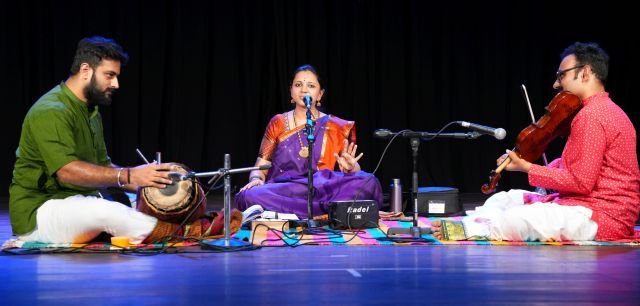 Samudyata Mattur The evening commenced with "Jivana Moulya" (The Value of Life), a vocal recital by Samudyata Mattur. Far from being a mere warm-up, this performance served as a fitting and grounding prelude. Mattur's rendition tuned the audience's minds inward, establishing a contemplative atmosphere that perfectly set the stage for the visual feast of dance to follow. Setting the philosophical stage for the dance segment, Rajeshwari M., a disciple of Dr Janaki Rangarajan, took the stage with her Bharatanatyam presentation, "Eka Aneka" (One and Many). The performance unfolded through two distinct yet complementary compositions. The first, "En Kannan," drawn from Subramanya Bharathi's evocative Kannan Paatu and set in a vibrant Ragamalika, was choreographed by her guru. The piece traced the multifaceted persona of Krishna - who appears as friend, servant, and beloved in turns. At its philosophical heart lay a beautiful paradox: the Supreme Infinite making himself intimately accessible to the devotee. Rajeshwari navigated this transition with grace, capturing the playful and the profound with equal ease. 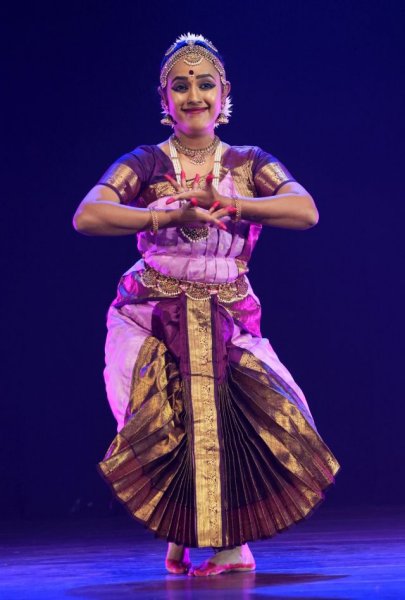 Rajeshwari M Transitioning from the playful to the poignant, her second presentation, "Amma," delved into the final days of Krishna's earthly life. Adapted from a chapter in K.S. Narayanachar's Krishnaavatara Koneya Dinagalu, the piece explored the twilight of the Avatar. Set to music composed by Rohit Bhat in a complex Ragamalika and Taalamalika, the choreography by Dr Janaki Rangarajan gave voice to Devaki, Yashoda, and Poothana. Through their perspectives, the piece illuminated the many shades of motherly love, asserting that no bond compares to a mother's devotion to her child. The performance concluded with a deeply moving lullaby. Rajeshwari M's performance was marked by a poetic fervour; her expressive and emotionally charged abhinaya transcended mere technique, touching the very soul of the audience. Shifting the cosmic lens, the final presentation, "Udaya" (The Dawn), was a spectacular dedication to Lord Surya. Danced by Shilpa Abhiram (a disciple of Lakshmi Parthasarathy Athreya) and Smriti Ramesh Kaushik (an alumna of Kalakshetra), the piece depicted the cosmic awakening of dawn and the journey of the one deity who can be perceived directly by the human eye. The performance opened with a mesmerising Surya Namaskara, where the rhythmic inhalation and exhalation of the dancers invoked the Sun God, visually depicting his journey across the heavens in a chariot drawn by seven horses. 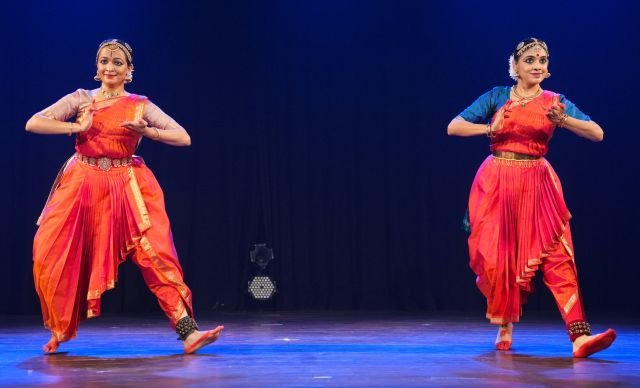 Shilpa Abhiram & Smriti Ramesh Kaushik The narrative then delved into rich mythological tapestries. The first story recounted the journey of Yagnavalkya, a disciple of Sage Vaishampayana. When asked to share the burden of expiating a sin, a proud Yagnavalkya declared his peers spiritually weak and offered to perform the penance alone. Enraged by this arrogance, Vaishampayana expelled him and demanded the return of all Vedic knowledge. Seeking untainted wisdom from a divine source, Yagnavalkya undertook intense penance to Surya. Pleased, the Sun God took the form of a celestial horse, revealing to him the pristine hymns of the Yajurveda. The narrative then pivoted to the destruction of the demon Kalasura, through which Surya restored light and balance to the universe. The presentation subsequently explored the cosmological order through Sandhya and Chaya, the consorts of the Sun who personify light and shadow. Along with their eight children, they represent the dichotomies of existence: radiance and shade, justice and karma, the present and the future. It was a brilliant reflection of the life-giving, yet exacting, power of the solar principle. The rendition featured intricate rhythmic notations and a soaring ode to Gayathri and Bhaskara, before concluding with a shloka from the Aditya Hrudayam. This quiet, deeply devotional close provided a perfect denouement to a work that had journeyed from intense penance to triumphant victory, and finally to cosmic harmony. Throughout "Udaya," Shilpa Abhiram and Smriti Ramesh Kaushik maintained a seamless synergy, brilliantly embodying the multifaceted dimensions of Surya. They portrayed his raw power, protective compassion, and boundless cosmic energy through expansive movements, commanding aramandis, vigorous rhythmic passages, and expressive abhinaya. Their remarkable ability to negotiate complex jathis with razor-sharp precision, all while sustaining a palpable dramatic intensity, was a testament to their disciplined rehearsal and growing artistic maturity. The carefully crafted choreography struck a masterful balance between vigorous ensemble sequences and intimate narrative episodes, making this exposition the defining highlight of the evening. A production of this magnitude relies heavily on its technical and musical backbone. The evocative script was penned by Arjun Bharadwaj, while the music was composed by Rohit Bhat. The performance was set to a meticulously produced recorded track that showcased the instrumental brilliance of Prasanna Kumar on the nattuvangam, Vinay Nagarajan on the mridangam, Jayaram Kikkeri on the flute, and Gopal Venkataramana on the veena. 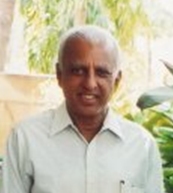 Bangalore based Satish Suri is an avid dance rasika besides being a life member of the Music and Arts Society. |
