
|     |
|
| |

REVIEW / REPORTAkram Khan's Thikra: Night of Remembering- Dr. Ketu Katrake-mail: khkatrak@uci.edu October 20, 2026 A palpable hush greeted us at the University of California, Los Angeles' storied Royce Hall where we gathered to witness the talented British Bangladeshi Akram Khan's Thikra: Night of Remembering. Thikra is an Arabic word that translates into English as ritual, and as remembrance. This show was slated for October 11 but had to be delayed to October 12 since US visa issues faced the London-based company. The Artistic Director of the Center for Performance (CAP) at UCLA welcomed us praising the tenacity of the Khan company and UCLA working together to bring these wonderful artists to perform in Los Angeles. The Director also asserted that he remained committed to bringing artists from across the globe to UCLA despite current hostility of US government policies to diverse peoples and their cultures. Akram Khan, a former Royal Festival Hall (London) choreographer in residence, is a master dance maker and collaborator over his career starting with Kaash (translated as If), created with visual artist Anish Kapoor and musician Nitin Sawhney in the Company's first full-length production. Kaash, a confluence of Indian gods with stories of creation and destruction, cymbals and tabla rhythms began Khan's "quest to build bridges between the worlds of contemporary dance and the Indian classical dance form Kathak." Khan has teamed up with Sidi Larbi Cherouki in zero degrees, with Juliette Binoche in In-I, among other partnerships. Khan's collaborator in Thikra, premiering in 2025 and touring in 2026-2027, is award-winning Saudi visual artist Manal AlDowayan (London-based). As I stand humbled within the vastness of this epic desert known as AlUla, I feel the urge to unearth the many cultures that have passed through here. - Akram Khan Khan's choreography in Thikra draws inspiration from the ancient desert landscape in Saudi Arabia with its sandy vista punctuated by rocks. Manal AlDowayan originally created "her rocky set on the desert sand." This work, developed in Saudi Arabia, "pulsates with physical intensity and ancestral rage" as reviewer Lyndsey Winship notes in The Guardian (October 29, 2025). The desert locale is resonant with "mythology and cultural heritage evok[ing] the idea that 'without a past, there is no future.'" Thikra's world premiere on January 25, 2025, took place at the AlUla Arts Festival in Saudi Arabia "at Wadi AlFann, a new 'cultural destination' in AlUla, an ancient oasis city and trade route in the Saudi Arabian desert" (Guardian). Crisscrossing trade routes brought a multiplicity of peoples and their cultures to this space that Khan replicates with his multiethnic dancers combining Bharatanatyam and contemporary dance. The world premiere of Thikra's indoor adaptation was on June 22, 2025, at Montpellier Danse Festival. Now, the production is touring North America--featured at Lincoln Center's Summer for the City / Contemporary Dance Festival, Jacob's Pillow Dance Festival, at UCLA, then to UC Santa Barbara among other locations. The show at UCLA began in half-light and half-shadow. From the first moment, I was mesmerized by the lighting, sound, and set, characteristic of all Akram Khan productions that showcase talented lighting, sound designers, and dramaturgs, and in Thikra, Manal AIDowayan's amazing visual effects. A spotlight focused on a raised platform, a rock surface from which a magisterial figure, lit evocatively, moved slowly down a curved staircase to stage level. I recognized the beautiful face and sure gait of Mythili Prakash, a local Los Angeles based Bharatanatyam dancer (now performing internationally) who has been working with Khan's company. This figure in red/magenta embodied a matriarchal nurturing spirit. I was delighted to meet Mythili after the show, and she graciously agreed to do a phone interview with me (on October 13) that helped me to write this review. Mythili noted that she was involved in the original research and development for Thikra and that "the movement material came from the bodies of dancers involved in the research and creation, while directed and shaped by Akram [as choreographer] towards his vision." She remarked that one inspiration for this work was the desert landscape with sand and rocks on which entire stories of rituals are carved in AIUla, Saudi Arabia. This used to be a trade route where many cultures met - a fact that fascinated Akram Khan. Center stage, in the background, red light bathed a cavernous opening, evoking a yoni in this all-female cast of nine (at times 11) dancers in gray ashen sarees. As their movements began, the light caught their hands, their fingertips, their hair, their faces and eyes, glinting in the semi-darkness. They moved in impeccable unison as one body in Khan's stunning choreographic moves. Dancers' arms stretched to their sides not as in Bharatanatyam, bow-shaped, but the line broken at their elbows. In another movement, their arms cupped their raised chins and moved over their faces. The superb lighting by Zeymep Kepekli whose work "influenced by nature, architecture and bodies in spaces" captured the spirit of Thikra suffusing it with an other-worldly ambience. A significant motif in Thikra was the dancers' long, below waist, open hair. Mythili Prakash commented (in my interview with her) that Khan was inspired by witnessing the performance of a 'hair-dance' that led to the dancers' lose hair and its connection to femininity and wildness, even as it is juxtaposed with their firm and syncopated movements. As the dancers moved forward, bending low, their hair fell forward covering their faces. Then in different scenes, the dancers' hair was pulled up from the scalp in sharp, jerky movements. When two dancers sat back-to-back, their hair was yanked from the scalp and intertwined as if evoking their twinned destiny. 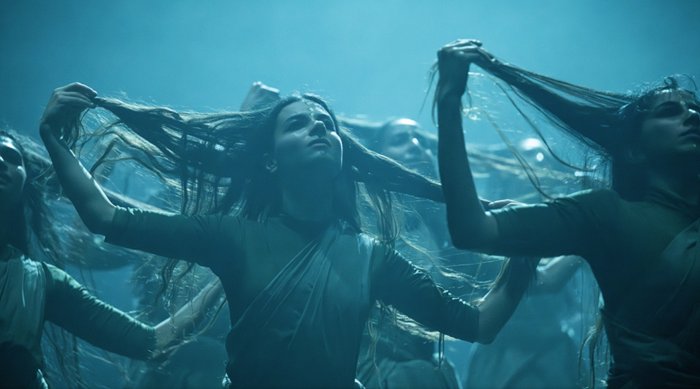 Khan engages the audience viscerally in his evocative choreography brought to life by the superb dancers ably supported by lighting and musical soundscapes. In all of Khan's work as also in Thikra, spectators are caught off-guard viewing dancers' familiar movements often startlingly different as in the dancers beating their chests with their fists or raising a cloth to cover their faces as in a burka. Surpassing any religious overtones, such movements are raised into a universal ritualistic spirituality. The performance by this all-female ensemble was accompanied by an original score, indeed a haunting soundscape by talented composer, Los Angeles based Aditya Prakash, with sound design by Gareth Fry. "The score" remarks the Guardian reviewer, "is head-filling in volume and density, with a physical sense of rhythm, drawing on Arabic music, plus a blast of Bulgarian choral music and a hint of Purcell's Dido. It's intense, but you can only melt into that atmosphere and await catharsis." The recorded composition included Adiya Prakash along with some ten to twelve others such as Ananya Ashok, Layth Sidiq, Jay Julio, Naseem Alatrash, Guhan Venkataraman, Sushma Soma among others. The layered soundscape included words that were muffled deliberately so as not to attach any meaning in spectators' ever-active minds seeking mundane interpretations; rather, we are enticed to give ourselves over to the resonant sounds. Only one line is sung distinctly by a heart-rending Bengali Baul singer: the powerful image of a caged bird yearning to fly, longing for freedom. This desire for autonomy is played out by specific dancers who step into solos identified by the color of their costume. One dancer in white embodies an ancestral spirit called to be part of the ritual, but she struggles to break free of control. In stunning moves, contemporary dancer Lani Yamanaka displays a panoply of emotions in her fight against being controlled. I sensed echoes of iconic Igor Stravinski's Rite of Spring score and folktale set to different dance productions by choreographers such as Khan, also South African Indian Jay Pather where a community seeks a female sacrificial victim. In Thikra, the dancer in white appears to be conjured up by the group of women on this "'night of remembering' for a rebirth of sorts, a ritual healing from the past" (Guardian). Such "healing" is hardly harmonious, but fraught with rage coupled with incredible beauty in riveting contemporary dance moves--frenetic, spastic, yet controlled. The dancer tries to lift the rock placed front center stage, to read its inscription but is unable to do so, as if it weighs a ton until she is assisted by the nurturing figure in magenta who easily turns the rock/tablet to reveal inscriptions on it that Lani Yamanaka traces with her fingers. Another dancer apart from the ensemble in gray sarees, is in rust colored costume (danced by Elpida Skourou) reflecting the desert landscape. In spectacular scenes, a female shamanic figure in black (danced by Joy Alpuerto Ritter) demonstrates her power by pointing her forefinger on the prone dancer in rust leading her to twitch, then getting her back off the ground with chest and body lifted into a backbend (as in yoga's wheel pose) then her back drops onto the floor. In another shamanic move, this dancer goes into a trance-like shaking, powerful, even unnerving, yet restrained. There is an air of magic in the production, as though humans get transformed into other forms. In one scene, the ensemble wears gauze like head gear appearing as creatures from outer space. They try to place a mask on the dancer in white who resists. As in Akram Khan's signature style, there is no one meaning in this powerful production. The audience is swept up in a rich sensory impact conveyed via a tapestry of color, visuality, movement, rhythm, magic, and emotion communicated by the dancers as they caught the impeccable lighting and felt the haunting sound. As in all Khan productions, this choreographer works with talented dramaturges. In Thikra, dramaturgy by Blue Pieta "explore(s) themes of mysticism, the absurd and mythology, merging practices of ancient storytelling with contemporary expression. They foreground the epistemologies of the Global South to invoke a 'New Surrealism' rooted in ancestral, ecological and pre-colonial world views". The production was filled with ancestral echoes and pre-colonial epistemologies. Overall, a captivating and absorbing performance by dancers who moved in unison with precision and clarity that was a pleasure to watch. Masterful lighting, sound, and visual design were as much "characters" as the dancers. As we left the auditorium, the sounds and rhythms still echoing in our hearts, and as my friend and I drove through the streets of Los Angeles, we sensed a feeling of wonder (adbhuta) lingering with us from Thikra. This transcendence arrived through labor, brutality and beauty that transported us from our daily reality to touch the fine sands of the AIUla desert.  Ketu H. Katrak is Professor Emerita of Research, Department of Drama, University of California, Irvine. |
