
|     |
|
| |

REVIEW / REPORTSwarupini: A soul-stirring celebration of women's voices and expressions in classical arts- Satish Surie-mail: satishism@yahoo.co.in Photos: Rule of Thirds Studio October 15, 2026 In a beautiful tribute to the feminine spirit in the arts, Trikala Arts presented Swarupini - Voices and Expressions of Women Composers and Artists, on the 6th of September, at the Meenakshi Rangamandira, Bengaluru. Conceptualised to highlight and celebrate music and compositions created by women, dedicated to women, and performed by women, the evening was a profound exploration of artistic brilliance and solidarity. 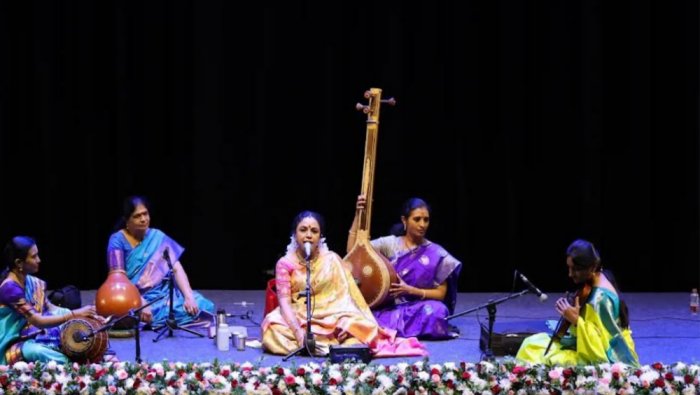 Sudha Raghunathan and ensemble The event commenced with a soul-stirring Carnatic vocal concert by Sudha Raghunathan. Setting a majestic tone for the event, choosing compositions popularised by her Guru, the late M.L.Vasanthakumari and M.S. Subbulakshmi, she was accompanied by a stellar, all-women instrumental ensemble: H.M. Smitha on the violin, Sukanya Ramgopal on the ghatam, Ranjani Siddanthi Venkatesh on the mridangam, and Ramya Srinivasan on the tambura. Their cohesive and powerful performance captivated the audience, serving as a perfect prelude to the visual feast that followed. Following the musical inauguration, the stage transformed for a visually stunning Bharatanatyam presentation led by acharya Indira Kadambi. She was joined by a brilliant ensemble of dancers: Sai Brinda Ramachandran, Apeksha Kamath, Preksha Gupta, Aishwarya Lakshmi, Aarti Hariharan, Aishwarya Dileep, Sarath Naik, and Adwith Shashidhar. Supporting this dynamic visual narrative was an exceptional music ensemble, featuring T.V. Ramprasad on vocals, Kedar Gurav on nattuvangam, Vinay Nagarajan on mridangam, Nitish Ammanaya on flute, and Srilatha Nikshit on veena. This stellar musical foundation provided the perfect rhythmic and melodic canvas for the artistes to execute the complex compositions with absolute precision. 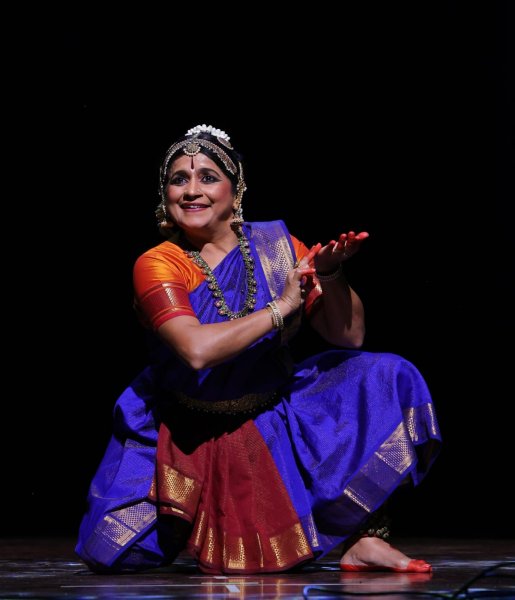 Indira Kadambi Indira Kadambi opened the dance proceedings with a profound invocation of the Divine Feminine. Embodying the essence of Tripurasundari, she interpreted a powerful shloka by Adi Sankaracharya that eloquently describes the vahanas (vehicles) of the Tridevis: the lotus of Saraswati, the celestial swan (hamsa) of Lakshmi, and the majestic lion of Parvati. This seamlessly transitioned into a vibrant Alarippu set to a Ragamalika. The blooming, expansive movements perfectly mirrored the unfolding of these divine energies, setting an auspicious tone for the evening. The momentum was brilliantly sustained with a rhythmic and visually captivating "Swarakattu." The ensemble of dancers flowed across the stage in perfect unison, executing crisp adavus and navigating complex rhythmic patterns with striking precision. The interplay of sharp geometric formations and fluid transitions showcased the dancers' rigorous training and youthful energy, creating a visually stunning spectacle. Building on this rhythmic foundation, the evening delved into profound narrative storytelling with a majestic Kannada Varnam in the raga Amritavarshini, set to adi tala. Composed by Dr Geeta Seetaram and rendered soulfully by vocalist T.V. Ramprasad, the piece provided a rich melodic canvas. The sahitya (lyrics) beautifully captured the pangs of viraha (separation) and the deep yearning of the nayika. Opening with the poignant plea, "Swami kare taarini nee Venugopala," the dancer, embodying the lovelorn heroine, urges her sakhi to fetch Lord Venugopala. Through highly nuanced abhinaya, the artiste vividly depicted the Lord's majestic forms, describing him as the lifter of Mount Mandara and the Madanana murali manohara. The emotional intensity peaked during the charanam, "Bare... karunatore Amritavarshini," where the nayika pleaded for compassion, confessing she was being bombarded by the arrows of Manmatha. The ensemble executed complex combinations that sparkled with scintillating footwork and vibrant, mathematically precise jathis, all guided by the distinct and masterful hallmark of Indira Kadambi's choreography. 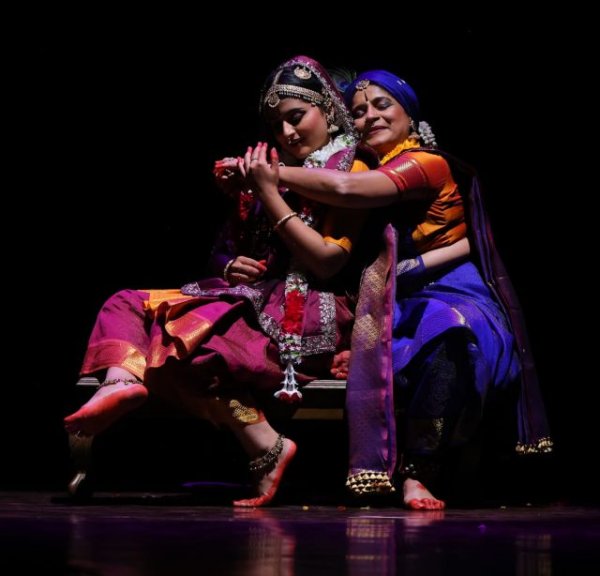 Aarti Hariharan and Indira Kadambi Shifting the emotional register, the evening offered a masterclass in restraint with a poignant exposition of Jayadeva's ashtapadi, "Kshana Madhuna," set to the lilting raga Kalyani. Presented as a moving tribute to guru Kalanidhi Narayanan, the piece featured a fascinating artistic choice. Indira Kadambi portrayed the role of Krishna, while Aarti Hariharan beautifully embodied Radha. Eschewing expansive physical movements, the choreography relied almost entirely on the subtle, magnetic power of netra abhinaya. Indira Kadambi, as Krishna, delicately pleaded with Radha to place her lotus-like feet upon a soft bed of tender leaves, offering to massage her tired feet, and gently asking her to let go of her viphala-rusha (futile, painful anger). Remarkably, even when the dancers were not directly looking at one another, the silent dialogue flowed with an effortless, palpable intensity. Indira Kadambi masterfully balanced the intoxicating human passion of shringara with the pure, selfless surrender of bhakti. 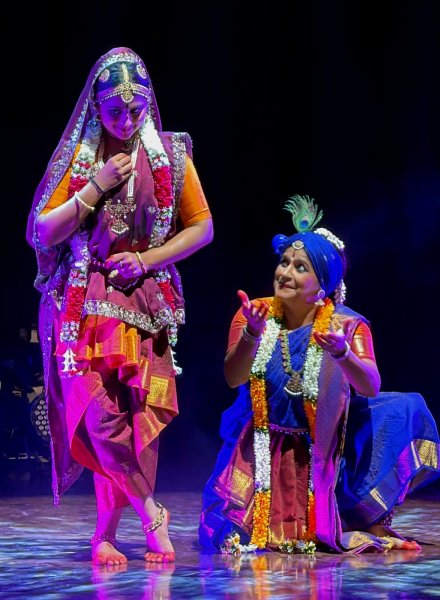 Shifting the narrative from divine mythology to profound human history, Indira Kadambi followed with a deeply moving soliloquy, "Yashodhara Vilapam." This poignant composition "Lepanaina lepalede" by Telugu writer Basavaraja Appa Rao holds special significance for the evening's theme, as the lyrics were remarkably penned by Vinjamuri Anasuya at the tender age of 13. The piece captures the visceral shock and profound grief of Princess Yashodhara upon discovering that her husband, Siddhartha, has abandoned his royal life in the dead of night to seek enlightenment. Through a series of heart-wrenching questions, the lyrics lay bare her agony: "He did not even wake me up to say goodbye... As I slept securely with my head on his chest, how could he desert me?" She laments her state, feeling like a "creeper whose support has disappeared," and desperately asks the very door of their chamber which way her husband fled, cursing her own eyes for failing to warn her through a dream. Indira Kadambi's portrayal was a masterclass in abhinaya, navigating the depth of lament, misery, and pathos with breathtaking histrionic brilliance. She seamlessly transitioned through innumerable moods, utilising not merely her expressive eyes, but her entire physical being to embody the raw bhava of the situation. The production values were brilliantly heightened by the use of a simple yet powerful prop: a cradle holding a baby. As Yashodhara looked upon the infant, questioning if he possessed any knowledge of his father's silent departure, the visual tableau added a devastating layer of poignancy to the already emotionally charged performance. 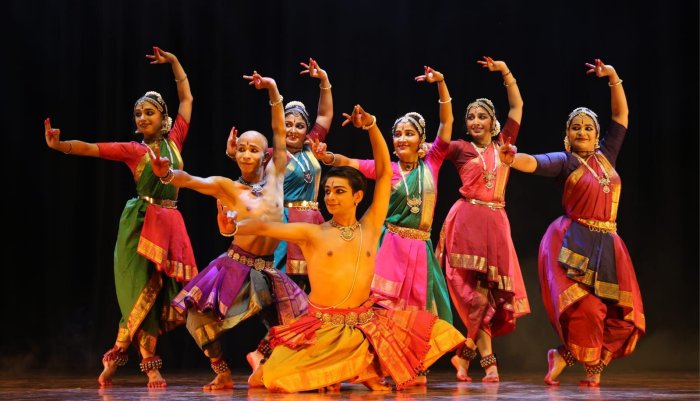 Ambalam ensemble The ensemble's final presentation, titled "Ananda Swarupini", offered a fascinating and jubilant glimpse into the cosmopolitan musical history of the Mysore court, bringing the evening's energy to a soaring climax. The piece was set to the celebrated "English Note" composition by Harikesanallur Muthiah Bhagavatar, historically crafted on the advice of Maharaja Krishnarajendra Wodeyar to infuse the traditional Carnatic framework with a distinct Western classical cadence and flavour. As the performance unfolded, the tempo scaled up dynamically, building a palpable sense of celebration. The dancers masterfully navigated this rhythmic complexity, incorporating synchronised, percussive clapping that added a layer of infectious energy. Choreographically, the dancers wove through the stage space with artistically defined movements, seamlessly transitioning between fluid sequences and striking "postural friezes." These breathtaking, statue-like moments of suspended animation highlighted the inherent sculptural beauty of the dance form. At its best, Swarupini demonstrated that a celebration of women in the classical arts need not depend upon rhetorical declarations of empowerment. The art itself can make the argument. In Indira Kadambi's choreography, in the musicianship of the women's ensemble, in the emotional intelligence of the abhinaya and in the varied histories of the compositions, women emerged not merely as subjects of classical tradition but as its interpreters, creators and custodians. It was this convergence of artistic authority and expressive range that gave the evening its lasting resonance.  Bangalore based Satish Suri is an avid dance rasika besides being a life member of the Music and Arts Society. |
