
|     |
|
| |

REVIEW / REPORTSpectacle soaked in spiritual splendor- V. Kaladharane-mail: vkdamaru.eda@gmail.com Photos: Gnanachandra October 13, 2026 The Rama theme, previously, was not popular amongst the dance teachers whereas themes of Nataraja, Krishna and Muruga have found great popularity amongst dancers and dance teachers. The very name of Rama demands grandeur, dignity and purity of action and it is sometimes extremely refreshing to see all these qualities depicted by great dancers. - U.S. Krishna Rao The highly evolved Indian dance forms explicitly and implicitly proclaim the indivisibility of aesthetics and devotion. The literary text of our traditional performing arts, for the most part, is quintessentially a glorious tribute to the Paramathma. Of the trinity, saint Thyagaraja, is one whose Ramabhakti knows no bounds. In his compositions, Lord Rama is a leitmotif aimed at emancipating humanity from the trials and tribulations of worldly existence. His Pancharatna kritis are a class by themselves. Amongst them Endaro Mahanubhavulu in raga Shree and adi talam, is a big salutation to the sages and musicians down the ages. Immortalized by the illustrious Carnatic vocalists, this kriti resonates in the minds of the devotees and the cognoscenti fervently. Anitha Guha, an acclaimed Bharatanatyam Guru and ace choreographer, joined hands with the multifaceted scholar and orator, Dushyant Sridhar, to bring out a two and a half-hour long dance-drama production titled, "Endaro Mahanubhavulu". It is conceptualized, scripted and narrated by Dushyant. Staged consecutively for two days at the Narada Gana Sabha, Chennai, in front of a packed audience, it turned out to be a remarkable spectacle, more specifically, an ensemble comprising of fifty-three dancers harmonizing music, dance and drama. Classified into seven solid segments titled Aiswaryam, Audaryam, Saulabhyam, Varenyathvam, Aghasosanatwam, Dukhanivarakatwam and Moksapradatwam, ‘Endaro Mahanubhavulu' has successfully accessed inputs from multiple sources right from the Vedas and the Puranas to the time-tested compositions of the eminent Vaggeyakaras. Short excerpts from the literary texts used in this production denote a pan-Indian character viewed from a cultural point of view. The first segment zeroes in on to the glory of Varadaraja of Kanchipuram in myriad hues. Lord Varadaraja's concern for his devotee, Doddayacharya, by granting him darshan in the banks of the Pushkarini while keeping his Kanchi devotees waiting is compellingly driven home by those who enacted the respective roles. Lyrics from the Vedas, Kuresa's Varadaraja Stavam, Doddayacharya's Devarajapanchakam in Sanskrit, Divya Prabandham, Vedanta Desika's Prabandham in Tamil and Annamayya's composition in Telugu revitalize the movements and the music. 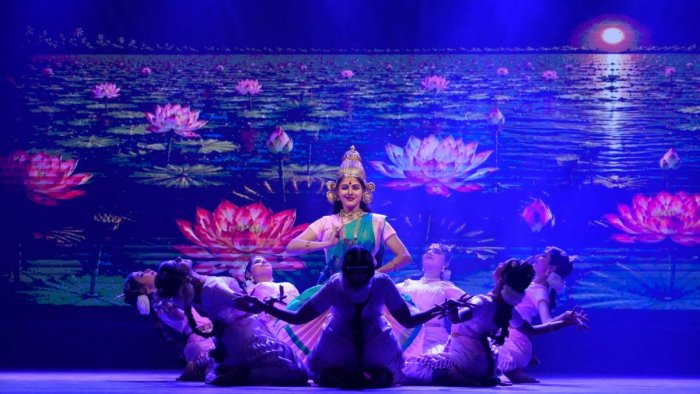 Audaaryam, the second segment, is centered around Goddess Mahalakshmi, the Jaganmatha, who bestows material wealth, kaivalya and moksha. By juxtaposing lines from the Kanakadhara Stothram of Adisankara, the exponent of Adwaitha and lines from the Sri Sthuti of Vedantha Desika, the proponent of Vishishtadwaitha, Goddess Lakshmi is shown appearing in the unfading lotus flower. The young dancers encircling Mahalakshmi turn into petals that fold and unfold. The scene is picturesque against the digital backdrop replete with lotus flowers. Next comes Ananathamruthakarshini, the renowned composition of none other than Muthuswami Dikshitar in raga Amrithavarshini. The visualization of Dikshitar playing the Veena and singing the Kirthana exhorting Bhavani to bless the land with copious rain is brief yet beautiful. The ringing sound of the first drops of water falling on the dry land and soon turning into torrential rain enlivening the innocent villagers into a joyful dance is an alluring visual frame. An amazing synthesis of music, rhythmic footsteps and bewitching postures! 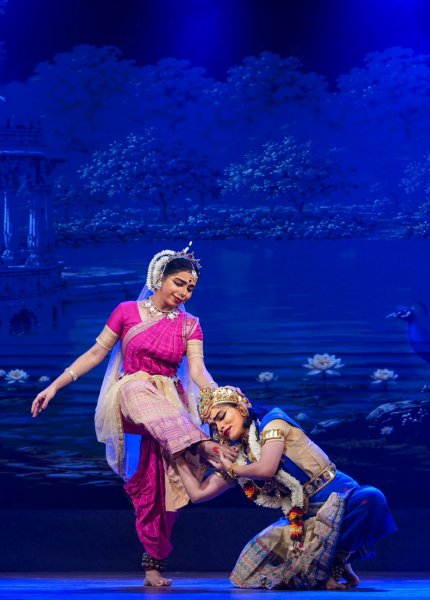 In the third segment, Saulabhyam, Radha and Krishna, the eternal lovers, are presented vis a vis poet Jayadeva and his consort, Padmavathi. Lord Krishna appears before Radha depicted here as the Virahotkhandita Nayika. The Ashtapadi, Vadasiyadi kinchidapi in raga Mukhari, is in fact, an emotional outpouring of Krishna who pleads with Radha to place her feet on his head. Jayadeva wasn't sure if Krishna would allow Radha to have her feet on his head. Hence, the poet leaves the spot. In the meanwhile, Krishna comes there disguised as Jayadeva and completes the lines left unfinished. Jayadeva then returns to the spot and finds the line complete. He is rejoiced by Krishna's affection towards his devotees. While the movements of Odissi and Jathis coupled with the Sopana style of singing and indigenous percussions still prevalent in the temples of Kerala do carry a distinct texture, the visual context is likely to create a certain amount of ambiguity in the minds of the spectators. 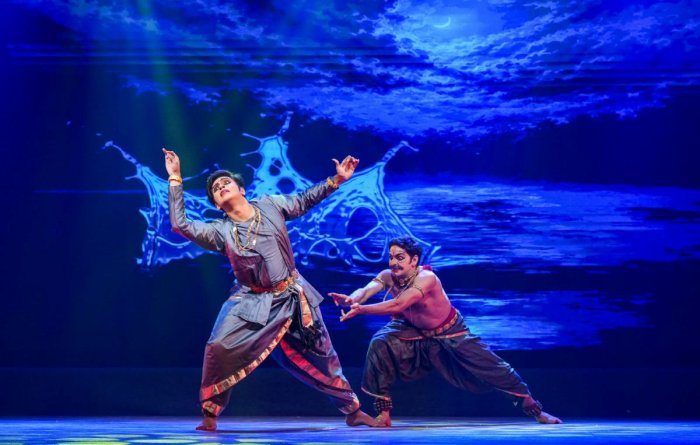 Gajendra Moksham There are moments in performing arts when the visuals become incapable of replacing the literary text. In the Utharamgam, the story of Gajendra moksham is convincingly portrayed by the talented dancers. The crocodile grabbing the elephant's leg and the latter trying in vain to shake it off is a situation that can be aesthetically reconceived. However, the finale of it in which Lord Vishnu sends Sudarshana, the fire disc, to annihilate the crocodile is a delight to the eyes. The dancer's transformation as the blazing Sudarshana was a bewitching visual piece. 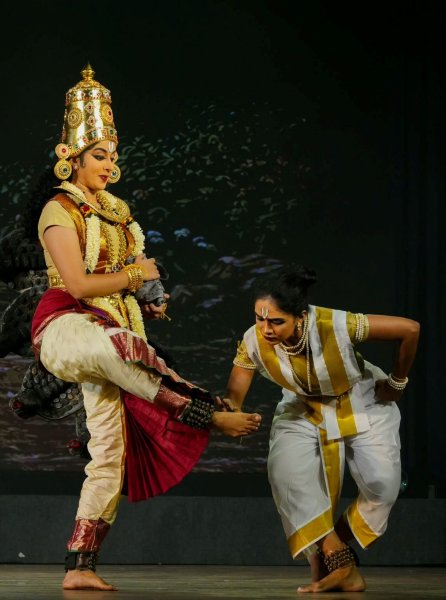 Varenyatvam closes in on to Andal and Mira Bai, the two Jeevathmas profoundly aspiring for union with Lord Krishna, the Paramathma. Andal's love towards Lord Narayana was boundless so that she once adorned herself with the flower-garland which her father had woven for the Vatapathrashaayi, the presiding deity of Srivilliputhur. Vishnuchitta, her father, reprimanded her for what she did. A heartbroken Andal couldn't control her sorrow. She sobbed and sobbed and finally fell asleep. She then slipped into a dream in which she could see Lord Ranganatha appearing before her walking in front of a grand procession of thousand Elephants. Andal, later, narrates this to her friend, and is happily wedded to her Lord. By deploying the ancient Kuchipudi configuration of Yavanika in the middle, Anitha Guha has attributed a fresh fragrance to her choreography. The story of Mira Bai has been portrayed in different dance forms time and again by the celebrated and unsung dancers. Here, Anitha has persuasively choreographed Mira's infinite attachment to Lord Krishna against all the odds she had to face in life. Exclusively employing Mira Bhajans, a blend of Rajasthani and Braj, and assimilating the movements from the famed Ghoomer style of dancing from Rajasthan, the dancer movingly depicted the plight of Mira who finally gets redemption. 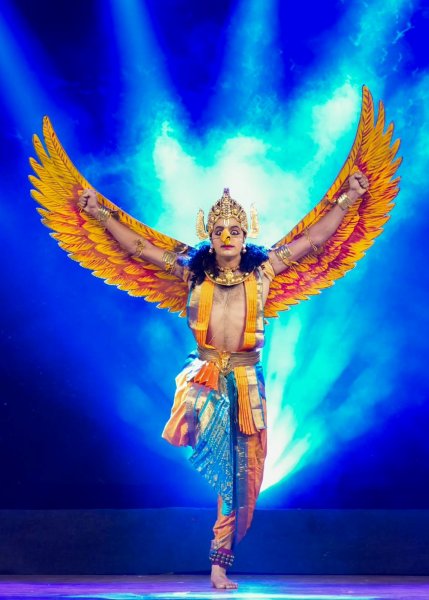 Garuda Of the many different versions of Ramayana, the one composed by poet Kamban stands apart. In the segment titled, Aghasosanatvam, Kamban walks into Chidambaram with his monumental work, Kamba Ramayanam, with the intention of winning recognition from the Sri Vaishnavas. In Chidambaram, Kamban comes across Lord Vishnu in a reclining posture and is fortunate to witness the cosmic dance of Nataraja with his consort, Sivakamasundari. Afterwards, he presents the manuscript of his work to the large community of Dikishitars who did not pay attention to it. A disheartened Kamban loitered along the streets that night and chanced upon a family grieving over their son bitten by a snake and lying unconscious on the ground. The three thousand Dikshitars were also there who seemed helpless. Kamban moved forward and recited a verse on Garuda used previously to invoke its blessings when Lakshmana was ensnared by snakes. As Kamban completes the recitation, the serpents take back the poison and the boy regains his consciousness. The choreographer has delicately handled the visuals of this even as the verses from the ancient Kavyas including Vedanta Desika's Garuda Dandakam, augment their gravity. Along with Kamban, Garuda, the vehicle of Lord Vishnu, in presence and absence, becomes an equally prominent protagonist in it. 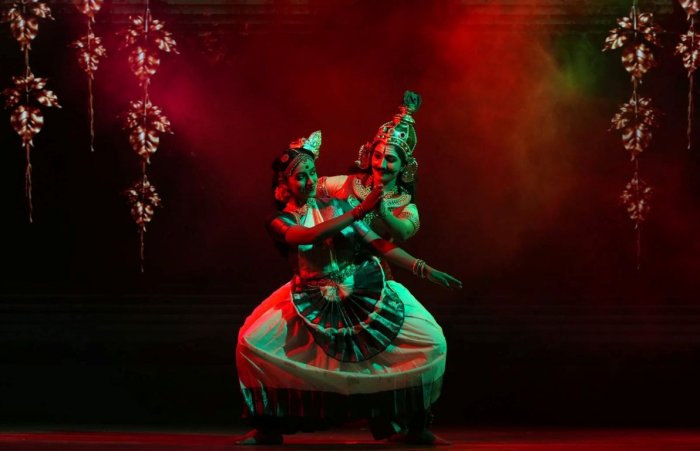 Kottichetham Kottichetham, an exceptional dance-item hired from Silappadikaram has added spice to the segment concerned. Siva's dance with his consort carries the flavor of Kerala Natanam, an eclectic form of dance conceived and choreographed by the late maestro, Guru Gopinath. Mohiniyattam too finds a little space in this piece. The last but one segment, Dukhanivarakatvam, proclaims the unconditional concern of the Lord of Kanchipuram to his ardent devotees. Following an altercation between the Pallava King and Kani Kannan, a disciple of Tirumalisai Alvaar, the King orders his banishment. Learning about the punishment, Alvaar too decides to leave the city with his shishya. He requests Lord Narayana of Kanchipuram to follow him. The Lord obeys and Kanchi turns gloomy. The Pallava King repents and all the three return to Kanchipuram. There is a slender thread of humor running throughout the visual frames of this brief episode. 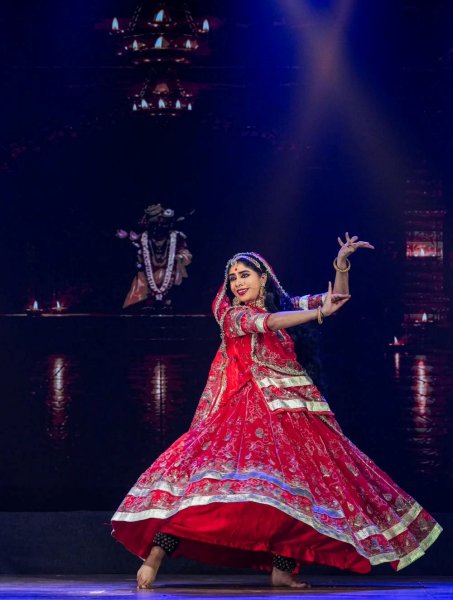 The succeeding scene is shifted towards the great Bhakti poet, Tulasidasa who incurs the wrath of Akbar, the Mughal emperor and is incarcerated. The same night, Tulasidasa composed a set of forty couplets on Hanuman and invoked his grace. Then and there, an army of monkeys reached the jail from nowhere, fought with the guards and liberated the poet. Similar is the story of Bhadrachala Ramadaasu who was thrown into the jail and tortured for years by Tana Shah, the then king of Golconda. Amidst torments, Ramadaasu composed Dasarati Satakamu. He then prayed for mercy from the Ramalakshmanas. Finding that his effort is futile, he seeks the compassion of Sitadevi. Thereupon both Rama and Lakshmana make a visit to the court of Tana Shah to repay the money alleged to have been taken away by Ramadaasu. The King accepts it and as receipt, he spits a bit of betel-leaf on Ramoji's angavastram. As soon as he is released from the prison, Ramadaasu runs to the temple in the hillock and spots the same angavastram there. The Lord's infinite mercy amazes his devotee. The visualization of these bits and pieces, sans much scope for transitory expressions, is quite demanding. Anitha overcomes this limitation by means of her keen visual sensibility and auchithya. Mokshapradayakam, the concluding segment, deals with the two preeminent Vaggeyakaras viz. Purandaradasa and Tukaaraam Maharaj. In all their immortal compositions, Vittala Bhakti is a recurring motif. The instances in their life underscoring the invincibility of Lord Narayana find excellent expressions in the choreography and presentation. The dance in perfect sync with the music elevates the spectators into a trance. The shifting digital backdrops, by and large, accentuate the contents of the changing contexts. The dramatic moments are indispensable to some of the contexts in the production. But there has been no effort on the part of the choreographer to overdramatize any such instances. Each and every segment is punctuated by the spiritually vibrant charanas and charanaswaras of "Endaro Mahanubhavulu" sung by highly accomplished vocalists skillfully supported by the accompanying artistes. By way of this refrain, the unfading image of Lord Rama envelops the entire segments of the production. Dushyant Sridhar rightly sums up the conviction of Tyagaraja Swamy before he signs off. "However intricate sangeeta be, however technically brilliant it is, without love for Dharma and the Paramatma, such sangeeta jnaana is useless tinsel". Apart from choreography, Anitha Guha has designed the costumes of each and every character in the production. Her color sense and refined taste in this regard deserve accolades. The veteran singer and composer Rajkumar Bharati's music has heightened the impact of the visuals through and through. Sai Shravanam's sound design has a decisive role in creating the desired effects in tune with the contexts and the characters. The expertise of Murugan and Nambu Kumar in light design for dance recitals is yet again bolstered in this jumbo production. Credit goes to Guru M.V.N. Murthy for the brief yet impressive Kuchipudi Jathi and choreography in the segment concerned. For composing the Odissi Pallavi, Anitha Guha has received vital support from Ghosh and Vidya Arasu. The team of dancers encompasses extremely talented disciples of Anitha Guha and several guest artistes who played their roles with elan. Immaculate was their movements and expressions in relation to and independent of the characters they identified with. Bharata's Natyasastra categorizes the audience as Prekshaka and Nanjana. While the Prekshakas are a discerning group of spectators capable of appreciating the aesthetic nuances of an artform, Nanjana comprises of common people watching an artform as a mass entertainment. While "Endaro Mahanubhavulu" primarily addresses the Nanjana, each of its segment does have certain subterranean tinges that appeal to the initiated Sahridayas. 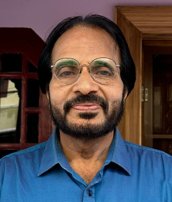 Former Deputy Registrar of Kerala Kalamandalam, V Kaladharan is also an art critic. He has published several articles at the academic level. 'From Meditative Learning to Impersonal Pedagogy' was published in an anthology 'Qui Parley' initiated and released by scholars and writers from the University of California, Berkeley. His articles on Indian performing arts and literature regularly appear in magazines and journals, and in the Friday Page of The Hindu. |
