|     |
|
| |

REVIEW / REPORTEkatva: When two classical traditions speak to one another- Megha Khairnare-mail: khairnar.megha6@gmail.com October 9, 2026 On September 20, 2026, at the Village Theatre in Danville, California, Kathak dancer Pooja Khandelwal and Bharatanatyam dancer Sriyanka Sundar came together for Ekatva: A Kathak–Bharatanatyam Samvaad, presented as part of the Eka Dance Festival by Kalpavrukshaa Creations, founded by Durga Swaminathan, and Shanmukha Theatres, led by Artistic Director Ryan Nathan. Choreographed by their gurus, Sayali Goswami and Durga Swaminathan, the work brought two distinct classical traditions into conversation through rhythm, expression and storytelling. Pooja, a principal dancer and volunteer instructor at Kathakaars School of Dance, is a disciple of Sayali Goswami and Uma Dogra, whose Kathak lineage is rooted in the Jaipur Gharana tradition of Pt. Durga Lal. Sriyanka is a disciple of Durga Swaminathan. Their distinct artistic lineages made their meeting on stage particularly interesting to watch. What stayed with me was how naturally the two traditions seemed to speak to one another. The work did not attempt to merge Kathak and Bharatanatyam into a single vocabulary. Instead, each retained its own movement language, while the dancers found points of connection without losing their individual identities. 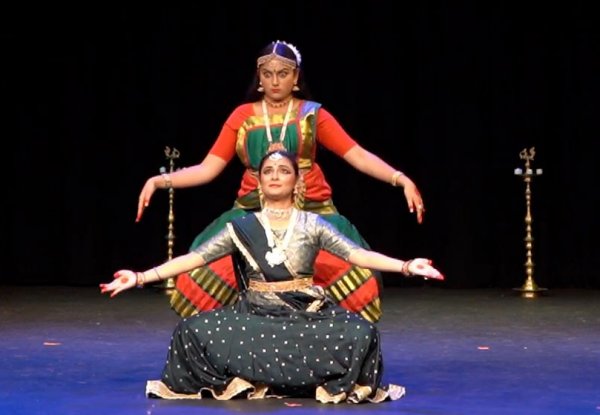 Sriyanka Sundar and Pooja Khandelwal This was apparent from the opening piece, Ardhanarishwara, portraying the union of Shiva and Shakti. After each rhythmic passage, the dancers arrived at a shared pose and held it. These moments of stillness were striking and gave the audience time to take in the image before the movement continued. The recurring poses, bringing the two dance vocabularies together, helped hold the piece together. Their coordination was beautiful, and the shared images had a quiet power of their own. The contrast in their portrayal of Shiva and Shakti was one of the strongest aspects of the performance. Sriyanka brought an intense Rudra quality to Shiva. The fierceness in her eyes immediately communicated the force of the character, and she sustained that intensity throughout. Yet whenever the dancers came together, her expressions softened to meet a gentler energy of Parvati. Pooja's portrayal provided a very different counterpoint. Her expressive quality felt grounded in compassion and tenderness, conveyed through her eyes and subtle changes in expression. Her smile had a quiet, calm quality rather than becoming overly demonstrative. She conveyed warmth without losing the strength and clarity of her movement. One's attention moved naturally between the two. Their energies did not compete; each made the other more vivid, making the relationship between Shiva and Shakti tangible as intensity and calm, force and tenderness existing together. The movement vocabularies were equally distinct. Pooja's Kathak brought intricate footwork and crisp chakkars, with a lightness that made them a pleasure to watch. One turn in particular stayed with me: she lifted her foot mid-spin, a different kind of chakkar from the others, and it looked beautiful. Sriyanka's Bharatanatyam brought its geometric structures, expressive mudras and strong emphasis on abhinaya, and her footwork carried a rhythmic texture of its own. 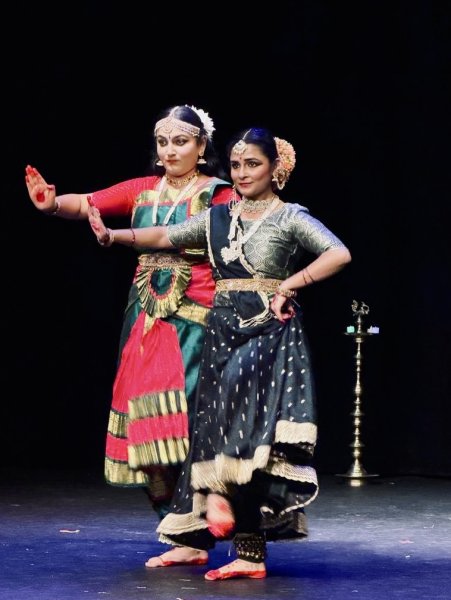 Sriyanka Sundar and Pooja Khandelwal The dialogue became most evident in Taal Samvaad, the rhythmic exchange between the dancers and musicians. It felt conversational rather than competitive, as though each side was listening for what might come next. One moment I especially loved was Sriyanka holding still while Pooja moved through a series of chakkars. The contrast between stillness and motion made the exchange particularly compelling. The live accompaniment by tabla artiste Adhira Ganesh, a disciple of Ganesh Betageri and Pt. Keshav Joshi, and mridangam artiste Siddharth Nair, a disciple of Cherthala Jaydev, brought two percussion traditions into the same exchange. Both musicians are young, and accompanying dancers from two classical traditions live on stage is no small responsibility. Their presence added another dimension to the performance. When the performance ended, I found myself thinking, Is that it? Not because the ending felt incomplete, but because I wanted to see and hear more of the conversation that had developed between the dancers. I left mesmerized, with a sense of calm and contentment, and with the desire to experience more. For me, that was the lasting quality of Ekatva. It did not suggest that Kathak and Bharatanatyam needed to become one form in order to communicate. Instead, it allowed each tradition to remain itself and let the dialogue emerge through their differences. In that meeting, Ekatva found its meaning: not sameness, but a sense of oneness created through difference. 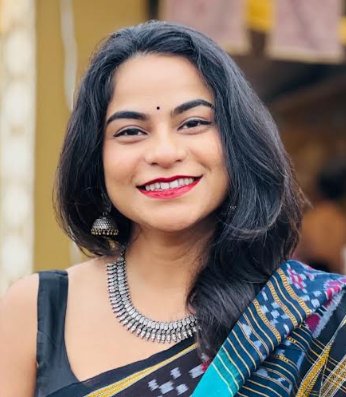 Megha Khairnar is a Kathak dancer and textile artist and designer. She trained in Kathak for over 15 years under Guru Rekha Nadgauda in Nashik, in the lineage of Pt. Birju Maharaj. She is a graduate of the National Institute of Fashion Technology (NIFT, India), and Savannah College of Art & Design (SCAD, United States). |
