
|     |
|
| |

REVIEW / REPORTA reflection on grief, abhinaya, ritual and transformation in The Anklet's Verdict- Samyukta Ninane-mail: samyuktaninan82@gmail.com October 6, 2026 There are moments in theatre when performance ceases to be performance. The body becomes memory, grief becomes ritual, and somewhere between the beat of the drum and the flicker of a lamp, a woman becomes a goddess. This was my overwhelming experience of watching Cilappatikaram - The Anklet's Verdict at the Delhi Theatre Festival staged in the Stein Auditorium at the India Habitat Centre. Directed by Sooraj Nambiar, one of the prominent practitioners of Kutiyattam today, the production brought to Delhi an unusual meeting of two ancient traditions - the great Tamil epic Cilappatikaram and Kutiyattam, Kerala's extraordinary tradition of Sanskrit theatre. What unfolded was not merely the staging of an epic. It was an exploration of how an ancient story can enter the body of the performer and acquire another life. Attributed to Ilango Adigal, traditionally believed to have been a Chera prince who became a Jain monk, Cilappatikaram is among the earliest surviving Tamil epics. Unlike epics preoccupied with war, conquest, kingship and statesmanship, this is a story that begins within the intimate world of human relationships. It is about love, desire, betrayal, loss and ultimately justice. Perhaps that is why it continues to speak so powerfully across centuries. The story begins in the flourishing Chola port of Poompuhar, or Kaveripoompattinam. Kovalan, married to Kannaki, falls in love with the courtesan Madhavi and loses his wealth. He eventually returns to Kannaki and the couple leave for Madurai, hoping to rebuild their lives. Kannaki gives Kovalan one of her precious anklets to sell. But a goldsmith falsely implicates him in the theft of the queen's anklet, and Kovalan is executed on the orders of the Pandya king. What follows has made Kannaki immortal. She walks into the king's court carrying the remaining anklet and breaks it open. Rubies scatter before the court. The queen's anklets contained pearls. One anklet proves the innocence of a dead man. And one woman brings a kingdom to its knees. 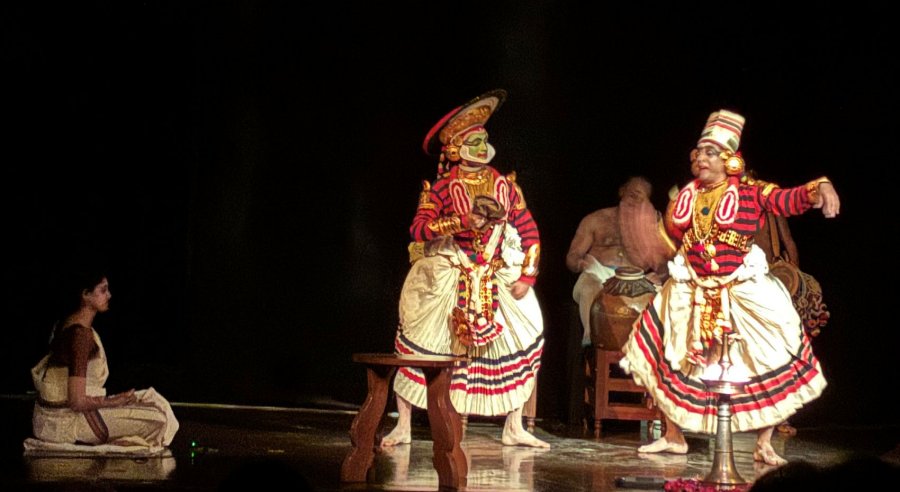 When an epic enters Kutiyattam Bringing Cilappatikaram into the performative universe of Kutiyattam is itself a fascinating experiment. Kutiyattam is a form of extraordinary precision. The eyes, face, hands and body speak within a highly codified vocabulary. Time does not operate here as it does in conventional theatre. A moment can be stretched, examined and inhabited. An emotion does not simply appear and disappear; it is allowed to gather within the performer. For audiences unfamiliar with this vocabulary, Kutiyattam can initially appear formidable. Traditionally, performances could unfold over several days. But the form has shown a remarkable ability to speak to audiences far beyond the ritual and temple spaces with which it has historically been associated. In The Anklet's Verdict, visual and contextual interventions helped the Delhi audience enter the narrative without reducing the complexity of the form. More significantly, the production marked an interesting departure from Kutiyattam's Sanskrit repertoire through the recitation of Tamil verses. The encounter between Tamil poetry and Kutiyattam therefore became more than an adaptation. It became a conversation between literary, theatrical and regional traditions. With Sooraj Nambiar as Kovalan, Kapila Venu as Kannaki and veteran theatre practitioner Sankar Venkiteswaran as the goldsmith, the epic acquired its power through performance rather than spectacle. And at its centre stood Kannaki. The body of grief Kapila Venu's Kannaki does not become the avenging woman immediately. First, she grieves. Her wail on learning of Kovalan's death seemed to tear through the performance space. It was not merely the representation of sorrow. The body itself appeared to carry grief. Then the mizhavu began to build. The rhythm intensified. The space turned red. Grief accumulated until it could no longer remain contained within the human body. This is where the production became particularly compelling for me. Kerala's ritual landscape is permeated by goddess traditions, and the imagery of Bhagavati and Bhadrakali seemed almost inevitably to enter the theatrical body of Kannaki. The bereaved wife gradually disappeared and another presence emerged. Kannaki confronts the king. She proves Kovalan innocent. But justice arrives too late. Her sorrow becomes anger. Her anger becomes rage. And her rage becomes cosmic. 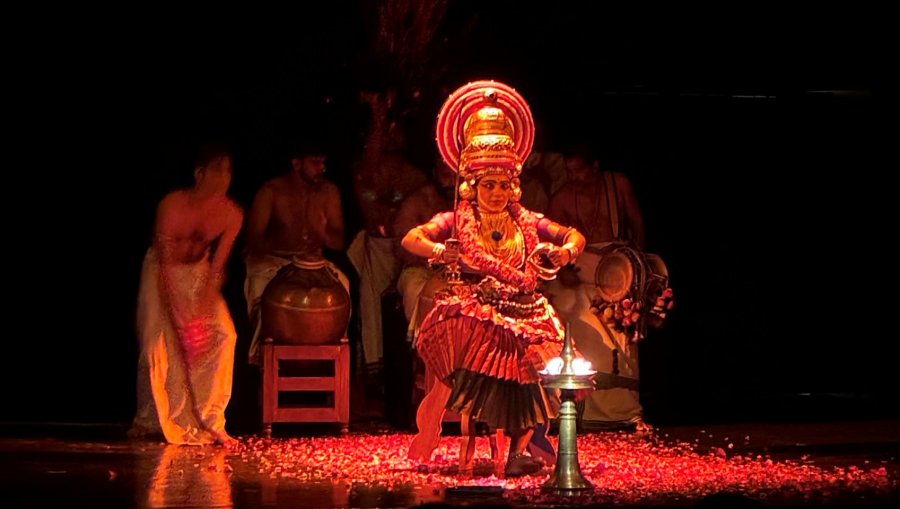 Emerges the Goddess Divine In that moment, Kannaki was no longer merely a literary heroine wronged by a king. Through the physical and emotional vocabulary of the performance, she seemed to cross the threshold between the mortal and the divine. The image inevitably evokes Bhadrakali - the fierce goddess of destruction, justice and retribution. Kannaki tears away her breast and curses the city that has destroyed the innocent man she loved. Woman, widow, avenger and goddess begin to merge. It is precisely here that Kutiyattam reveals its extraordinary power. Transformation does not require elaborate scenery or theatrical illusion. It happens through the performer. Through the eyes. Through breath. Through gesture. Through stillness. Through rhythm. The human body becomes the site upon which the epic is rewritten. And perhaps this is why The Anklet's Verdict remained with me long after the performance ended. It demonstrated that tradition survives not because we preserve it untouched, but because artists are willing to enter into conversation with it. Here was an ancient Tamil epic travelling through the grammar of an ancient Kerala performance tradition and finding an audience centuries later in Delhi. Yet what remained with me most was not its antiquity. It was Kannaki. A woman walks onto the stage carrying an anklet. She has lost her husband, her future and her faith in earthly justice. By the time she leaves us, she has become something infinitely larger. The anklet breaks. The rubies fall. The drums rise. Madurai burns. And somewhere within that terrifying blaze, we are no longer watching Kannaki. We are in the presence of the goddess…  Samyukta Ninan is an educator, writer and cultural enthusiast whose work lies at the intersection of history, heritage and the performing arts. A history educator by profession, Samyukta has worked extensively with children, using heritage walks, theatre and storytelling to make the past accessible and meaningful to young audiences. She has also written and directed heritage-based plays and is currently developing historical fiction for young readers. Whether through the classroom, the written word or the performing arts, her work is driven by a desire to bring history out of the archive and into lived experience. |
