
|     |
|
| |

REVIEW / REPORTEngaging solo dance performances- Satish Surie-mail: satishism@yahoo.co.in Photos: Prof.K.S.Krishnamurthy October 3, 2026 A KUCHIPUDI EVENING OF DEVOTION AND DELIGHT Swetha Prasanna at NGMA The stately galleries of the National Gallery of Modern Art (NGMA), Bangalore, provided an evocative setting for a Kuchipudi recital by Swetha Prasanna. Presented through three contrasting compositions, the evening traversed the form’s devotional, narrative, and rhythmic dimensions, revealing the dancer’s command of abhinaya, lyrical movement, and technical precision. The recital opened with Purandara Dasa’s “Gajavadana beduve”, an invocation to Lord Ganesha. Prasanna approached the composition with a measured and contemplative abhinaya, bringing alive the deity’s attributes. The unfolding of Ganesha’s wisdom, benevolence, and role as remover of obstacles was handled with clarity and restraint. Her interpretation allowed the devotional content to emerge naturally, establishing a serene mood for the evening. 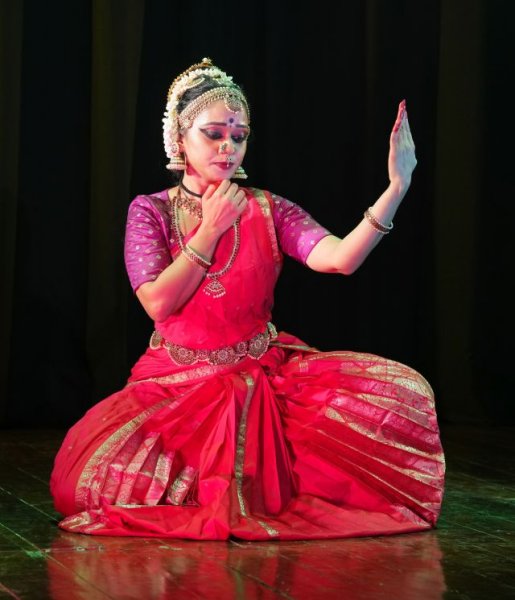 Swetha Prasanna The centrepiece was a Pravesha Daravu depicting Rukmini, choreographed by Guru Vempati Chinna Satyam. An entrance piece that introduces a character through movement, stance, and expression, the Daravu demands both technical control and an ability to establish personality without elaborate narrative action. Swetha Prasanna brought lyrical grace and quiet dignity to her portrayal of Rukmini. Her measured gestures and poised movements suggested the refinement of a princess and the inner resolve of a woman whose devotion to Krishna would lead her to choose her own destiny. The choreographic lineage of Vempati Chinna Satyam was evident in the clean lines and carefully paced unfolding of the composition. Swetha Prasanna responded to the choreography with sensitivity, allowing character to emerge through suggestion rather than overt dramatisation. The evening concluded with the vibrant Govardhana Giri Tarangam, a technically demanding composition that remains one of Kuchipudi’s most distinctive features. The narrative centred on Krishna lifting Govardhana hill to protect the villagers from the torrential rain sent by Indra after they turned their worship towards the hill. Prasanna negotiated the transition from narrative enactment to rhythmic brilliance with confidence. The gathering storm, the villagers’ distress, and Krishna’s intervention unfolded through expressive movement, leading into the intricate footwork of the Tarangam. Performing on the rim of a brass plate, Swetha Prasanna demonstrated balance, agility, and rhythmic control as the tempo gathered momentum. The percussive accompaniment enhanced the visual and aural impact of the presentation, with the brass accents complementing her footwork and contributing to the exhilarating finale. Across the three compositions, Swetha Prasanna demonstrated the versatility of Kuchipudi, moving from devotional stillness to narrative refinement and rhythmic virtuosity. The recital offered a compact yet thoughtfully structured presentation of the form, with each piece contributing a distinct dimension to the evening. The choice of compositions and the dancer’s assured execution made for an engaging showcase of Kuchipudi’s enduring appeal. DEAR KANNAMMA: A PORTRAIT IN FRAGMENTS Janani Murali at the Bangalore International Centre In the crowded landscape of contemporary Bharatanatyam presentations inspired by literature, Janani Murali’s ‘Dear Kannamma’ distinguished itself through its quiet insistence on intimacy. Drawing upon the life, poetry and unresolved longings of Mahakavi Subramania Bharati, the work presented the poet not as a national monument but as a man of flesh and blood, shaped by exile, desire and unfinished correspondence. A fictional narrative inspired by historical currents, it offered not a biography but an atmosphere, a portrait assembled through fragments of memory, poetry and theatrical imagination. The performance opened with “Kummiyadi Penne”, Bharati’s progressive song calling for women’s freedom, education and empowerment. The choice was pointed rather than decorative. The kummi, a communal and celebratory form, became an embodiment of the liberation demanded by the lyrics. Its collective energy established the ideological foundation of the work while bringing Bharati’s radical vision into the immediacy of the stage. The biographical currents underlying the production gave this opening added resonance. Bharati’s marriage to Chellamma in 1905, when he was fifteen, and his subsequent encounter with Sister Nivedita’s ideas on women’s empowerment informed his progressive writing. His political convictions eventually led to exile in Pondicherry, where his second child was born. The imagined muse of Kannamma, as framed by Janani Murali, carried the emotional weight of this journey: a life of early domesticity transformed by radical conviction, political awakening and personal cost. The poet’s death at thirty-eight, following years of hardship, declining health and an injury sustained from a temple elephant, cast a further shadow over the work. The performance did not linearly narrate this biography, but its presence lent depth to the fragments that followed. 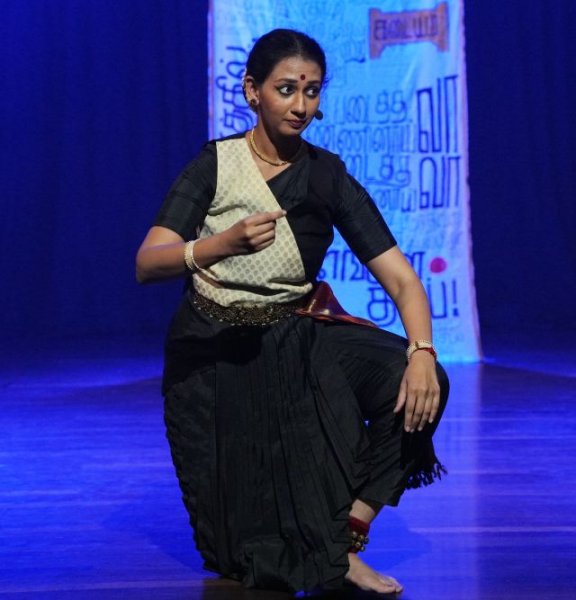 Janani Murali The work proper opened in a register of distant, almost mythical past. Colonial oppression was established with striking economy. The Englishman was named “the devil,” while Bharati’s call for collective resistance, “everybody that’s man and woman have to stand shoulder to shoulder,” was delivered with a starkness that avoided bombast. The passage also conveyed the frustration of a voice unheard in its own time, a prophecy addressed to a world not yet ready to receive it. Janani Murali’s physicality registered this tension through shoulders that squared and collapsed, and feet that stamped with purpose only to hesitate. Rather than pursue chronology, Janani worked through collage. Spoken narration, sung fragments, passages of pure nritta, sudden laughter and intimate episodes of abhinaya formed a shifting theatrical vocabulary. Mythological imagery surfaced without warning, as in the passage, “I, the defeater of Kubera, must pass over this mountain; the beautiful stands in my way.” Bharati’s invocation of gods and demons framed a deeply human obstruction of desire. The register then shifted abruptly to the private utterance, “My dear, I miss him,” followed by the letter, “I write to you for one last time from the hearts of Kashi.” The stage, once a public arena, became an interior space of correspondence. These transitions were effective precisely because they resisted smoothness, evoking the disorientation of a poet whose fiery political writing coexisted with tender lyricism. Technically, Janani Murali remained rooted in the Pandanallur lineage, with clean lines, unforced adavus and a restrained yet precise use of the torso. Her distinctive contribution lay in allowing the classical vocabulary to serve the theatrical structure rather than allowing technique to dominate it. Spoken text and gesture did not merely support one another; they interrupted, extended and completed each other. At times, Janani Murali appeared to inhabit both the poet and the recipient of his words, a dual consciousness suited to the fluid identity of Kannamma in Bharati’s poetry. She could be a divine beloved, an earthly wife or, through the biographical undercurrents of the work, Chellamma herself. The abhinaya was never ornamental. The softening of the eyes and the hands tracing the curve of a remembered face conveyed an intimacy that felt earned. Janani Murali’s restraint allowed the emotional charge of the poetry to emerge without excessive emphasis, and her ability to move between the public and private registers gave the characterisation considerable complexity. The musical ensemble, comprising Eashwar Iyer on vocals, Vinay Nagarajan on mridangam and percussion, and Rahunandan on flute, complemented the production with a soundscape of notable restraint. The music never crowded the stage. Periods of silence, or near silence, allowed the residual energy of a movement to settle before the next impulse arrived. In a genre where literary adaptations can sometimes overwhelm the senses in an attempt to match the density of their source material, the production adopted the opposite strategy. Less became more. Laughter and song acquired greater force because of the space around them, while the musicians’ restraint functioned as an integral compositional choice. The excerpts also revealed the inevitable limitations of attempting to contain Bharati’s restless intellect within a single performance frame. The political and the erotic, the maternal and the divine, the public orator and the private letter writer coexist within his poetry. No single dance work can fully encompass their simultaneity. Yet Janani Murali’s refusal to resolve these tensions into a neat narrative was itself a form of fidelity. Bharati’s Kannamma was never a fixed person but a shifting site of devotion, desire and defiance. The production honoured that multiplicity rather than flattening it into a singular interpretation. ‘Dear Kannamma’ did not insist upon its contemporary relevance. Instead, it trusted the audience to recognise that exile, silenced speech and longing for an ideal beloved remain unsettled questions. At a time when classical dance frequently oscillates between revivalism and overt contemporisation, Janani Murali’s work occupied a more considered middle ground: classical in technique, theatrical in structure and quietly urgent in spirit. Even in its fragmentary form, ‘Dear Kannamma’ revealed a thoughtful approach to literary adaptation, one that understood Bharati’s poetry as a living field of contradictions rather than a fixed body of texts. The hope was that the full production would travel further, allowing these fragments to gather into a larger theatrical portrait of a poet whose life and imagination continue to resonate. GRACE IN FULL BLOOM Shubha Dar's Bharatanatyam Margam at Seva Sadan Shubha Dhar, an alumna of Kalakshetra and a holder of a master’s degree from Jain University, presented a Bharatanatyam margam at Seva Sadan on September 12. Presently mentored by Acharya Indira Kadambi, she demonstrated a command of the form that was marked by both technical assurance and expressive sensitivity. She opened her exposition with a sacred shloka from the Markandeya Puranam, set in raga Lathangi, which flowed seamlessly into an Alarippu. Her energy, precision and ability established a confident tone for the evening. Among the many demands of a Bharatanatyam margam, the varnam remained the ultimate proving ground, requiring mathematical rigour in nritta and emotional depth in abhinaya, often within the space of a single line. Shubha Dhar met this challenge with quiet assurance in her presentation of “Sarasalanu Ippudu Marimanara”, set to raga Karnataka Kapi and Rupaka tala, composed by Ponniah of the Thanjavur Quartet and choreographed by Indira Kadambi. 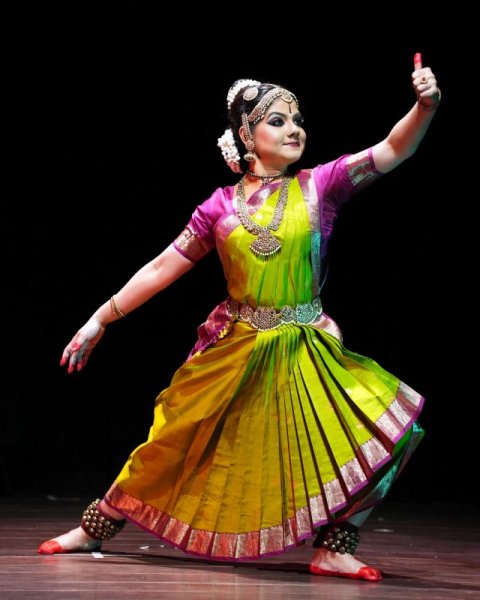 Shubha Dhar The varnam opened with the nayika’s plea, “sarasalanu ippudu marulukonṭira vinara calamelara”, questioning, with a touch of hurt pride, why her beloved remained indifferent to her devotion. Shubha Dhar shaped the opening as an unfolding mood, moving with fluid ease from entreaty to a more playful and impish register. Her portrayal grew delicate, flirtatious and faintly petulant, revealing a nayika fully aware of her charm and unafraid to wield it. She negotiated the balance between petulance and elegance with considerable confidence. What made the abhinaya passages memorable was not any single technical flourish, but the expressive economy of her face. Nuance emerged through small, precise shifts: a raised brow, a softened gaze and the faintest curve of a smile, each carrying the emotional weight of the sahitya without tipping into melodrama. Such restraint was not easy to sustain across the length of a varnam, where the temptation to underline every sentiment remained constant. Shubha. Dhar largely resisted it, trusting the music and lyric to carry their share of the expression. The tone shifted as the nayika’s yearning found its object in Brihadeeswara: “karuṇakara ghanuḍau nivu”, a plea to the merciful and great Lord to come without delay and take her into his embrace. Shubha Dhar’s abhinaya softened further, the coquetry of the earlier lines giving way to a more devotional and surrendering quality. Her movement vocabulary carried the same gentleness, whether in a cleanly executed adavu or in the stillness that framed an emotive line. An unforced grace pervaded the performance, never calling attention to itself. The varnam thus revealed the range of her artistry, setting the geometry of nritta against the interiority of bhava, with transitions that felt organic rather than contrived. Drawing on her Bengali roots, Shubha Dhar also presented Tagore’s “Mamo chitte niti nritye” (The Eternal Dance), a composition that evoked the continuous rhythmic interplay of life and death, joy and sorrow, within the human mind and soul. Tagore’s verse reflected on the cyclical nature of birth and death and the coexistence of liberation and worldly bonds through day and night. Its playful, bouncing cadence was carried by the recurring phonetic refrain “taata thoi thoi,” which evoked the sound of traditional Indian drums. The lively musicality of the piece was rendered with aplomb by vocalist Rohit Bhatt. A change of costume brought a change of register with a padam by Ghanam Krishna Iyer. The composition, “Unnai thoodhu anuppinen,” opened with a gentle yet emotionally charged remonstrance. The nayika confronted her close friend, the thozhi, whom she had sent as a messenger to Lord Muruga. She questioned why she had entrusted the friend with her message, only to find that instead of bringing Muruga back, she had betrayed her confidence by succumbing to his affections. Rendered at a very slow, heavy pace, rich in microtonal inflexions, the padam reflected the depth of heartbreak and conflict at its core. Its dialogue-oriented approach to abhinaya, associated with the lineage of Kalanidhi Narayanan, called for each interpretation to be first elucidated through spoken exchanges and their intended intonations. Shubha Dhar portrayed the complex interplay of anger towards the friend, love for Muruga and absolute despair over the betrayal. The measured unfolding of the padam allowed the emotional tensions to deepen without haste. Shubha Dhar concluded with a thillana in Sindhu Bhairavi, composed by Lalgudi Jayaraman, which served as the energetic climax of the margam. The piece opened with crisp vocal syllables, including jathis such as “dhimita jhanu,” establishing geometric precision through sharp, sweeping adavus and fast-paced tattadavus. These matched the crispness of Lalgudi’s signature violin strokes. The sudden shift into lyrical sahityam created a striking contrast. As the music turned to Lord Muruga, the physical speed gave way to abhinaya, with Shubha Dar bringing out the vivid iconography of Muruga riding his peacock, holding his sacred vel and comforting his consorts, Valli and Deivayani. The aural backbone of the evening was provided by an exemplary ensemble of musicians. Rohit Bhatt lent vocal support, while Acharya Indira Kadambi handled the nattuvangam with attentive command. Vidyashankar on mridangam, Raghu Simha on flute and Prashanth Rudrapatna on veena contributed to the musical richness of the performance, enlivening the presentation throughout.  Bangalore based Satish Suri is an avid dance rasika besides being a life member of the Music and Arts Society. |
