
|     |
|
| |

REVIEW / REPORTA triumph of masculine grace and cosmic energy- Sumana Sachidanandae-mail: sumanas29@gmail.com Photos: Suresh Muralidharan October 2, 2026 The Kanak Sabha, Nalanda Dance Research Centre, Mumbai, witnessed a superlative programme based on the holy Dwadasha Jyotirlingas, on the 11th of September 2026. The brainchild of Dr. Usha RK who has become synonymous with innovative curation of thematic classical dance presentations, this evening was a glorious manifestation of the masculine energy in its full form. Star Bharatanatyam dancers Mithun Shyam, Nidhaga Karunad and Vidhun Kumar swept the audience off its feet like hurricanes. Bharata Muni would have probably called for an encore to revisit the innumerable moments of artistic splendour. Nothing like dancing to live music. The camaraderie between the dancer and accompanists only adds to the aural and visual experience. There is musicality in dance, and movement in music. One must experience a presentation of this stature to truly understand the magic of a live ensemble. The evening began with Dr. Usha explaining the philosophy of the Linga, and busting myths surrounding it. She mentioned her inspiration for this work came from Dr. Bibek Debroy's book on the Jyotirlingas. The Linga is misunderstood as a phallic symbol world over. However, the primary definition of the Sanskrit term Linga is simply- mark or sign. In grammar we come across Linga in gender classification- Pullinga, Streelinga and Napunsakalinga. The deeper, metaphysical interpretation is derived from "Leena" + "Gamaka" meaning "to dissolve" and "subtle transition", as quoted in Abhinava Gupta's musical treatise. She even mentioned how Linga is the conjunction of a circle and an infinite column. So, the merging into a fluid space can be regarded as the real definition of the term Linga. Jyotirlinga is nothing but an infinite column of divine golden fire. The Dwadasha Jyotirlingas emerged in locations across India as responses to cosmic and human suffering, acting as direct gateways to spiritual transcendence. Interestingly, Shiva temples, particularly the Jyotirlingas have become top destinations for Millennials and Gen Zs, who are displaying a renewed zeal for spiritual awakening unlike their predecessors. A TOI article from last year spoke about 'shrinecations'. Youngsters are trying to align with their 'Shiva Tattva' and discover their true selves. If Shiva is Nirguna (devoid of Gunas), and Nirakara (devoid of a form), then why is there such a specific form in which he is worshipped? Dr. Usha mentioned that the structure of the typical Shiva Linga in a temple consists of the Base representing Brahma the creator, the Pedestal representing Vishnu the Sustainer and the Shaft representing Shiva the Dissolver. For those who are unaware, you may read up about the legend of the "Lingodbhava" from the Shiva Purana, where Shiva appears as a limitless column of blazing light to teach Brahma and Vishnu a lesson of humility. One needs a visual entity to worship, and hence our tradition has beautiful ways to simplify the abstract to the mundane. Every ritual, every Upachaara has its significance, and helps the Bhakta connect with the Divine intimately. And hence, we see Mahadev being worshipped in the physical form of the Linga. 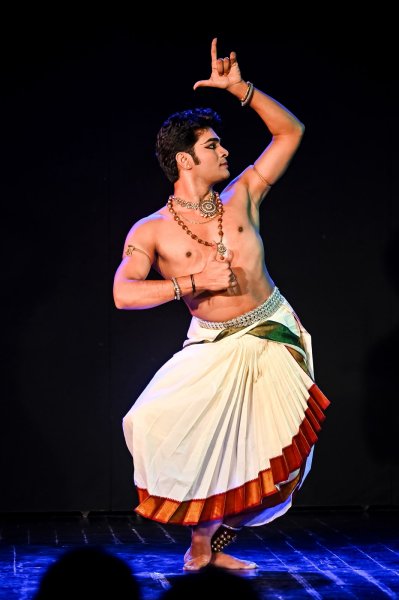 Mithun Shyam The first performance of the evening was on the Somnath Jyotirlinga of Gujarat by Mithun Shyam. An entertainer par excellence, he commenced with the Shloka citing the 12 Jyotirlingas. The dramatic story of Soma the Moon's curse was portrayed effortlessly by Mithun. As per the Skanda Purana, the Moon-God Chandra/ Soma, married the 27 daughters of Daksha Prajapati, who represent the 27 Nakshatras. Although he was expected to treat all his wives equally, Soma became especially attached to Rohini, who was extraordinarily gorgeous, neglecting the others. The neglected wives complained to their father Daksha, who repeatedly warned Soma to be impartial, but Soma could not change his ways. Angered by his continued partiality, Daksha cursed Soma with Kshaya, a wasting disease. Soma consequently lost his radiance and was distraught. On the advice of the creator Lord Brahma, he went to Prabhasa Kshetra (Gujarat) and performed severe penance to appease Lord Shiva, while chanting the Maha Mrityunjaya Mantra. Pleased with his intense devotion, Shiva appeared but modified the curse as opposed to liberating him from it entirely. The compromise was that for 15 days, the curse would take effect, and Soma would gradually wane, losing his brightness until he became invisible (the dark fortnight or Krishna Paksha ending in Amavasya). Just as every cloud has a silver lining, by Shiva's blessing, for the next 15 days, Soma would gradually regain his strength and brightness until he shone in full glory (the bright fortnight or Shukla Paksha ending in Purnima). Out of gratitude, Soma built a temple of gold for Lord Shiva in the same Kshetra. Today, we know it as Somnath (Lord of Soma). Mithun has impeccable mastery over abhinaya. The hopeless-in-love Soma, the charming Rohini, the jealous wives, the livid Daksha, the compassionate Lord Shiva, and finally the transformed Bhakta Soma were all brought to life with absolute conviction. He is a born performer with a commanding stage presence. There was not one dull moment in his engaging recital. The second part of his performance included a much-needed capsule of history, highlighting the Islamic invasions that the Somnath temple has endured over centuries. It's probably the most resilient temple in the country, having overcome 17 attempts of destruction including one by Ghazni in the 11th century. The temple as we see it today was constructed under the vision of Sardar Vallabhbhai Patel after Independence. These invaders were notorious for defacing our precious sculptures, and in some cases destroying entire temple complexes. Their determined efforts to annihilate Sanatana Dharma have proved futile, as demonstrated in this segment of Mithun's performance. Every time the Somnath temple was disfigured or plundered, the successive Hindu rulers ensured the temple sprung back to life. As per history records, Ghazni killed around 50,000 defendants and broke the Jyotirlinga. He wore his heart on his sleeve and could not be bribed with riches to spare the Linga. He prided himself on his role as an iconoclast (idol- breaker). It is believed that King Bhima and King Bhoja reconstructed the Linga after this. This destruction - reconstruction happened many times. Every time the devotion of the Bhaktas was put to test by the violent invaders, and the Bhaktas more than rose to the occasion to protect their dear Somnath. Mithun offered a moving depiction of the attacks by the vile barbarians and the unwavering resolve of the Bhaktas to save their Dharma. His performance perfectly illustrated the phrase- "Dharmo Rakshati Rakshitaha"! 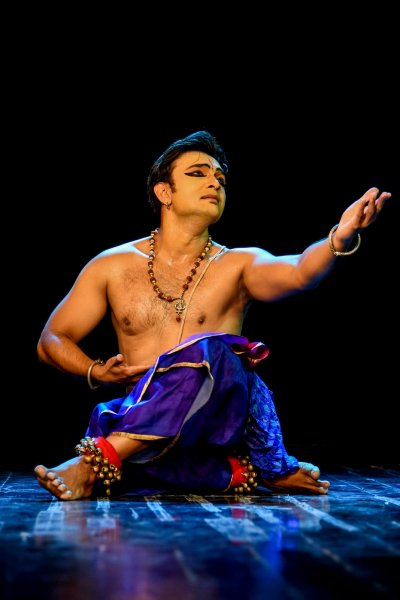 Nidhaga Karunad The second performance of the evening by Nidhaga Karunad transported us to the scenic hills of Andhra Pradesh - The Mallikarjuna Jyotirlinga of Srisailam. Nidhaga took off quite literally with a power-packed jathi that set the tone for his performance. His agility was demonstrated through jumps and stretched postures. His Anga Shuddhi (Pandanallur style) was remarkable. One could observe deep araimandi, long linear geometric movements and controlled execution in his dance. He enacted the very popular legend of the Ganesha - Kartikeya race. Kalahapriya Narada Muni instigates the two sons of Shiva-Parvati on Mount Kailash, saying whoever circles the entire universe 7 times first would get to marry Riddhi and Siddhi. Kartikeya, the supreme army commander, is determined to win and soars into the skies seated on his Vaahan - the peacock. He flies at a thrilling speed, convinced that he is invincible in the matter. The launching of the peacock into the cosmos under the control of Skanda was depicted with great vigour and artistry by Nidhaga. It was thoroughly enjoyable. Poor Ganesha realises that this tiny, slow Vaahana of his, Mushak, is no match for Skanda's Mayura. But as they say, 'brain over brawn' prevails. Ganesha, the wise one, decides to circumambulate his parents as they are the universe to him. He wins the race and gets to marry Riddhi-Siddhi! A furious Kartikeya, who feels outwitted by his chubby brother and let down by his parents, leaves Kailash and settles in Srisailam. Shiva-Parvati ride atop Nandi, the majestic bull, and travel towards the south traversing lush valleys, until they find their beloved son. This was visualised with a delightful touch of humour by Nidhaga. They decide to keep visiting him there, to console him and maintain harmony in the family. It is believed that the Mallika represents Parvati, and Arjuna, Shiva. They take turns during the full moon and new moon respectively to visit their son Skanda. All is well that ends well! It is believed that this Jyotirlinga blesses its devotees with a peaceful, harmonious family life, and resolves afflictions. The lyrics for this performance were composed by Nidhaga himself, in Kannada and then translated into Hindi. He concluded with the Shloka on Mallikarjuna which extolls the Jyotirlinga as a Samsara Samudra Setu - The Bridge to the Ocean of Existence. The young students in the audience cheered loudly for Nidhaga several times during his performance, such was his riveting presence. 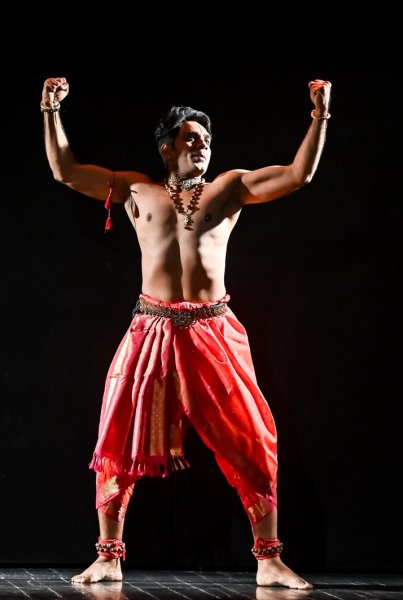 Vidhun Kumar The final act of the evening was by Vidhun Kumar, who gave us a glimpse of the Bhimashankar Jyotirlinga of Maharashtra. Bhimashankar is believed to have been named after Bhimasura, the son of Kumbhakarna. Bhimasura lived in the Sahyadri hills with his mother Karkati. Learning that Rama (an avatar of Lord Vishnu) had killed his father and uncle, Bhim vowed to seek revenge on Vishnu and performed intense penance to Lord Brahma, gaining unmatched strength. He conquered the heavens, and then turned to conquering the earth, imprisoning King Sudakshina of Kamarupa, a devout follower of Shiva, in an underground dungeon. Even in prison, Sudakshina continued worshipping the Shivalinga. When the gods and sages prayed for relief from Bhimasura's tyranny, Lord Shiva assured them he would protect his devotee. On seeing Sudakshina's earnest Bhakti, Bhimasura attacked the Shivalinga with his sword in fury. Lord Shiva emerged from it in his mighty form. A tremendous battle shook the universe until Sage Narada urged Shiva to end it swiftly. With a glance of his third eye, Shiva reduced Bhimasura to ashes. Shiva agreed to remain there forever as Bhimashankar, granting the wishes of devotees. It is said the sweat from his body during the battle gave rise to the Bhima River, which originates nearby. Vidhun's entry on stage as the mighty Bhimasura was striking. His eyes conveyed the rage of the Asura exceedingly well. He maintained the fierce demeanour of the antagonist throughout the presentation which is extremely challenging for any dancer. Negative characters demand far more emotional control, strength and focus to be impactful. The violin prelude by Anantharaman was lyrical. Vidhun's transition from the antagonist to the protagonist Lord Shiva himself, was seamless. They say the villain makes the story captivating, and Vidhun's portrayal of Bhimasura was testament to this. The usage of Marathi verses was a pleasant surprise and enhanced the experience for the rasikas. The sudden shifts from bhava to nritta during the course of the performance were executed flawlessly by Vidhun. Dwadasha Jyotirlinga conceived and curated by Dr. Usha RK was a unique gift to the city of Mumbai. The highly engaged audience responded with thunderous applause for all 3 artistes. The evening was a beautiful Samagam of our gripping Pouranika Kathas, first- rate Bharatanatyam and enthralling live music. The fantastic accompanists who breathed life into the presentations were: vocal - Sujesh Menon, nattuvangam - Kalishwaran Pillai, mridangam - Dakshinamurthy Pillai and violin - B. Anantharaman (Ravi). Sujesh Menon deserves a special mention for being the vocalist and composer of all the 12 Jyotirlinga performances of the tour! Har Har Mahadev!  Sumana Sachidananda is a Kathak dancer based in Mumbai. She is an MBA from ISB Hyderabad and has also trained in Carnatic music. She holds a Senior Diploma in Kathak from Bharatiya Vidya Bhavan and is a DD graded artist. |
