
|     |
|
| |

REVIEW / REPORTRasārādhanam - An exemplary tribute to the Rasas and to the compositions of Śatāvadhānī Dr. R Ganesh- Arjun Bharadwaje-mail: arjunbharadwaj@gmail.com September 28, 2026 20 September 2026 offered a special audio-visual treat to the rasikas of Bengaluru. Nirupama Rajendra presented Bharatanrityam to compositions by Śatāvadhānī Dr R. Ganesh. The event was hosted by the team of Rasārādhana as a tribute to Dr Ganesh on his being conferred the Padma Bhushan. The honour has indeed found a most deserving recipient and serves as a fitting recognition of Ganesh's enduring contributions to diverse domains of classical poetry, the arts, and the śāstras. Nirupama Rajendra's offering was especially meaningful, for she owes much of her understanding of the philosophy underlying the Nāṭyaśāstra, as well as her insights into classical literature, to Ganesh. The performance was aptly titled a Bharatanrityam offering, for Nirupama Rajendra primarily employed the movement vocabulary of the immortal treatise Nāṭyaśāstra, as reconstructed by Dr. Padma Subrahmanyam. Nirupama, who is known for her excellence in two styles - Bharatanatyam and Kathak, learnt the vocabulary from Late Sundari Santhanam, one of the prime disciples of Dr. Padma Subrahmanyam. In the words of Nirupama, this marga vocabulary has immensely enriched both her desi styles and has increased the possibilities for creative expression multiple-fold. T. D. Rajendra and Nirupama have extensively used these movements and their adaptations in all their solo, duet, and group presentations, which have won the hearts of millions of connoisseurs across six continents. Nirupama's presentation also included a unique vocabulary she conceived, bridging the marga with the desi. These 108 movements, called the Desi-Marga-Aḍavus, were developed by her during the lockdown of Covid-19, keeping in mind the psychosomatic correlations and the creative possibilities of movements. The movements, which took their birth under the guidance of Dr. Ganesh and were named by him, not only work as pedagogical tools, but also as important media for communication. While the upper body is designed to follow the nṛtta hastas of the Nāṭyaśāstra, the lower body performs the aḍavus, thereby making it a blend of the marga and the desi. This contribution alone is sufficient to make Nirupama immortal in the echelons of time. 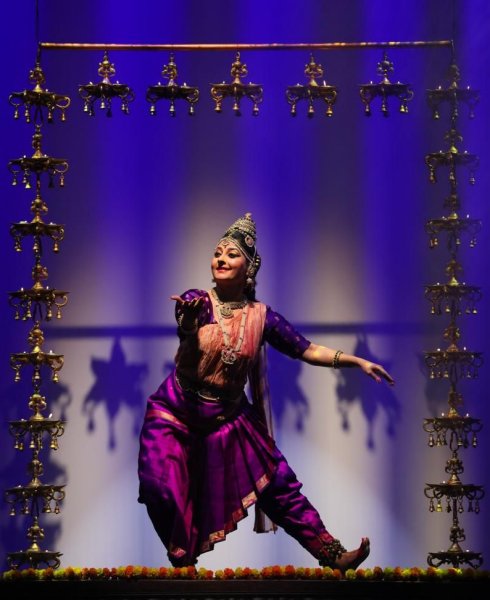 Nirupama (Anjali) The evening began with a beautiful anjali dedicated to Bhagavan Srikrishna. The lines go, Desi Gokula dharaṇi tale Mrrga Murāriravatarati: The Divine, all-pervading Murāri takes birth upon the soil of Gokula, just like the pan-Indian marga finds its regional application in the desi. Nirupama succinctly brought to life the environs of Gokula through her impeccable abhinaya, by employing the karaṇas and the aforementioned Desi-Marga-Aḍavus. She displayed the leelas of Srikrishna. The short piece, set to raga Kalyaṇi and involving numerous gati bhedas provided an auspicious beginning to the program. The music was composed by Rajkumar Bharati. The second choreography is a masterpiece by any standard. Titled Atma saundarya, the composition traces Devi Parvati's journey from a maiden to becoming Bhagavan Śiva's inseparable wife. The presentation began with Nirupama depicting Śiva's single-minded tapas, unperturbed by anything around him. Parvati tries to win him over by her physical charms and enticing costume. Manmatha, who symbolises Parvati's love, appears there, casting a spell of romantic companionship all around him. Nirupama suggestively indicated that Parvati's very desire for Śiva manifested as Vasanta and Malaya maruta, which in turn act as uddīpana vibhāvas for her love. She creatively depicted Manmatha choosing his bow by picking up a sugarcane, biting it, relishing its taste, and deciding that it would serve to amplify the sweetness of his endeavour. Bees form his bowstring, and five flowers constitute his arrows. Just as he spots Śiva in tapas and shoots an arrow at him to make him fall in love, he is reduced to ashes by the fire that emerged from the rageful third eye of the lord. Parvati, who witnesses this, is heartbroken and decides that all her external beauty is of no use; the jaganmata offers all her aspects of beauty to nature. Nirupama's enactment of this sequence is inimitable. The deer, which had rather dull eyes until then, become bright and bubbling due to the gift of the goddess's eye. The lotuses smile by blossoming wide, having received the beauty of Parvati's lips. Similarly, the creepers develop dainty and curvy bodies, and snakes wrap around each other, being blessed with the charm of devi's body and tresses. Having thus embodied her physical beauty in nature, Parvati performs tapas in all six seasons. Nirupama's depiction of the seasons was so appealing and accurate that the audience could almost feel the scorching heat of the sun and the chilling winds of winter. The creative lighting and accompanying music enhanced the effect to provide a multi-dimensional treat to the connoisseur. Parvati performs tapas amidst four fires in the cardinal directions, with the Sun being the fifth fire. She is unflinching in the rainy season, the autumn, the winters and the harvest season. Nirupama succinctly portrayed the overflowing rivers of the rainy season by doing a quick sanchari that indicated the river Ganga, which was brought down to the earth by Sage Bhagiratha. She suggested the Hemanta ṛtu by depicting the harvest of crops, without ever compromising on the tala or the movements of her feet. As though to test her commitment, Śiva appears in the disguise of a brahmachari. The lord changing his guise was also enacted as a humorous sequence by the artiste. The brahmachari taunts Parvati by saying that she is going behind a person whose parentage is unknown and who lives in the crematorium, constantly asking, kīdṛśo mahātmā? For each one of the questions, Parvati provides a philosophical answer, thereby emphasising the realisation of Śiva tattva within herself. Impressed, Śiva surrenders to her and wishes to marry her. While Parvati is overcome by immense joy and is bashful, she asks him to put forth the proposal to her father. 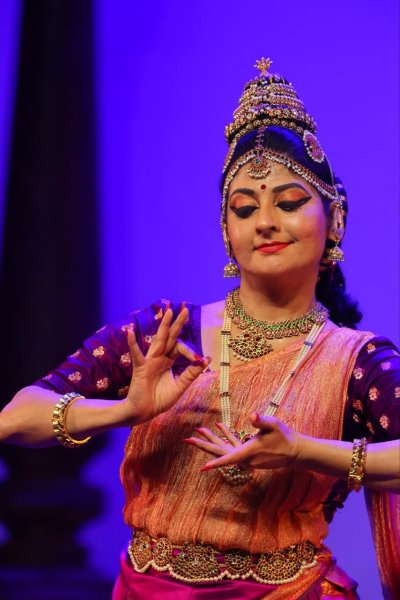 Nirupama (Atma saundarya) Thus, the composition amply emphasises the importance of the spiritual union of a couple, rather than an attraction founded merely on the physical. It is Atma saundarya that brings the primordial couple together, and not deha saundarya. Inspired by Kalidasa's immortal epic Kumarasambhavam, the composition traces Parvati's progression from aharya and aṅgika, through vachika, culminating in her realisation of sattvika śiva within herself. The composition was set in Ragamalika and Talamalika, providing ample scope for the musicians to bring forth the best of their creative abilities. Praveen D Rao composed the music, skilfully weaving in dramatic elements that heightened both the narrative and its underlying emotions. Nirupama's deep understanding of classical literature lent further depth and nuance to the interpretations she presented. The next composition was structured to bring out the essential non-difference between Hari and Hara. Bhagavan Śiva and Śriman Narayaṇa are manifestations of the same underlying principle, and the composition portrayed Śiva and Vishnu as mutual admirers. Śiva wishes to hear the melodious strains of the flute played by Vishnu in his avatara as Srikrishna, while the latter wishes to hear Śiva's rhythmic playing of the ḍamaru. The flute represents melody - śruti - while the ḍamaru represents rhythm - laya; together, they constitute music. Thus, both divinities are shown to be indispensable to the art of music. Vishnu demonstrates the manner in which he danced upon the slippery hoods of the Kaliya serpent, while Śiva displays his Ananda taṇḍava in the kanaka sabha. Nirupama's creativity and meticulous attention to detail in these segments served as a masterclass for students of both dance and literature. She depicted the manner in which Srikrishna performed the mardana of Kaliya, rather than his saṃhara, and emphasised how he never lost his balance during the dance. She even assumed the posture immortalised in Chola bronzes depicting Kṛishna's final stance upon the hoods of Kaliya, with the serpent's tail drawn upwards. Nirupama's mastery over sthiti and gati in dance was particularly evident in these passages. The sanatanic divinities are celebrated not merely for their saukumarya as artists; they also manifest uddhata qualities in their avataras and leelas. The composition accordingly proceeded to the portrayal of Rama vanquishing Ravaṇa. After depicting the ferocity of the battle, traversing vira and raudra rasas, Nirupama did not fail to bring out Rama's karuṇya upon the death of Ravaṇa. Rama proceeds to ensure the rakshasa's cremation, bringing to mind the celebrated words of the Ramayaṇa - maraṇāntāni vairāṇi. Nirupama then depicted Śiva's vanquishing of the tripurāsuras, the rakṣhasas who had assumed the form of three cities. The trimurtis, together with the Earth, the Sun, the Moon, Mount Meru, the Vedas, and the infinite serpent Ananta, come together in the destruction of the asuras. Having thus portrayed the avataras and leelas of the Divine, Nirupama brought the composition to a close with a charming familial touch. Hari and Hara, accompanied by their respective spouses, mount their vehicles and journey forth to meet and greet one another. The conclusion thus also brought to the fore the family values embodied by the divinities - their gṛhastha dharma. The next presentation was an aesthetic amalgamation of two compositions by Ganesh, skilfully woven together by Nirupama into a coherent and touching narrative. While the first three presentations were rooted in themes centred on the Divinities, this fourth presentation was rich in lokadharmi, exploring an entirely human theme without recourse to supernatural elements. The compositions, titled Dautya dīkṣite and Rasika sahāye, are novel conceptions of Ganesh, conceived within the classical framework of nayika abhinaya. In the first of the two, a heroine, yearning for the company of her beloved who is away on a journey, wonders about the ideal medium through which she might send him her message of love. She considers several possibilities, only to discover that none would quite serve her purpose. If she were to entrust her message to the clouds, they might melt away, washing away her colourful dreams with them; if she were to request the wind to carry it, the wind might scatter the message in all directions, diluting its intensity. A parrot might not preserve her confidence, while a peacock, beautiful though it is to behold, possesses a harsh voice. After contemplating these possibilities, the nayika finally decides to send her own mind as the messenger - but alas! The mind reaches her beloved and never returns. The poet's ingenuity and the dancer's impeccable ability to communicate even the subtlest of ideas reigned supreme in the presentation of this composition. The narrative then proceeds with the same nayika being teased by her sakhi, who suggests that her beloved might not remain faithful to her. The nayika, however, as a svadhinapatika, displays an unwavering and proud confidence in her husband, declaring that she could never become a khaṇḍita or a kalahantarita. Nirupama, who peppered the enactment of this second composition with abundant hasya, deftly brought out both the charm and the profundity of true couplehood. The compositions were set to music by Rajkumar Bharati, employing the ragas Ratipatipriya, Vasanta, Rasikapriya, Durga, Ritigowla, and Hemavati. The evening concluded with a tillana in the raga Sumanoranjini, set to music by Dr. Nagavalli Nagaraj. Nirupama started the presentation of the composition from the lyrics, which went Tapanavaṃśa soma! Sunāma! Addressing Sri Rama as the cool moon of the lineage which started from the blazing sun, the lyrics trace the personality of the Divine. Nirupama provided a visual commentary by enacting various episodes from his life at different spots on the stage. Then, for the pallavi and the anupallavi, she donned the roles of Hanuman and Lakshmaṇa, the best devotees of Sri Rama. Finally, to the lyrics of the charaṇa, Nirupama transformed herself into Sita, who is telling the story of Rama to Lava and Kusha. The sequence ends with Sita going back into her Mother Earth, having completed her duty in her avatara. Sri Rama, too, although distraught due to the separation from his beloved, is nikama, i.e., desires nothing for himself. He thus gathers himself together and continues to rule the world. The recital thus ended on a serene and dharmic note. The recital, which started with Kṛishṇa, traversed through Śiva and concluded in the portrayal of Raja Rāma. It was truly a celebration of all rasas - Rasārādhanam. Speaking on the occasion, Dr. R Ganesh lauded Nirupama's ability to translate every idea into action, with no transmission losses. He observed her impeccable character-switching and deep sattva in every role. The celebrated musician, M. S. Sheela, the chief guest of the evening, called Nirupama Abhinaya sharade, a title she truly deserves. The music ensemble included Raghuram on the vocals, Mahesh Swamy on the flute, Mattur Srinidhi on violin, Prashanth Rudrapattna on the veena, D.V.Prasanna Kumar on nattuvangam and Khanjira, and Vidyashankar on the mridangam. The ensemble, which consisted of many veterans, provided the best collaborative support to the dancer. The lighting was managed by Ajay Viajendra, who thoughtfully cast the colours to enhance abhinaya. Santosh, the wardrobe manager, did a fabulous job in decking the artiste as well. The event was attended by many stalwarts from the fields of literature, dance, music, and painting and won the hearts of the lay and the learned alike.  Arjun Bharadwaj is a Sanskrit scholar with deep interest in literature, philosophy, and aesthetics. As a poet, he has penned numerous compositions for dance and theatre productions. Well-versed in Sanskrit, Kannada, English, Greek, and German languages, he has authored and translated over fifteen works, which have gained renown around the world. |
