
|     |
|
| |

REVIEW / REPORTMitr, Friends: Kuchipudi and Odissi in conversation- Anita Vallabhe-mail: editor@globalindianartist.com September 23, 2026 (The article first appeared in Global Indian Artist™ LLC, dated Sept 18, 2026) 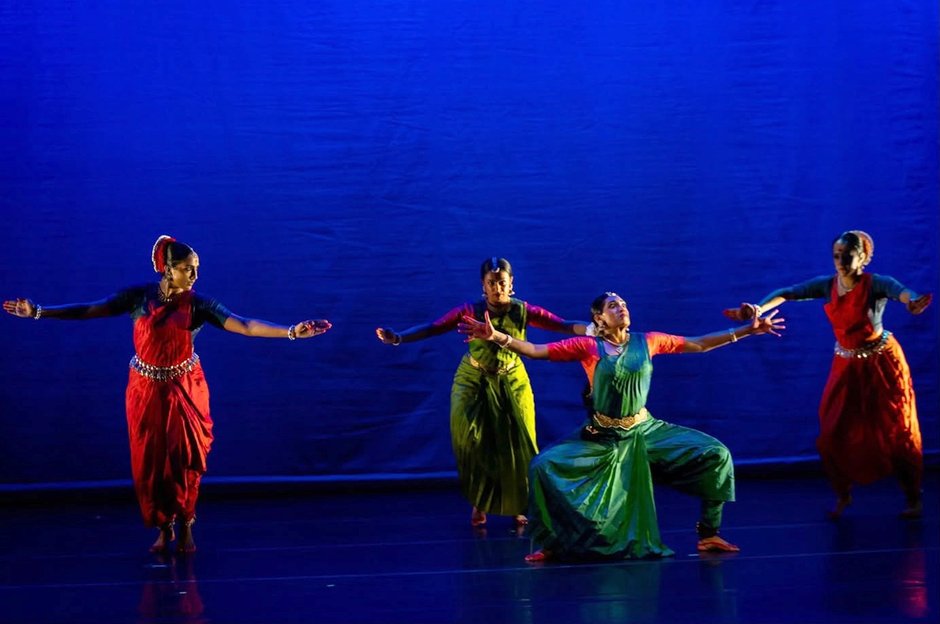 September 12, 2026 · Richard J. Ernst Community Cultural Center, Annandale, Virginia mitr, friends, a collaboration between Kalanidhi Dance and the Bijayini Satpathy Dance Collective, premiered on September 12, 2026, at the Richard J. Ernst Community Cultural Center. At its heart, mitr stages a friendship between two classical dance forms, Kuchipudi and Odissi, each shaped by a distinct tradition, yet both grounded in grace, precision, and a shared cultural inheritance. Four dancers of striking physical strength and control give expressive form to this conversation: Ariaki Dandawate and Malavika Singh from Odissi, and Mytreyi Nair and Pragnya Thamire from Kuchipudi. Across Kinkini, Kāvya-Sitāharan, and Nirgun, the articulation of the spine and hips makes the distinction immediately visible: Odissi's grounded chowka and defining tribhaṅgī find their counterpoint in Kuchipudi's more mobile ardhamaṇḍalī and buoyant utplavanas. The dancers retain the particular energy of each form while moving toward a shared emotional register. The opening work, Kinkini, is a nṛtta-centered tillana in raga Desh, composed by Sri. Lalgudi Jayaraman. Satpathy conceived the Hindustani-style flute prelude leading into the Carnatic tillana as a way of "bringing together the two traditions" through their musical sensibilities. Conceptually apt, the flute passage nevertheless feels overly extended. Once the tillana begins, however, the same Carnatic musical structure passes through two movement vocabularies, revealing the distinctive accents of Odissi and Kuchipudi. The pièce de résistance is Kāvya-Sitāharan, a work Satpathy received from her teacher, Protima Bedi, for her debut and later reworked. In transmitting it to a new generation, and through another dance form, she began to see the narrative as "a script for choreography for any style," capable of acquiring renewed life through different movement vocabularies. Even as the premise of the work is being announced, the four dancers offer a fleeting physical preview of the drama to come. From this evocative opening, the narrative gathers momentum as they move between the roles of Rama, Sita, Lakhmana, Marica, Ravana, and Jatayu. What gives the episode its force is the economy with which each moral and emotional position is established. Rama's regal authority is tempered by controlled anguish. Sita's alarm at hearing what she believes to be Rama's cry - an illusion created by Mārīca - gathers into an anguished insistence that Lakshmana go to him. Lakshmana, recognizing the deception, is caught between obedience to Rāma, responsibility toward Sītā, and the consequences of disregarding either. Fear, duty, suspicion, and foreknowledge pass through the ensemble as the dancers move between roles. The abduction unfolds as a chain of choices and consequences, rendered with remarkable clarity. The dramatic apex is the encounter between Ravana, played by Pragnya Thamire, and Jatayu, played by Ariaki Dandawate. Thamire gives Ravana a fierce, forward-driving aggression - the determination to possess at any cost - while Dandawate answers with an equally forceful physical and moral resistance. At this moment, the distinct vocabularies of Kuchipudi and Odissi cease to demand separate attention; both are placed entirely in the service of the drama. The episode closes with Jatayu lying mortally wounded, his severed wings suggested through the broken contours and convulsions of Dandawate's body. In Dandawate's upward gaze, Jatayu appears at once helpless and unvanquished. The heroic gives way to pathos, evoking karuṇa rasa in the audience. Satpathy's choreography moves intelligently within the capacious possibilities of both traditions. Her decision to temper Kuchipudi's characteristic speed and buoyancy allows it to enter the slower emotional arc of the choreography without surrendering its identity. That the two forms can inhabit a shared choreographic space without collapsing into one another speaks to Satpathy's scholarship, virtuosity, and understanding of movement from within the practice. 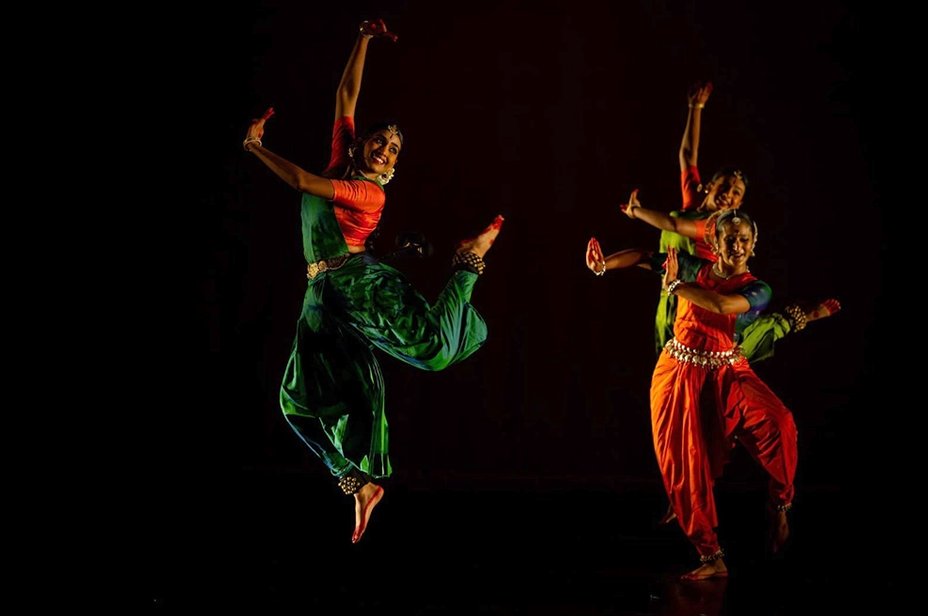 Photo: Shiva Sottalu / Courtesy of Kalanidhi Dance The production's visual atmosphere is further enriched by Deepa D, lighting design, realized with Carrie Kraemer as lighting technician, and Alexander Russell] as programmer. The personal and artistic histories of these works give the program emotional coherence, but they also explain why its center of gravity remains with Odissi. The compositions emerge primarily from Satpathy's own artistic archive, material she created, inherited, or lived through, with Kuchipudi invited to inhabit and transform it. A composition arising from the Kuchipudi repertoire might have made the exchange more fully reciprocal. The music similarly leaves unexplored some of the polyphonic and polyrhythmic possibilities inherent in both traditions. A more sustained layering of vocal literature (sāhitya) with percussive, non-lexical syllables might have allowed the musical structure to participate more fully in the conversation. The finale, Nirgun, draws upon the poetry of the mystic Kabir and Satpathy's personal attempt to understand her father's passing away. Moving beyond stories of gods and goddesses, it enters a more philosophical realm, asking how traditional gesture might express something "universally human" without depending upon familiar characters or narrative symbols. The four performers appear as wandering minstrels, carrying the work toward a conclusion that is both poignant and joy-filled. Here, death is approached not as an extinguishing, but as a release. The dancers move together with an ease that makes the ending feel like a homeward journey. Such ease, however, is hard won. Beneath every effortless transition lie years of exacting training: bodies disciplined into expressiveness, movement vocabularies absorbed until they become instinctive, and individual virtuosity refined into the more difficult art of listening - to the music, to the space, and to one another. Friendship, the work suggests, does not require difference to disappear. It asks each dancer to remain fully herself while becoming more attentive to the presence of another. mitr is more than an ode to friendship. It is a meditation on what becomes possible when kinship and distinction are allowed to coexist. At its finest, the production illuminates the singular beauty of Kuchipudi and Odissi while revealing the shared aesthetic ground upon which the two forms can meet while retaining their distinct identities, as companions in movement.  Anita Vallabh, Ph.D, is an author and the Founder and Editorial Curator of Global Indian Artist, based in Boston. |
