
|     |
|
| |

REVIEW / REPORTColourful bouquet of performances at the Bangalore International Centre- Satish Surie-mail: satishism@yahoo.co.in Photos: Prof .K.S.Krishnamurthy September 22, 2026 LOVE LANGUAGE "For immigrants, love is an indulgence." This spare, resonant line provides the point of departure for Preethi Ramaprasad's 'Love Language', a Bharatanatyam performance that engages with displacement, belonging and intimacy through the grammar of the classical form. Rather than treating Bharatanatyam as a fixed inheritance, Preethi Ramaprasad approaches it as a living language, one capable of articulating the particular complexities of lives lived between cultures. A disciple of Prof. Sudharani Raghupathy and a doctoral scholar of Critical Dance Studies at UC Riverside, Preethi Ramaprasad brings to the work both rigorous traditional training and an informed awareness of transnational experience. Love Language draws particularly on the architecture of the varnam, traditionally the most demanding and emotionally expansive section of a Bharatanatyam recital, while extending its familiar terrain of longing into the contemporary immigrant experience. If the classical nayika's yearning has conventionally been directed towards a human or divine beloved, here the idea of "home" itself becomes an object of longing, a place remembered, reconstructed and sometimes discovered in another person. 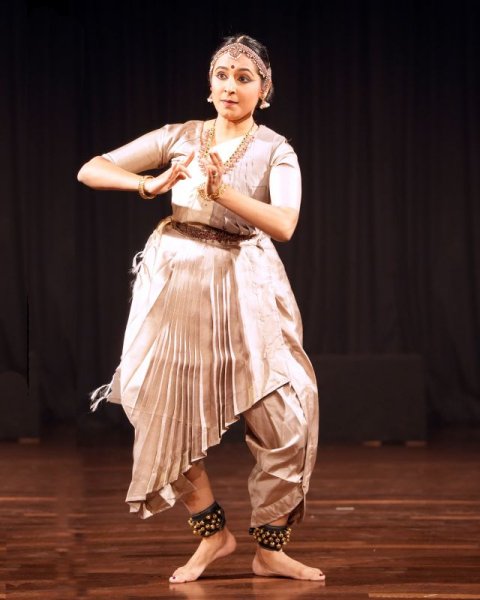 Preethi Ramaprasad Structured around the framework of a varnam, the work unfolds through memory rather than a strictly linear narrative. It begins with a woman boarding a train to work. A stranger's glance becomes the trigger for a cascade of recollections: an early encounter, the tentative beginnings of a relationship, the discovery of shared interests, the imagined and remembered intimacies of raising a child. Gradually, these fragments converge in a quieter realisation that solace and belonging may ultimately reside in the steady presence of a partner. The musical vocabulary mirrors this hybridity. Freddy Mercury and Queen appear alongside a Tamil varnam and a poem by Kabir, reflecting the layered cultural reality of Indian-American lives. Significantly, these disparate materials do not appear as decorative markers of multiculturalism. They are absorbed into the rhythmic and expressive language of Bharatanatyam. Preethi Ramaprasad moves with ease between the formal discipline of nritta and the more intimate, conversational register of abhinaya, finding expressive material in ordinary experiences: shared meals, borrowed interests, caring for a child, and the gradual transformation of another person's home into one's own. Preethi Ramaprasad's stage presence is centred and unforced. The clean geometry of her lines and the precision of her footwork reflect the rigour of the Tanjore tradition transmitted through her guru, while her abhinaya is marked by a contemporary restraint. Rather than relying on theatrical amplification, she allows small gestures to accumulate meaning. A moment of physical dependence, an exchange of familiarity, the quiet transmission of cultural habits, all become signs of an immigrant life in the process of making the unfamiliar intimate. In this context, the title assumes a broader significance. Love is not restricted to romantic attachment. It resides in the everyday gestures through which relationships are sustained: tucking a child into bed, offering a blanket against the cold, sharing an interest, or simply creating a space in which another person can feel at home. At its most expansive, love becomes the freedom to inhabit the world in one's own voice. The musical and compositional framework by Sruthi Sarathy supported the work effectively. S. Adityanarayanan's vocals, T.V. Sukanya's violin, Priya Murle's nattuvangam and Sarvesh Karthik's mridangam provided responsive accompaniment, maintaining the rhythmic and emotional architecture without competing with the dancer's narrative. Keerthi Kumar's lighting contributed unobtrusively to the shifts between memory, longing and intimacy. Supported by the Young Arts Fellowship and produced under the aegis of Shreya Nagarajan Singh Arts Development Consultancy (SNS), the presentation was marked by a clean and professional production aesthetic that kept attention on the central work. What ultimately distinguishes Love Language is its refusal to set tradition against innovation. Preethi Ramaprasad does not discard the varnam's structural rigour or the expressive vocabulary of sringara; instead, she relocates them. The emotional grammar remains recognisably Bharatanatyam even as the circumstances that generate its longing have changed. The performance concluded with a Q&A, an apt extension of a work that invites dialogue as much as contemplation. Love Language is not a radical rupture with the past, nor does it claim to be one. Its achievement lies in something subtler - a thoughtful and elegantly danced extension of the classical vocabulary into the emotional landscape of contemporary migration. In doing so, Preethi Ramaprasad demonstrates that tradition remains most vital when it is allowed to encounter lives that are still searching for a language of their own. AMRUTA PARANJAPE'S KATHAK RECITAL Amruta Paranjape, disciple of Shambhavi Dandekar and taal yogi Suresh Talwalkar, presented an engaging Kathak recital titled Through Rhythm and Storytelling at the Bangalore International Centre. The carefully structured evening moved through the varied dimensions of Kathak, from the intricacies of nritta and rhythmic virtuosity to nuanced abhinaya, silent dramatic enactment and the playful textures of devotional expression. What emerged was not merely a display of technical accomplishment, but a portrait of an artiste whose training was beginning to find a distinctive interpretive voice. The recital opened with a Ganesh Vandana, followed by Taal Dhamaal, "Sumirana Karo". Beginning with the understated movements of thaat, the presentation gradually gathered momentum through aamad, todas, parans, layakari and intricate tatkar. Amruta Paranjape's dancing was marked by clarity and precision. Her movements were crisp without becoming angular, while her footwork demonstrated a firm command of laya. There was an assured quality to her stage presence, allowing the rhythmic architecture of the choreography to unfold with both authority and refinement. The vocal support of V. Ramadasan and Nagesh Adgaonkar complemented the opening with melodic ease. The transition from nritta to abhinaya was particularly effective in Maharaj Bindadin's "Pragate Braj Nandalal", learnt from Shambhavi Dandekar and rendered with sensitivity by Ashwini Gokhale. The composition explored Krishna's appearance in Braj through the intertwined emotions of vatsalya and bhakti. Amruta Paranjape initially inhabited Yashoda's intimate world, evoking the tenderness of motherhood through restrained gestures, a gentle gaze and the imaginary rocking of a child. The emotional landscape gradually expanded from maternal affection into devotion, with the personal experience of love becoming increasingly universal. 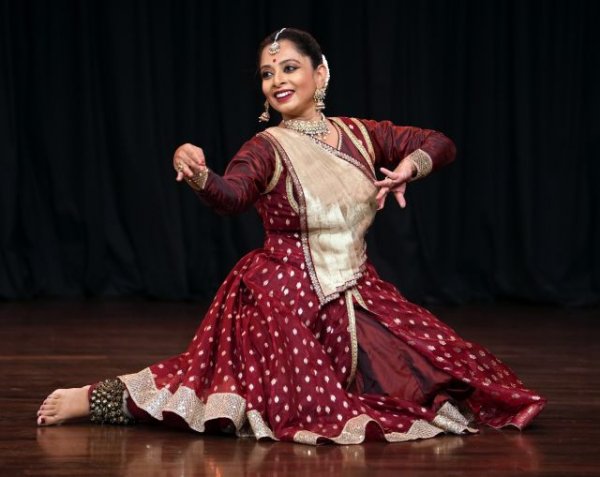 Amruta Paranjape The strength of this interpretation lay in its restraint. Amruta Paranjape avoided overstatement, allowing the eyes, facial expression and carefully calibrated gestures to carry the emotional progression. The two bhavas coexisted rather than competing for attention, eventually merging into a shared sense of wonder and devotion. This was among the most mature sections of the recital, revealing an artiste increasingly aware that abhinaya derives its power not from embellishment but from the ability to sustain an emotional state with conviction. The evening reached its dramatic high point with "Jatayu Moksha", a Gat Bhav drawn from the tradition of the legendary Kathak maestro Gopikrishna. Gat Bhav demands a different kind of theatrical discipline, as the narrative unfolds without spoken or sung words. The dancer must create characters, situations and dramatic transitions through the body, eyes, face and gestures alone. Amruta Paranjape met this challenge with considerable clarity. She moved between Ravana, Sita, Rama and Jatayu, distinguishing each character through subtle changes in physicality and expression. Ravana's deceptive mendicant persona carried an underlying menace, while Sita's innocence and trust were conveyed through softer, more open gestures. Rama's pursuit of the golden deer established the dramatic circumstances that led to the abduction. The narrative culminated in Jatayu's confrontation with Ravana, where Paranjape conveyed the vulture king's courage and diminishing strength through sharp, increasingly effortful movements. The final image of Jatayu receiving moksha in Rama's arms provided a moving close to the episode. The ability to sustain a complex narrative without verbal assistance was one of the evening's significant achievements. Amruta Paranjape's command of the Gopikrishna tradition was evident in the precision with which she shifted between characters and maintained the narrative thread. Here, storytelling became an extension of rhythmic and physical vocabulary rather than a separate theatrical device. A particularly distinctive feature of the recital was the Ninda Stuti, "Bade Bhole Mere Nath", a form less frequently encountered in Kathak presentations and more commonly associated with South Indian devotional traditions. Drawing inspiration from an earlier interpretation, Amruta Paranjape developed her own version around the affectionate, humorous exchange between Shiva and Parvati, to Chandanbala's composition and vocal rendering. The success of the piece lay in its delicate balance between teasing and devotion. Parvati's apparent complaints about Shiva were comic, but never irreverent. Amruta Paranjape handled the humour with assured timing, while retaining the underlying tenderness of the relationship. Her expressive ease was especially apparent here, as she moved between satire, romantic playfulness and bhakti without allowing one mood to overwhelm the others. The conclusion, in which the chant of "Om Namah Shivaya" ultimately drew Shiva back, provided the piece with a gentle touch of irony. It was an imaginative choice that allowed humour and devotion to coexist, while demonstrating the adaptability of Kathak's abhinaya vocabulary. The recital concluded with a Taraana in raag Bhairav, rendered by Vinay Ramadasan. After the narrative and emotional intensity of the preceding sections, the Taraana returned the focus to nritta. The brisk tatkar, intricate rhythmic passages and sustained energy brought the evening back to its strongest recurring element: Amruta Paranjape's command of rhythm. Even after a demanding programme, her footwork remained clean and articulate, while the solemnity of Bhairav provided an interesting counterpoint to the exuberance of the movement. Rhythm and Storytelling thus travelled through several registers of Kathak without losing its central rhythmic identity. Amruta Paranjape's training under Shambhavi Dandekar and Suresh Talwalkar was clearly visible in the discipline of her technique and rhythmic understanding, yet the recital also suggested the emergence of an individual artistic personality. It was this movement from accomplished student to increasingly self-assured artiste that gave the evening its particular significance. KUCHIPUDI YAKSHAGANAM At eighty-five, Guru Pasumarthi Rattaiah Sarma remains one of the few living custodians of Kuchipudi Yakshaganam, a theatrical tradition in which dance, music, abhinaya, spoken dialogue and the singing of padyams once formed an indivisible whole. A presentation by Kuchipudi dancer Aishwarya Meenakshi offered a rare glimpse into this repertoire through a selection of dharuvus, bringing to the contemporary stage, a form whose distinctive theatrical vocabulary has all but disappeared from regular performance practice. The evening commenced with "Tandava nritya kare", an invocation to Lord Ganesha in Mohanam. The opening adavus immediately established the character of the presentation. There was a refreshing absence of contemporary embellishment in the movement vocabulary, with the dance retaining a certain groundedness, directness and rhythmic economy characteristic of the older Kuchipudi idiom. The brisk footwork and clearly articulated rhythmic phrases possessed energy without becoming hurried, allowing the traditional grammar of the form to speak for itself. 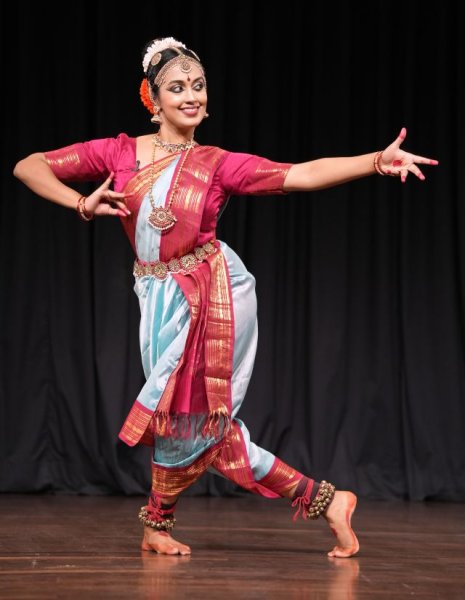 Aishwarya Meenakshi An excerpt from Prahlada Natakam followed, providing the evening's most substantial dramatic exploration. Aishwarya Meenakshi essayed both Hiranyakashipu and Prahlada, negotiating the transition between the two characters with commendable clarity. Her Hiranyakashipu was particularly vivid. The character's regal authority, elaborate adornment, arrogance and commanding presence were established through a series of sharply observed details. The grandeur of his court, the obeisance of his subjects and the atmosphere of royal power were conveyed with considerable theatrical verve. The scene acquired added authenticity with Guru Rattaiah Sarma himself appearing as the minister. His measured counsel to the king, reminding him that Prahlada was but a child who might still be persuaded, introduced an appealingly intimate conversational quality. When Prahlada was summoned to the sabha and entered singing the praises of Vishnu, the dramatic conflict sharpened immediately. The father's mounting anger and the child's unwavering devotion were delineated through a combination of movement, expression, song and speech. It was here that the significance of Yakshaganam as total theatre became most apparent. Aishwarya's use of vachika abhinaya was integral rather than ornamental. Spoken dialogue did not interrupt the dance; it was part of its dramatic language. The alternation between speech, song, mime and movement created a fluid theatrical continuum that is rarely encountered in contemporary classical dance recitals. The scene consequently offered more than an excerpt from a familiar mythological narrative; it revealed a performance structure in which the dancer was simultaneously actor, storyteller and dancer. The Pravesha Daruvu from Usha Parinayam shifted the mood from confrontation to intimate romantic wonder. Usha, daughter of Banasura, recalls the mysterious encounter with Aniruddha experienced in a dream and wonders whether someone has entered her presence. On discovering that no one has come, she gradually recognises the extraordinary nature of her experience, culminating in the evocative "Emi maaya chesi pothivo." Aishwarya brought considerable sensitivity to this Mugdha Nayika, allowing wonder, confusion, attraction and dawning realisation to succeed one another with quicksilver changes of expression. The subtlety of the portrayal lay in its refusal to overstate the emotions. The Madana Dharuvu from Bhamakalapam, set in Anandabhairavi, presented Satyabhama in the throes of separation from Krishna. Overcome by the arrows of Kamadeva, her emotional distress unfolded through an abhinaya that was intense without becoming melodramatic. The subsequent passage in Shanmukhapriya revealed another facet of Satyabhama, where longing was intertwined with pride and self-consciousness. As a Virahotkanthita Nayika, she remained vulnerable yet conscious of her own dignity. Aishwarya negotiated this emotional duality with restraint, giving the character both tenderness and authority. 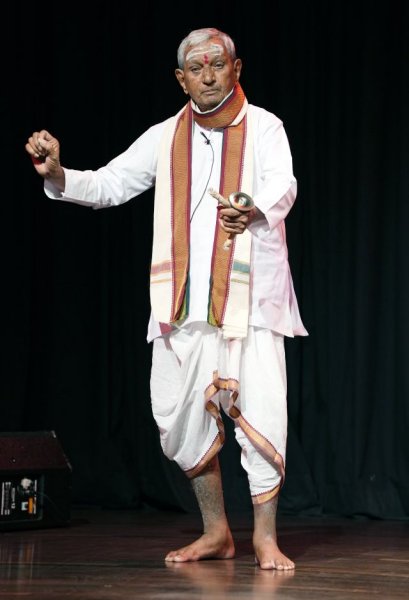 Guru Rattaiah Sarma The concluding Lekha from Bhamakalapam, brought the evening to an especially evocative close. Satyabhama, unable to bear her separation from Krishna, turns to her sakhi Madhavi portrayed by Guru Rattaiah Sarma, and asks her to write a letter to her beloved. What unfolds is not merely a message to Krishna but an emotional recollection of a shared past. Satyabhama recalls her marriage, the adornments and jewellery given to her by her father, and the moments of happiness she and Krishna once shared. Having lingered over these memories, she is brought back to the painful present, marked by solitude and the torment of Kamadeva. The emotional movement of the Dharuvu was finely graded. From reminiscence and tenderness, Satyabhama gradually arrives at vulnerability, asking Krishna's forgiveness and finally signing the letter with the deeply personal words, "Nee Prana Sakhi" - your beloved companion. She then asks Madhavi to ascertain an auspicious time and deliver the letter to her Lord Krishna. The scene drew much of its effectiveness from Aishwarya's command of vachika abhinaya. Her clear diction and fluent delivery in chaste Telugu gave the spoken passages an immediacy and charm, while ensuring that the poetry retained its dramatic force. The dialogue felt natural within the movement, reaffirming how organically speech belonged to the older Yakshaganam tradition. Throughout the performance, Guru Rattaiah Sarma's nattuvangam formed its rhythmic backbone. His intervention was not merely accompanimental but carried the authority of a practitioner deeply immersed in the tradition. His participation as Madhavi in Lekha added another dimension to the guru's role: he was at once custodian, performer and transmitter of the very tradition being presented. At eighty-five, his presence on stage lent the evening a significance that extended beyond the performance itself. The accompanying musicians contributed with equal sensitivity. Ajeesh Menon on vocals, Sreerang Kalamandalam on mridangam, Srikrishna Bhat on flute and Arjun MD on violin created a cohesive musical environment that supported the dance, dialogue and dramatic action without competing with them. Their sensitive accompaniment helped sustain the seamless relationship between music and theatre that is central to the Yakshaganam aesthetic. What distinguished Aishwarya Meenakshi's presentation was her decision to approach the repertoire with fidelity rather than reinterpretation. She did not attempt to modernise the movement vocabulary or smooth away the distinctive theatrical conventions of the older Yakshaganam tradition. Instead, she allowed its pacing, dramaturgy, diction and expressive logic to remain intact. Her assured vachika, expressive abhinaya and rhythmic clarity demonstrated that this older vocabulary could still communicate directly when approached with knowledge and conviction. The evening consequently acquired the quality of a transmission across generations. Guru Rattaiah Sarma embodied a living memory of Kuchipudi Yakshaganam, while Aishwarya Meenakshi demonstrated the sensitivity and discipline required to carry that memory forward. A Mangalam brought the proceedings to a close, after which the audience rose in a standing ovation. The response was fitting for an evening that had been as much an act of preservation as a performance. In the presence of Guru Pasumarthi Rattaiah Sarma and through the committed work of Aishwarya Meenakshi, the old flame of Kuchipudi Yakshaganam was not merely remembered. For one evening, it burned brightly again. 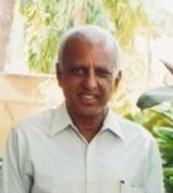 Bangalore based Satish Suri is an avid dance rasika besides being a life member of the Music and Arts Society. |
