
|     |
|
| |

REVIEW / REPORTThe emergence of warrior princess Rajendranandini- Vijay Shankere-mail: vijaydance@gmail.com Photos: Rudra Mandal Milon Manch September 19, 2026 Shahana, Tagore Centre for Indian Music and Culture, celebrated the 51st foundation day with the grand finale of golden jubilee programme with Alokdhara - a composite Rabindrasangeet concert themed on the Divine Feminine with singers Palashi Ghosh, Shramana Chattopadhyay and Megh, presentation of dance drama 'Rajendranandini' (the warrior princess) based on Tagore's play and poem Chitrangada, at the Veer Savarkar auditorium, Mumbai on 29th August. After the inaugural music and dance by the students of Shahana, dance drama Rajendranandini was presented, a slightly extended version of the play which was presented last year at the NCPA Experimental theatre. Based on Tagore's Chitrangada, Rajendranandini portrays the story of the warrior princess, a powerful exploration of identity, love, gender and self acceptance. As warrior princess 'Kurupa', she encounters Arjuna, she proposes but is rejected when Arjuna says, "Shama Karo, Ami Brahmachari" (please excuse me, am a bachelor). Kurupa is distressed and prays to the Almighty to be transformed as Surupa, a beautiful maiden. She meets Arjuna again and he falls in love with her but later there is news of a forthcoming war, she rushes back to her kingdom as she realises that her primary duty as a warrior princess is more important. The transformation brings her face to face with a deeper question; is love founded on an idealised image of beauty or on the recognition of the whole person? Through Tagore's poetry, music, movement and drama, with dialogues in Bengali and narration in English, Rajendranandini traces her struggle from strength and femineity as she says, "Ami Rajendranandini" (I am Rajendranandini), taking her on a journey of appearance, identity, desire and authenticity. Ultimately, she rejects the false persona she created and chooses to reveal herself as the warrior princess. The production celebrates Tagore's vision of equality, dignity and freedom to be fully oneself - a message that remains remarkably relevant today. 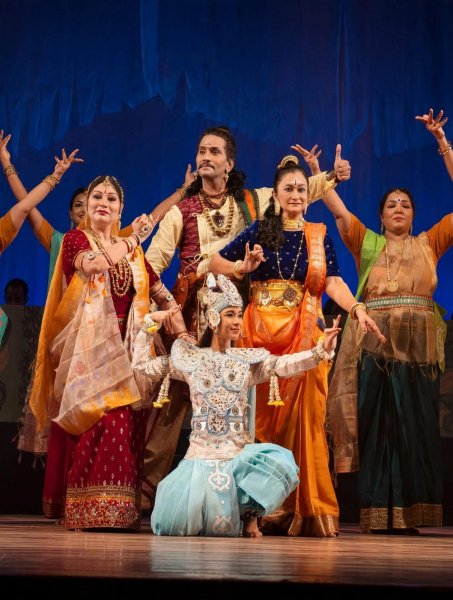
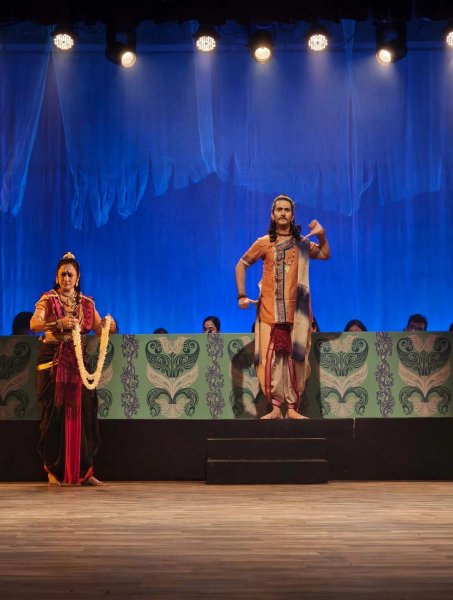
Scripted by Upamanyu Bhattacharya, the role of the warrior princess Kurupa was played by Anusree Bonnerjee, Bharatanatyam exponent and the choreographer of the dance drama. The role of Surupa was enacted by Purbita Mukherjee and the lead role of Arjuna was played by Bharatanatyam exponent Anil Kumar Singh. The role of Madan was played by Triya Bannerjee. Anil Kumar Singh gets better mileage as he appears twice with Kurupa and Surupa, as he danced and played his parts quite well. The scene when Surupa appears and Kurupa disappears was well portrayed as drapes of clothes were drifting from one side to another, hence the appearance and disappearance of the lead actors were cleverly handled. The earlier scene when Arjuna is seen meditating, could have been a better visual, but the sight of the musicians who were seated behind, disturbed the dramatic quality of the particular scene. On the whole, it was quite an enjoyable show, combining elements of dance and drama, movements of Bharatanatyam, Manipuri and Kathakali, besides creative movements, simultaneously with melodious music and dramatic narratives that enhanced the story telling aspect of the performance. A fight sequence or preparation of the war could have enhanced the martial aspect of the warrior princess. The singers of the production were Sanjukta Ghosh Maity, Minakshi Lahiri, Urmimala Roy Chowdhury, Dr Trisha Sen, Arup Chowdhury, Sayantan Ray and Sudipta Nandi. The dialogues renditions were by Paromita Sarkar, Sharmila Goswami and Upamanyu Bhattacharya.  Vijay Shankar is a Kuchipudi and Kathakali exponent, teacher, bilingual journalist, arts critic and actor. |
