
|     |
|
| |

REVIEW / REPORTThe 32nd Guru Kelucharan Mohapatra Award Festival- Tapati Chowdhuriee-mail: tapatichow@yahoo.co.in Photos: Manas Babu and Debjyoti Dhar September 12, 2026 The 32nd Guru Kelucharan Mohapatra (GKCM) Award Festival, organised by Srjan - Guru Kelucharan Mohapatra Odissi Nrityabasa in collaboration with Sri Sri University (SSU), Cuttack, launched its highly appreciated and impressive show at Rabindra Mandap on 5th September. The five-day cultural extravaganza, scheduled from September 5-9 at 7 pm daily, featured a stellar line-up of classical music, dance, and theatre performances. This year's edition of this premier classical event in the cultural calendar of Odisha coincides with the commemoration of the birth centenary year celebrations of revered Guru Kelucharan Mohapatra. The inaugural evening witnessed a befitting opening with the celebrated Hindustani vocalist and music luminary Shubha Mudgal captivating the Bhubaneswar audience with her melodic presentation. 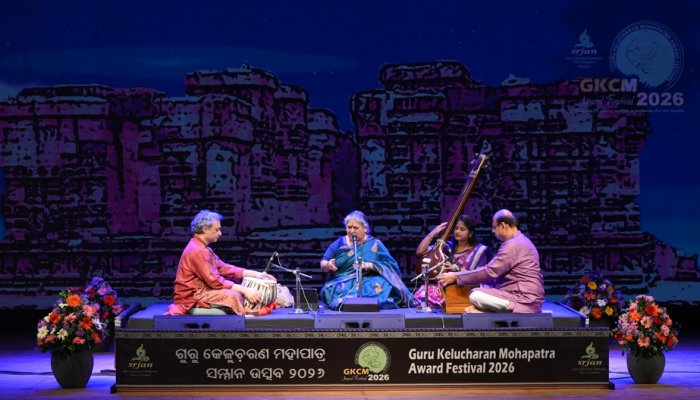 Shubha Mudgal and ensemble Mudgal began her soiree with two compositions in the beautiful and melodious raag Bageshri, which is deeply expressive and romantic and is usually sung late at night. The first was a composition that centred around the birth of Lord Krishna in Vilambit laya set to Rupak taal. The lyrics "Mangal gao mai aaj lal ko janm dyosai, baajat rang badhaai," sung sonorously, spread a devotional mood in the halls of Rabindra Mandap. She then presented a composition in Madhya laya set to Teen Taal, a composition of her Guru Pt. Ramashreya Jha, "Ramrang," "Khelan mangat chaand kanhayi," which resonated with the devotional spirit of Krishna Janmashtami and the aura of the intricacies of raag Bageshri. The graceful rendition of a mature artist was devoured with relish in a hall filled with rasikas. Widely recognized as one of India's leading classical vocalists, she then rendered a beautiful and soulful composition in raag Gaur Malhar, evoking deep monsoon imagery, the effect of which was not lost on the audience. The presentation of Hindustani vocal euphony was rendered with deep musical imagination and stylistic nuance. She was accompanied by Aneesh Pradhan on the tabla, while Sudhir Nayak played the harmonium. Nilima Pradhan was on the tanpura. Nitin Joshi provided technical support as her chief sound engineer. She provided a befitting inauguration to the festival. 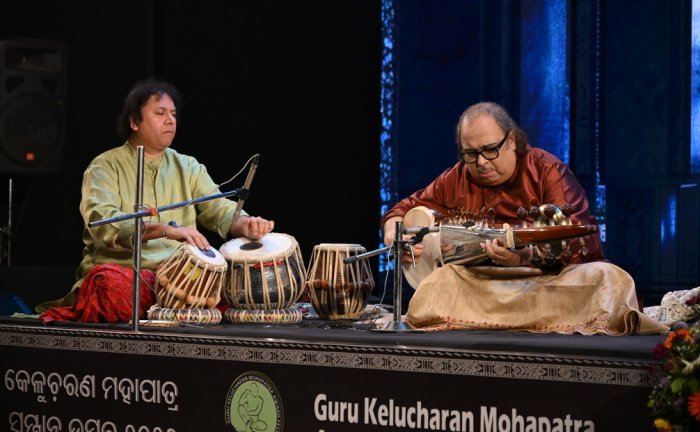 Pt. Tejendra Narayan Majumdar Sarod recital by Pt. Tejendra Narayan Majumdar, accompanied by Satyajit Talwalkar on tabla, followed by a solo Odissi recital by Lipsa Satapathy, was the offering on the second day of the festival. Trained in the Senia Maihar Gharana, Pt. Tejendra Narayan Majumdar, who is famed for his Dhrupad, Tantrakari, and Gayaki styles in his music, began his recital with the serene evening melody, raag Shuddha Kalyan, that is typically performed during the first prahar, between 6 and 9 pm. This peaceful, devotional, and deeply contemplative raga evoked a tranquil inner stillness as dusk fell across the Bhubaneswar skies. It was a blissful time as I sat in the second row of Rabindra Mandap with my eyes closed, listening to the Alap, Jor, and Jhala. A sweet feeling of peace and tranquility descended on my senses. I was transported to my comforting zone and could hear the sweet and soft notes of the Rabindra Sangeet "Madhuro dhwani baje hridaya kamalo majhe." Tejendra Narayan uniquely made use of subtle gliding transitions. Befitting the word Kalyan, which means good fortune, it literally unfolded an evening of good fortune. As the evening progressed, the strumming of the sarod journeyed through intricate taans from his treasure chest, springing one surprise after another, before going into a sawal-jawab session with the percussionist to end with a rich, dramatic finale, only to be met with tumultuous claps from the audience. Time flew in the wink of an eye. The sarod maestro engaged the audience with his meditative and architecturally precise performance, ably accompanied by the vibrant rhythmic support of Satyajit Talwalkar on the tabla. The powerful yet meditative sound of his sarod playing was complemented in perfect synergy with the cadence of the tabla's rhythmic notes, as Satyajit Talwalkar also captivated the audience with his flawless technical precision, dynamic energy, and profound musicality. 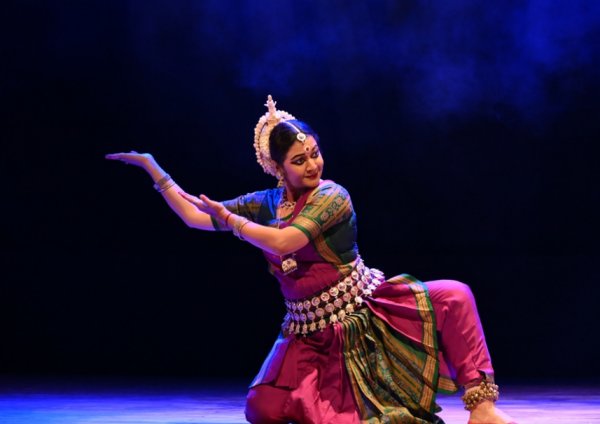 Lipsa Satpathy The second half of the evening shifted to Odissi dance, showcasing the artistry, vitality, and elegance of acclaimed Odissi dancer Lipsa Satpathy. Her performance opened with Pancha Bhuta, a grand and evocative production that beautifully depicts the five cosmic elements - Earth (Prithvi), Water (Jal), Fire (Agni), Air (Vayu), and Sky (Akash) - through sinuous dance movements and yogic postures. Set to Ragamalika and Talamalika, this piece is a choreography of Guru Aruna Mohanty, composed to music by Guru Ramahari Das and Sumanta Kumar Mohanty, and set to the rhythm composition of Guru Dhaneswar Swain. She then proceeded to perform Debagandhari Pallavi, a pure dance piece with intricate footwork, rhythmic speed, and graceful body movements, choreographed by Guru Bichitrananda Swain and set to the music composition of Guru Ramahari Das and rhythm composition of Guru Dhaneswar Swain. The presentation concluded with "Kahibaku laja," an evocative Odia abhinaya authored by Kabisurya Baladeba Rath. This emotive piece subtly portrayed Radha's shy, tender nostalgia after Krishna fondly embraces her, enchanted by her heartfelt veena performance. It was choreographed by Guru Aruna Mohanty to the soulful music composition of Suramani Ramesh Chandra Das and rhythm composition of Guru Gangadhar Pradhan. Lipsa Satpathy brought refined performance vocabulary and depth to the stage of Rabindra Mandap. She was supported beautifully by an ensemble of musicians with Rupak Kumar Parida on vocals, Agnimitra Behera on the violin, Soumya Ranjan Joshi on the flute, Sitakant Jena on the mardala, and Rohita Pradhan on the manjira. The third day of the GKCM Award Festival marked a historical milestone with Odisha's first-ever Marganatya performance - Saugandhikaharanam, a choreographed Sanskrit play presented by Chidakash Kalalay-Centre of Art and Divinity at Rabindra Mandap. The festival continued its heartfelt celebration of the classical arts with this revitalization of the ancient Marga tradition of Natya from Bharata Muni's Natyashastra. The production was based on the Nata-Dharma Parampara and directed by Piyal Bhattacharya, renowned for reconstructing ancient instruments like the Vakra Veena and Sage Bharata's Kutapa orchestra. Live music was composed by Sayak Mitra. Saugandhikaharanam unfolded Bhima's quest for the celestial Saugandhika flowers to fulfil Draupadi's desire. As Bhima's unchecked strength disrupts the sacred Gandhamadana forest, Hanuman intervenes as an aged monkey, humbling Bhima's pride through wit, wisdom, and the manifestation of his awe-inspiring Vishwarupa. Blessed by Hanuman and permitted by Kubera, Bhima returns with Saugandhika flowers as a transformed individual, having learned restraint, humility, and true strength. While the Pandavas reside near Mandaraparvata, a celestial flower of exquisite and otherworldly fragrance is carried by Vayu and falls into Draupadi's hands. Enchanted by its divine aroma, Draupadi expresses her longing to possess more such flowers, and, moved by her desire, Bhima sets out to seek their source. Bhima follows a relentless swarm of honeybees flying unwaveringly in one direction and absorbed in pursuit and intoxicated by purpose, becomes unaware of his surroundings. His immense strength unconsciously devastates the forest paths and mountain terrain, striking fear into the beings who inhabit them. Gradually, he arrives at the sacred Gandhamadana forest - an ethereal realm inhabited by apsaras and kiṁnaras, and the seat of Kubera, whose holy sarovara is the birthplace of the Saugandhika flowers. This land, forbidden to mortals, is protected by divine decree. 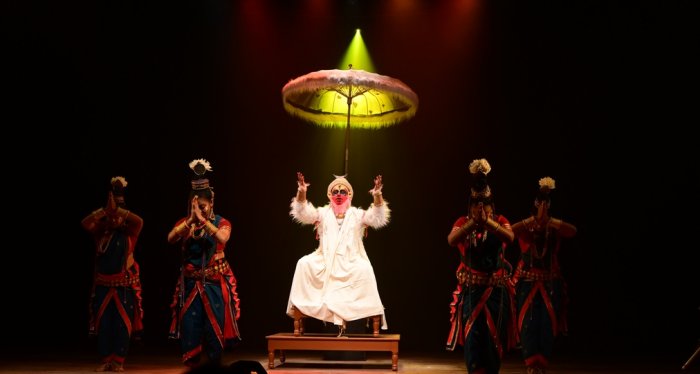 Saugandhikaharanam - Hanuman & the Saugandhika flowers Saugandhikaharaṇam commenced with a beautiful maṅgalacharaṇa addressed to the Yakṣaraja Ghaṇṭakarṇa. The maṅgalacharaṇa, an important vidhi in classical Asian dramatic performance as well as in literary works, invokes auspiciousness and seeks the blessings of an infinite, unseen energy for both performers and spectators. The choice of this invocation is significant. According to the Mahabharata, when the Paṇḍavas reached Mandara Parvata, Vaisampayana Muni warned them that the region was inhabited by Yakṣas and Kinnaras who worshipped the Yakṣa Maṇibhadra Ghaṇṭakarṇa. Piyal Bhattacharya drew the spectator towards this Vyasian textual reference by beginning his rendition of Saugandhikaharaṇam with an invocation to Maṇibhadra Yakṣa. This departure from the original text is deliberate and dramaturgically meaningful. While Vishvanatha Kaviraja, the author of the fourteenth-century Prekṣaṇaka, begins his work with an invocation to Sarasvatī, Bhattacharya's staging places greater emphasis on the material and dramatic world of Mandara Parvata - a forest inhabited by Yakṣas and Kinnaras, whose presence is integral to the theatrical unfolding. Within this larger dramaturgical framework, the encounter between Bhīma and Hanuman assumes particular importance. Hanuman functions as a protector, but not as a gentle or reassuring guide. He repeatedly provokes Bhīma, confronting and attacking his pride until his arrogance reaches an almost absurd intensity. Unaware of Hanuman's true identity, Bhīma challenges him, only to encounter the limits of his own strength. The encounter gradually exposes the futility of power when it remains unaccompanied by awareness. Maṇibhadra, therefore, is not merely a protective presence. He is also associated with the dispelling of afflictions, both material and transcendental, and with the granting of realization. Seen in this light, Bhattacharya's departure from the original literary invocation becomes dramaturgically justified. The bīja, or root impulse, of this presentation is not merely Bhīma's pursuit of the Saugandhika flower. Beneath that external journey lies an inward journey: the transformation of human Bhīma through his encounter with Hanuman, whose austere and uncompromising guardianship compels him to confront the limits of his own power and arrive at realization. Residing in this forest since the Treta Yuga is Hanuman, now an ascetic-seer. Perceiving the impending imbalance caused by Bhima's unchecked force, Hanuman intervenes, disguising himself as a frail, aged monkey lying across Bhima's path. Through subtle wit, layered puns, and measured restraint, Hanuman unfolds the deeper dimensions of dharma - revealing the limits of brute strength when unaccompanied by humility and awareness. When Bhima insists on proceeding, Hanuman calmly asks him to move his tail aside; despite all his might, Bhima fails to shift it even an inch. Realization dawns - this is no ordinary being - and with reverence and surrender, Bhima seeks forgiveness and requests the monkey to reveal his true form. Hanuman manifests his divine identity and, at Bhima's request, unveils his awe-inspiring Vishwarupa, humbling Bhima completely. Blessing him, Hanuman grants him the necessary vidya and permission to approach Kubera's realm. 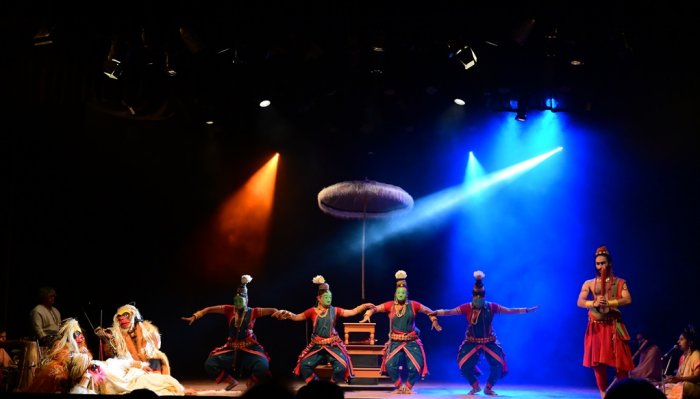 Saugandhikaharaṇam - Bhima being tested by Hanuman At the sarovara, Bhima is confronted by the apsaras guarding the flowers. A fierce encounter ensues, but before destruction unfolds, Kubera himself appears. Recognizing Bhima's devotion and the righteousness of his intent, Kubera grants him the celestial flowers personally. Bhima returns - transformed not merely as a bearer of divine blooms, but as one who has learned restraint, reverence, and the true measure of strength. The mask used in the presentation by Saugandhikapushpa and the Kinnaris is significant precisely because it exists at the threshold between the inanimate and the animate. The moment it is inhabited by the performer, it acquires animation. The performer does not merely wear the mask; through the body, breath, gaze, movement, and intention, the mask becomes a living presence. The mask therefore enacts a transition within itself - it moves from the objective to the subjective. This transition fundamentally alters the relationship between performer and prekṣaka (the audience). This is particularly evident in Saugandhikaharaṇam. The Saugandhika flower, performed by the young and promising Nikhil Bora, and the Apsaras/Kinnarīs, performed with experience and grace by Srijan Biswas, Amrita Adhikary, Smriti Majumder, and Moumita Dhar, appear through specially created masks. These masks, designed by Mriganka Mouli Sen under the guidance of Acharya Piyal Bhattacharya, do much more than establish the external identity of the characters. They transform them into perceptual subjects and thereby contribute directly to the dramatic architecture of the performance. The Saugandhika and the Kinnarīs consequently become significant presences within the dramatic field. They elevate and ornament the dramatic tension between Bhīma, performed by the young Inderpal Singh, and Hanuman, played by Sayak Mitra. Inderpal's gradual blossoming as an actor is itself a pleasure to observe alongside his performance in this prekṣaṇaka. Sayak Mitra, of course, requires little introduction; his recent recognition with the Bismillah Khan Yuva Puraskar has further affirmed his place within the country's cultural landscape. For the ninety minutes of the performance, the mask becomes more than a theatrical device. It becomes a threshold through which the material moves towards the subjective, through which the visible begins to suggest the invisible. In Saugandhikaharaṇam, this use of the mask is therefore not merely an aesthetic embellishment but a fundamental dramaturgical intervention. It makes the space subjective, intensifies the awareness of atmosphere, redirects the gaze of the prekṣaka, and creates the possibility of moving, however temporarily, beyond ordinary material consciousness. This was truly a masterstroke by Piyal Bhattacharya. Kubera and Young Monkey - Subhendu Ghosh, while Apsara and Young Monkey was Amrita Dutta. Saugandhikapushpa Nikhil Bora; Apsaras Amrita Adhikary, Srijani Biswas, Moumita Dhar, Smriti Majumder were commendable. They were supported by the Kutapa orchestra comprising Piyal Bhattacharya on Mizhavu (percussion), Durba Sinha Roychowdhury as the Gayika (vocalist), Koushik Das on the Maardangik or mridangam (percussion), Rick Mukherjee on Susheera Vadya (flute), Avijit Ray on Tataha Vadya (Dhrupadi Rabab), Khokan Das on the Pataha (Dholak), Sougato Murmu, Shubhendu Ghosh, and Rudrarup Mukhopadhyaya as the Taal Dharaka. Lighting for the performance was designed and executed by Dinesh Poddar (Prakasha), with Subhash Das assisting (Sahakari). The production was based on the 14th-century Rupaka by Vishwanatha Kaviraja, with Hindi poetry (Kavita) by Raj Bendre, under the overall direction (Nirdeshaka) of Acharya Piyal Bhattacharya. The presentation stood out with its attention to detail, from the use of classical languages and symbolic stage props to the ancient Kutapa orchestra. The performers commanded the stage with charisma and presence while delivering nuanced portrayals of their respective characters. Chidakash Kalalay's actor-centric performance transformed the stage of Rabindra Mandap, integrating nritta, geeta, vadya, and abhinaya to offer the audience a unique sensory experience with a deep spiritual ethos. 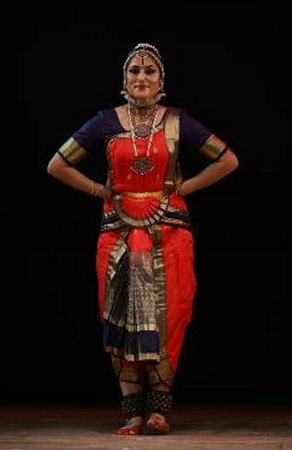 Janaki Rangarajan Rasikas at Rabindra Mandap witnessed an engaging evening of Bharatanrityam, as envisaged by its maker Padma Subrahmanyam, on the penultimate day of the festival. Janaki Rangarajan performed Maharaja Swati Tirunal's Pada Varnam "Sami ninne nammitira" in ragam Yadukulakambhoji set to adi talam. Portraying a viraha utkanthita nayika longing for Lord Padmanabha, the emotive depth in her depiction of separation was remarkable. She did not pity her condition; rather, she delved deep to offer her mortal soul to the supernatural, pleading with Padmanabhaswamy to show her his divine compassion and take her under his protection because cupid's arrows had left her bewildered. Bhakti Sringar to match this famous composition of Swati Tirunal was rather challenging. Bharatanrityam represents a contemporary evolution of dance pedagogy rooted in Bharata's Natya Sastra, integrating textual traditions and local practices to create a new marga. A student of such a teacher of 15 years' standing could have done no less than by acknowledging her roots. She was supported by the able and harmonious Carnatic music ensemble comprising Shilpa Gopalakrishnan on vocals, TV Sukanya on the violin, K Sarvesh on the mridangam, and S Vijay Kumar on the nattuvangam. Her performance was further aided by the befitting and creative light design of Debiprasad Mishra. 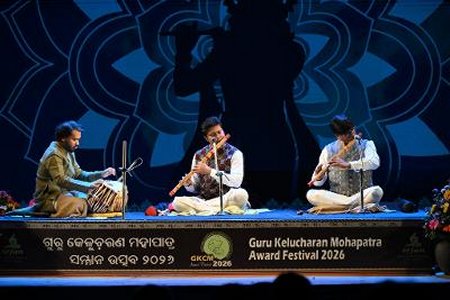 Flute duet - Abhiram Nanda and Srinibas Satapathy The second half shifted to a captivating Flute Jugalbandi (duet) featuring two of Odisha's finest flautists, Abhiram Nanda and Srinibas Satapathy. Nanda, a disciple of Pt. Hariprasad Chaurasia, brought his characteristic tonal warmth and rhythmic poise to the stage, while Satapathy effortlessly showcased his melodic subtlety and vitality. They commenced their duet with a composition in raag Madhuvanti, set to Rupak taal of seven beats. They then moved on to present Madhyalaya in Teen Taal and Dhrut Teen Taal. Their playing styles brought out the enigmatic charm of the melody, balancing deep meditative expression with technical prowess. This was followed by renditions in Pahadi Dhun in Dadra and Keherwa Taal, beginning with a tranquil, lilting sentiment and subsequently elevating the energy to a lively, rhythmic climax. They played in tandem, blending warm, majestic resonance with delicate, expressive notes in acoustic harmony. Their jugalbandi was complemented by the dynamic percussion play of young tabla prodigy Yashwant Vaishnav as he matched the flautists' intricate melodies with crisp rhythmic vitality. It was a challenge faced bravely by the flautists because of the presence in the audience of the greatest among flautists, Pt Hariprasad Chaurasia. 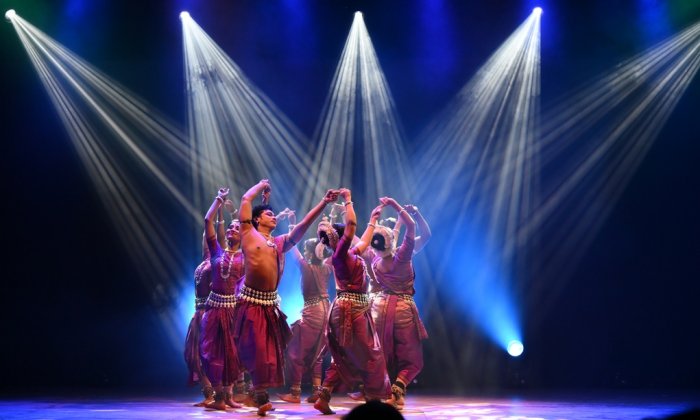 Mati by Srjan ensemble A repeat performance of Mati, presented in its 32nd edition as aficionados and lovers of Odissi observed the centenary of Guru Kelucharan Mohapatra, sprang many surprises. The production possessed a freshness befitting, perhaps, Gen Z, who have little time to divert their attention from their smartphones; their entertainment is dominated largely by digital technology and social networks. The far-sighted choreographer Guru Ratikant Mohapatra presented his repertory members to the audience through this new work. His experimental production, which has established a new artistic vocabulary, introduced movements to translate Radhamohan Gadanayak's poem Mati, a celebration of the eternal resilience of Mother Earth. The verses were translated literally into dance movements that appeared easy to follow, with quick transitions to recurring choreographic phrases designed to hold the attention of an audience whose attention span is often considered to have shortened. The production was both neat and brief. Choreographer Ratikant Mohapatra is a precursor of this new style. The music was composed by Laxmikant Palit, and the script was by Jayadev Das. The dancers - Rajashree Praharaj, Aishwariya Singhdev, Preetisha Mohapatra, Madhavi Rout, Diana Ghosh, Pallishree Priyadarshini, G. Sanjay, and Rajkumar Kar - performed with remarkable precision. The musicians too were outstanding. The storyline received a contemporary interpretation. Mati or Earth, was personified as an elevated and emancipated soul - desireless and ready to assume, with a smile, the mantle bestowed upon her by the Almighty. Drama, music, and pure dance were inseparably interwoven. The movements, rehearsed to perfection, were sharp and knife edged. The work was innovative and thoughtfully designed. Lighting was by Debiprasad Mishra.  Tapati Chowdhurie trained under Guru Gopinath in Madras and was briefly with International Centre for Kathakali in New Delhi. Presently, she is a freelance writer on the performing arts. She is the author of 'Guru Gopinath: The Making of a Legend.' Tapati received the Sangeet Natak Akademi Award for 2024 for Art Critique in Performing Arts. |
