
|     |
|
| |

REVIEW / REPORTNrityajog Festival 2026: A luminous homage to classical tradition- Satish Surie-mail: satishism@yahoo.co.in Photos: Kavita Kavya September 11, 2026 Bangalore's classical dance calendar received a refined and resonant addition with Nrityajog Festival 2026, organised by Sanjog Academy of Performing Arts and curated by Kathak exponent Guru Amartyya Chatterjee Ghosh. The evening unfolded as a thoughtfully curated dialogue between two great classical streams, Lucknow Gharana Kathak and Odissi, each revealing its distinctive aesthetic while sharing a common reverence for tradition, rhythm and expressive depth. 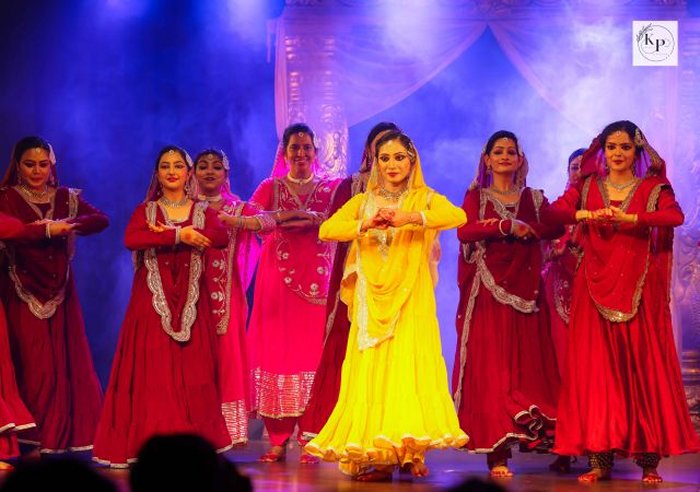 Amartyya Chatterjee Ghosh and dancers The thematic production "Ada e Lucknow" formed the heart of the Kathak presentation. Amartyya, a well-known name of today's generation and a disciple of both Santosh Chatterjee and the late Pandit Birju Maharaj of the Lucknow Gharana, held the beauty of Lucknow Gharana Kathak with quiet aesthetic authority. She chose the theme "Darbar ke Andaz," building the production around raag Darbari music compositions by Pandit Birju Maharaj. Old tarana bandishes were carefully selected and stitched into a seamless blend of Kathak gestures, graceful footwork and rhythmic complexity, translating the elegance of the Lucknow andaaz into a living dance pedagogy for the Bangalore audience. Particularly memorable was the treatment of "Payaliya jhankar tori" in raag Darbari, set to the expansive cycle of Taal Dhamar (14 beats). The composition became a showcase for the beautiful transfer of the ancient Mughal period sensibility, rich with intricate rhythmic compositions of tihai, paran and spins. The Sanjog Dancers, under Amartyya's direction, executed these structures with precision and unhurried grace, allowing the soft yet assertive footwork, lyrical arm movements and the subtle play of angik and vachik abhinaya to reveal the authenticity of the Lucknow style. The payal imagery was rendered not merely as ornament but as an extension of the dancer's own rhythmic voice, bringing the courtly atmosphere vividly to life. 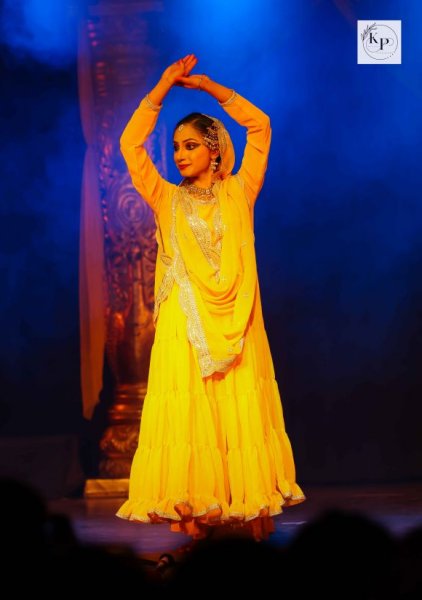 Amartyya Chatterjee Ghosh Amartyya herself delivered a finely calibrated abhinaya piece on "Maan jao more piya," again in raag Darbari. Portraying a nayika who could no longer tolerate the teasing of her nayaka and who tries to request him to stop this behaviour in front of others, she navigated the delicate emotional territory between wounded dignity and quiet plea. The restraint in her facial expressions and the measured unfolding of the sanchari sequences revealed a mature command of the Lucknow school's characteristic understatement, where less is often more, and the eyes speak volumes. The live musical ensemble provided an equally sensitive foundation. Sagar Bhartraj on tabla, Manasa Shastry on vocals, and padanth, Subhramanya Hegde on sitar and Soorya Upadhya on harmonium worked in seamless dialogue with the dancers. Their interplay was never overpowering; instead, it created an intimate acoustic space in which the bols, tarana syllables and melodic phrases of raag Darbari could breathe fully. 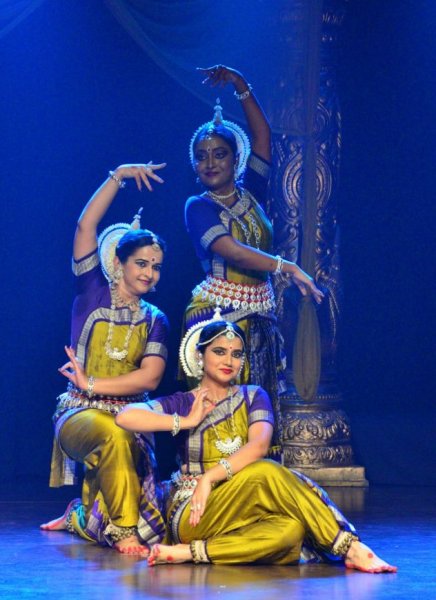 Yasomati Mishra and dancers A luminous counterpoint arrived with the Odissi segment presented by Guru Yasomati Mishra and her students. The evening opened with the Shiv Panchakshara Stotram, a prayer that praises Lord Shiva's beauty, power and supremacy as the destroyer of evil and upholder of righteousness, the one who drinks the poison born of the world's sins. One who recites the Panchakshara hymn in praise of the Lord, Na Ma Shi Va Ya, can hear the auspicious name every time, everywhere. Set in raag Mishra Bhairagi and taal Khempta, the composition was offered by Debanshi Mohanty, Jnyaneesha Dey, Aavya Behera, Sahana Prashant, Dyumna Mohanty and Sai Stubya. The young dancers approached the sacred text with sincerity and collective focus, allowing the auspicious syllables to resonate through measured movement and shared devotion. This was followed by a Pallavi in raag Hamsadhwani and taal Ektaal. A Pallavi, literally "to blossom," is among the purest expressions of Odissi's grace and charm. Alisha Behera, Srijani Guha Raj and Guru Yasomati Mishra wove a series of lyrical movements that unfolded with the raaga's gentle ascent, gradually expanding into faster, more intricate footwork. The dance composition by Guru Kelucharan Mohapatra and the music of Pandit Bhubaneswar Mishra provided a classical framework of crystalline clarity. The dancers' ability to elaborate the movement vocabulary in pace with the melody, culminating in crisp rhythmic patterns, offered a vivid demonstration of Odissi's sculptural beauty and rhythmic intelligence. 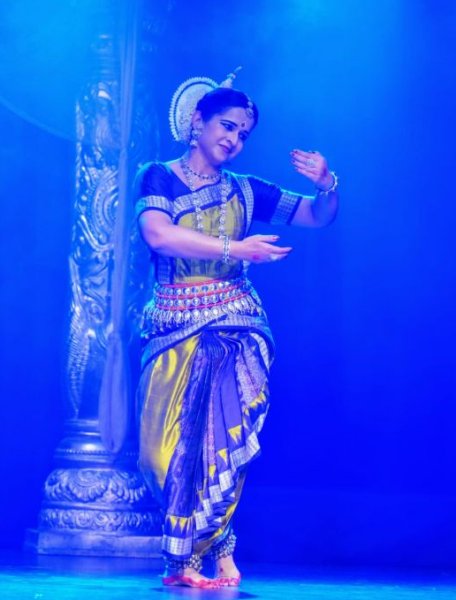 Yasomati Mishra The segment reached its expressive peak with the Oriya abhinaya "Kede chhanda janelo sahi", written by the great Odia poet Banamali Das. Set in raag Mishra Pilu and tala Rupak, with dance composition by Guru Kelucharan Mohapatra and music by Pandit Bhubaneswar Mishra, the piece was performed by Guru Yasomati Mishra. Through a series of engrossing episodes from the Krishna Leela, Pootana, Bakasura, Shakatasura, Dhenuka, and culminating in the Vishwarupa revelation when the child Krishna opens his mouth to reveal the entire universe, the dancer brought Yashoda's astonishment and forgotten scolding to life with remarkable clarity and emotional restraint. The abhinaya remained clean, poised and deeply rooted in the Odissi tradition's blend of narrative richness and physical grace. Together, the Kathak and Odissi offerings of Nrityajog Festival 2026 succeeded not through spectacle but through fidelity to gharana, to bandish, to pallavi and to the quiet sophistication of classical form. Amartyya Chatterjee Ghosh and the Sanjog Dancers, alongside Guru Yasomati Mishra and her students, demonstrated that tradition, when handled with knowledge and sensitivity, remains a living art capable of speaking powerfully across lineages. The evening left one with the lingering resonance of raag Darbari and the soft, insistent jingle of payals, interwoven with the sculptural lyricism of Odissi and the sacred cadence of Na Ma Shi Va Ya, a reminder that the courtly ada of Lucknow and the temple-born grace of Odissi continue to find elegant new homes in the same shared space. 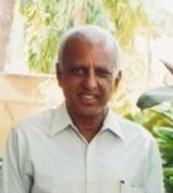 Bangalore based Satish Suri is an avid dance rasika besides being a life member of the Music and Arts Society. |
