
|     |
|
| |

REVIEW / REPORTDiscourses on Ramayana in Kutiyattam- V. Kaladharane-mail: vkdamaru.eda@gmail.com Photos: Nepathya Adarsh September 10, 2026 Plays composed from the great Indian epic, Ramayana, have had a lasting impact on the stage performances of Kutiyattam, the sole surviving Sanskrit theatre tradition in India. The Chakyar community in Kerala, traditionally the custodians and practitioners of this highly evolved Sanskrit drama, have always upheld the plays of Bhasa and Shaktibhadra as against the illustrious plays of Kalidasa which are invariably hailed as supreme poetic utterance. Of the eminent Acharyas who ruled over Kutiyattam in the last century, Ammannoor Madhava Chakyar was instrumental in restoring on stage the glory and the aesthetic rigor of Shaktibhadra's Ascharyachoodamani. His disciple and the son of the late maestro, Ammannoor Kochukuttan Chakyar, Margi Madhu Chakyar has, for several decades been committed to broadening the repertoire of Kutiyattam through enlivening the text and performance of the plays he had already mastered while choreographing excerpts from some of the well-known plays which have for long remained unnoticed. Under his stewardship, Nepathya, Centre for Excellence in Kutiyattam, situated in a remote village Moozhikkulam in Ernakulam District, has been conducting Kutiyattam festivals since 2010. This year's festival coincided with the 60th birthday celebrations of Madhu Chakyar. The highlight of the festival was "the rare juxtaposition of two classical dramatic interpretations of Sita's abduction. In the celebrated Kutiyattam text of Ascharyachudamani, Ravana appears disguised as Rama before carrying out the abduction, while in Bhasa's Pratima Natakam, Ravana appears as an ascetic mendicant". Ravanankam, Act 5 of Pratima Natakam and Mayasitankam, Act 3 of Ascharyachudamani, thus offered tremendous scope for Madhu Chakyar, Nepathya Rahul Chakyar, Dr. Indu.G., Nepathya Yadukrishnan, Nepathya Sreehari Chakyar and a few others besides the ace percussionists headed by Kalamandalam Manikantan on the mizhavu and Kalanilayam Rajan on the edakya, to showcase their artistry. 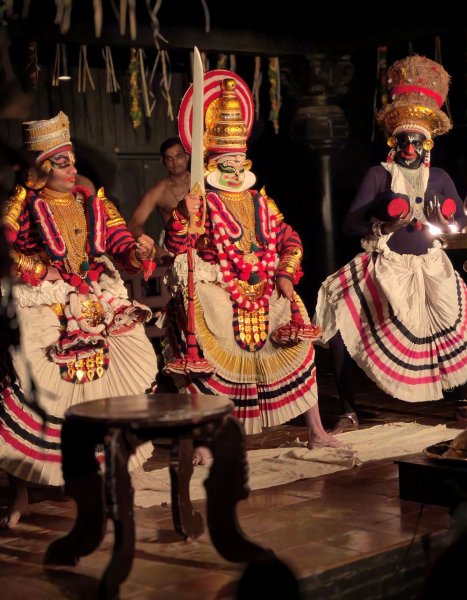 Sootha, Ravana, Soorpanakha The experience derived from a close reading of the Sanskrit play is different from the experience of reading its onstage recital since the latter is dictated by the Attaprakaram (theatre manual) handed down from generation to generation by the Chakyars. In the Kuttambalam (traditional temple-theatre/Natyagriha) of Nepathya, I was witness to the presentation of Mayasitanakam 4th Day by the three highly talented actors viz. Margi Madhu Chakyar as King Ravana, Nepathya Rahul Chakyar as the mutilated Soorpanakha and Nepathya Sreehari Chakyar as the Sootha (charioteer). As the play began, Ravana, Sootha and Soorpanakha stepped into the chariot. As Ravana, Madhu compellingly enacted three dominant expressions; Sringara towards Sita, Lajja (disgrace) seeing the disfigured (by Lakshman) Soorpanakha and Raudra (acute anger) directed to the Devas (heavenly beings) who were laughing at Ravana. With mixed feelings of irritation and impatience, Ravana chides Sootha for the slow pace of the chariot and instructs him to drive fast. At this point, Madhu as Ravana goes into Nirvahana (a brief recollection of the reasons that made him travel to Panchavati to avenge the physical and mental insults inflicted upon his sister Soorpanakha. Soorpanakha, however, dissuades her brother from his determination to kill Srirama and advises him to abduct Sita instead. Here, Sootha intervenes with a general statement that the evil-minded ladies will outwit ingenious men obliquely referring to Soorpanakha. Ravana appreciates her opinions and imagines the situation of him killing Srirama and forcibly takes away Sita. She will soon die out of fear and distress. Ravana then goes on describing the glory of his hands that subjugated Lord Indra and his subjects in heaven. 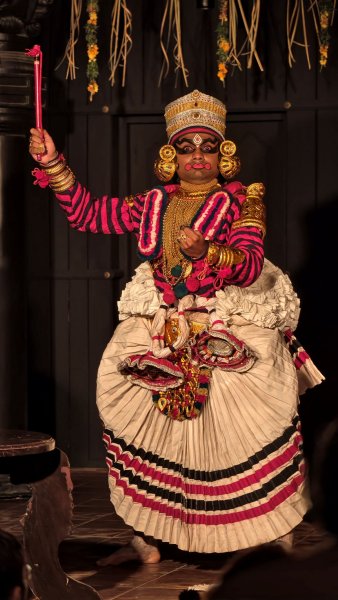 Nepathya Sreehari Chakyar as Sootha 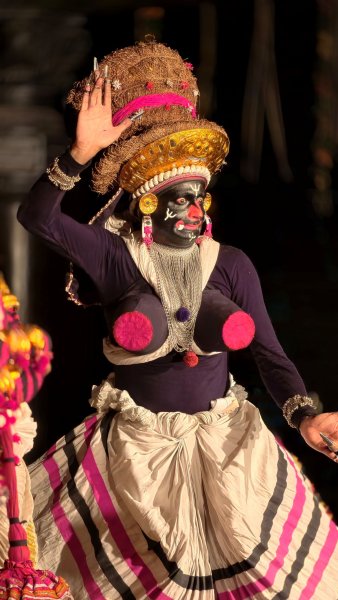 Nepathya Rahul Chakyar as Soorpanakha Sootha once again intervenes and apprises his master that the luminous horses have started trembling, their steps turning unsteady and tears roll down their eyes. The implication is that even the horses have come to know about the sinister plots of Ravana and his sister against Sita. Sreehari as Sootha made memorable his aversion towards the devious conspiracies of both Ravana and Soorpanakha driven by anger and vengeance. I watched with bated breath the trios whose thanmayeebhava (involvement) and theatrical acumen made me identify with the protagonists through and through. Their highly stylized hand gestures, body movements and facial expressions made us Prekshakas (spectators) feel the invisible presence of Sitadevi. The satwikabhinaya (emotive acting) of Madhu and Rahul hardly ever slipped into melodrama while Sreehari as Sootha in minimum facial make-up and costumes was admirably composed. Mizhavu, the principal percussion instrument of Kutiyattam and Nangiarkuttu, independently and in consonance with the gamaka-laden edakya provides the precision and grace of rhythms and tempo-transitions. Kalamandalam Manikandan and Nepathya Jinesh on the mizhavu and Kalanilayam Rajan and Moozhikulam Harikrishnan on the edakya meticulously traced the macro and micro movements and expressions of the characters concerned. 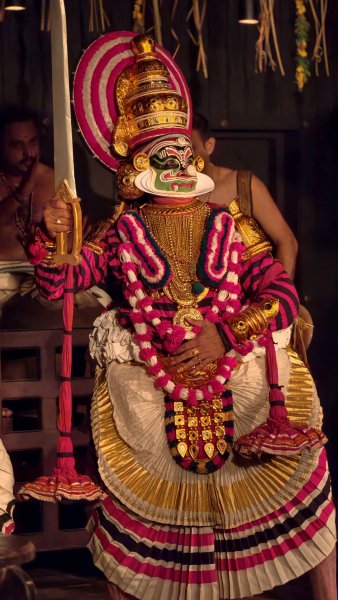 Margi Madhu as Ravana The performance progressed with Ravana reaching the hermitage of Rama. Following the Kesadipadavarnana (hair to feet description), Ravana reminiscences his conquest of heaven and the way he reveled in the pulchritudinous of the celestial beauties. Ravana's memories move further on to Goddess Parvathi which in turn leads to his confrontation with Lord Vaishravana, seizing of the aerial chariot of Pushpaka, Kailasodharanam (lifting of the mountain Kailasa) and Parvathiviraham (suspecting infidelity, Parvathi takes leave of Lord Siva but soon returns to his embrace as Ravana lifts mountain Kailasa with his twenty hands). My reflections on Kutiyattam in general and the most recent performance in particular zero in on to two of its distinctive features. 1. The high degree of meditation each actor invests in characterization and in the organic framework of Kutiyattam. 2. The harmonization of the Natyadharmi (stylization) and the Lokadharmi (realism) in carving out the movement dynamics of the characters. These are the two aesthetic substances that can truly inspire the dancers of Mohiniyattam, Bharatanatyam, Kuchipudi and Odissi. Kathakali, the classical dance-drama, has always been indebted to Kutiyattam for many of its structured improvisations. Of late, several Mohiniyattam and Bharatanatyam dancers are gravitated towards the techniques of theatre applied in Kutiyattam without realizing the fact that the simple yet complex language of this Sanskrit drama tradition does not fit into the craft or content of the Indian classical dance heritage. 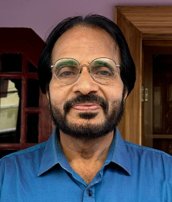 Former Deputy Registrar of Kerala Kalamandalam, V Kaladharan is also an art critic. He has published several articles at the academic level. 'From Meditative Learning to Impersonal Pedagogy' was published in an anthology 'Qui Parley' initiated and released by scholars and writers from the University of California, Berkeley. His articles on Indian performing arts and literature regularly appear in magazines and journals, and in the Friday Page of The Hindu. |
