
|     |
|
| |

REVIEW / REPORTShades of Sringara: The duration of desire- Aneri Nanavatye-mail: aneri.nanavaty@gmail.com Photos: Vipul Prasad September 10, 2026 The stage lights at the Shadbolt were angled in such a way that you could see the dust in the air. Fine particles drifted, catching the beams and losing them. The air was cold and crisp, and everything seemed suspended in something. On 9 July, Sujit Vaidya opened the Indian Classical Music Society of Vancouver's Salon Series with Shades of Sringara, a full Bharatanatyam margam set to live Carnatic music at the Studio Theatre in Burnaby. The programme ran seventy-five minutes without an intermission, moving from an alarippu through a varnam and an ashtapadi to a thillana. The choreography is by Vaidya's guru, A. Lakshman. Vaidya introduced each piece himself, standing at the edge of the stage in the half-light, and by the later introductions he was audibly out of breath. I found I didn't mind, because it placed a working body three metres from us, which is not something a proscenium usually allows. In everyday use, sringara means adornment. It is a person adorning themselves, or the dressing of a deity for a festival. The rasa shares the word and something of the same association: desire as ornament, brought out when the occasion calls for it. What I did not expect was that the evening would be less about the shades of desire than about the duration of it. Here I was confronted with an hour of just sringara, with no contrasting rasa and no interval to break the spell. I came out of it in a state I am still trying to name. 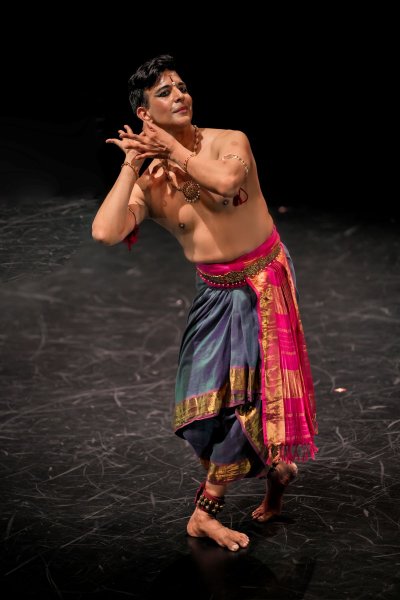 The opening was centred on Ardhanarishvara imagery, the masculine and the feminine I held in the same body without either being softened into the other. The choreography here was built on balance and symmetry, and Vaidya used that architecture the way a vocalist uses a tanpura: as something to move against. The ferocity was not only in the limbs but in the eyes and the jaw. The body could be describing a symmetrical line while the face was doing something far less composed. A solo can drown in a stage this size. Vaidya's spatial sense is such that the question never came up. He worked the diagonals, the verticals, and the full depth of the floor, and the space stayed full. The varnam gave us a nayika under attack. Vaidya enacted Kama's flower arrows landing one by one: lotus at the heart, ashoka at the lips, mango blossom at the eyes, jasmine in the hair. He gave the god of desire a small private smile, as if enjoying his own work. Then he became the nayika's sakhi, scolding Madhava for his indifference, and the scolding was funny in a way I did not anticipate, holding affection and exasperation in the same breath. Everything enacted was crisp and visible: the deer, the bird, the river, and the lotus leaf floating away on it. This is the part of abhinaya that resists explanation to anyone who has not sat in front of it, because nothing is on the stage, and yet the leaf is moving away downstream, and you are watching it go. 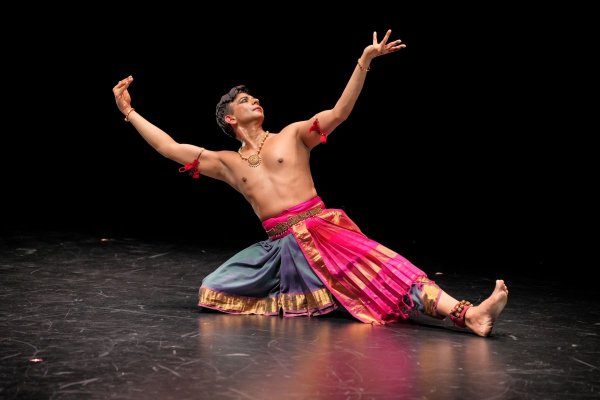 The ashtapadi was Krishna's, and it was his desire we were inside. We were not watching Radha's longing observed from outside, but Krishna himself waiting, preparing, unfolding her in anticipation. He did not consume her. He anticipated her, at length, in front of us. This piece almost made me blush. This was not because anything was explicit, but because it was open. There were no stolen glances, nothing hushed or half turned away, and none of the strategic modesty that sringara is often performed with on a public stage. Desire was unravelled in full, physical and emotional at once, and Vaidya occupied the stage with all of it. None of it was vulgar, but it was human and divine. The live ensemble featured Curtis Andrews on mridangam, Sheema Balakrishnan on vocals, Shriram Rajagopalan on violin, and Arno Kamolika with Ishwarya Chaitanya on nattuvangam. In the varnam, as each of Kama's arrows found its target, the violin bow quivered with it, arrow for arrow. I found myself watching the musicians watch Vaidya, and it was clear they were following his abhinaya rather than simply supporting it. By the thillana, I had stopped taking notes. It was light-footed and precise, building rhythmically toward a crescendo, and by then I was full. I was not bored, but I was saturated. An hour of a single rasa with no release valve had done something to my capacity to receive it, and the crescendo, which in another programme would have discharged the evening, only tightened it. I have come to think this was the point, which was the most interesting thing the evening did, whether or not it set out to. Sringara is usually served as one flavour among nine. Held alone for seventy-five minutes, it stops being a mood and becomes a condition: arousal without resolution, the thing itself rather than a depiction of it. The form did to the audience what the flower arrows did to the nayika. What lingers is not any single image but the sensation of having been kept in anticipation and then sent out into the evening, still immersed. That is its own argument about the subject. Desire is not an ornament brought out for the occasion, though the word remembers that adorning is itself a kind of waiting. It is a duration you are made to sit inside.  Aneri Nanavaty is a writer based in Vancouver. She is a student of Indian classical dance and music. |
