
|     |
|
| |

REVIEW / REPORTBeyond the stage: When expressions speakText & Photos: Dr Shyam Prakash Me-mail: smattumm@gitam.edu September 8, 2026 The Bharatanatyam performance by Anju Aravind as part of the Lokya Dance Festival held at the Layam Koothambalam, Tripunithura, Ernakulam, was a remarkable artistic experience that brought the audience a tangible sense of joy. Beyond the technical precision of Bharatanatyam, the dancer was able to experience the world of ideas of each genre through her body and expression. The performance began with the Shiva kriti "Sada madin dalathu gathara...." by Tyagaraja. This work, set in the Gambheera Vani raga and Deshadi talam, has been choreographed by Anju Aravind herself. The theme of the work is the inner anguish of a woman who cannot enter the temple due to her social status and lives with the desire to see Shiva every day. She offers flowers to the temple but is denied the right to see her lord in person. Once, when she tries to take a look inside the temple at dusk, the doors close the moment her eyes reach the temple gate. "Do I not always carry you in my heart?" Her silent question takes the audience into a complex state of devotion and pain. The dancer portrayed these emotional layers with subtlety. 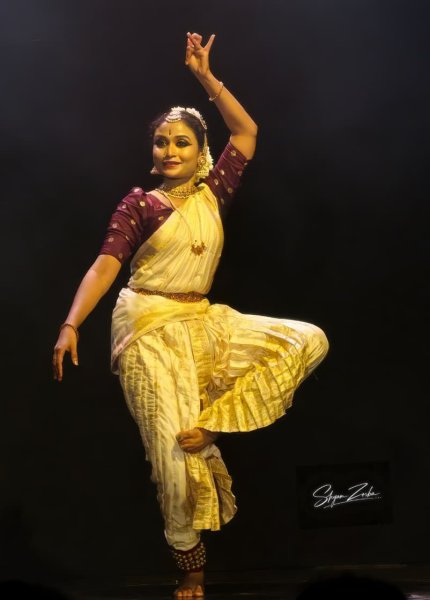 The varnam "Mohamana en midil..," was one of the main enjoyable items of the performance. This work, part of the Varnam series of the Thanjavur Quartet, depicts the heroine's love and longing for Tyagesha of Thiruvarur. The choreography is structured in the manner of a royal dancer performing in the presence of her patron. The heroine's question of whether it is right for her lover to be indifferent to her when her love and desire are at their peak becomes the emotional center of the Varnam. Composed by Ponnaiah Pillai in the Bhairavi raga and roopaka talam, the heroine's longing and the arrows of Manmatha develop through clear emotional levels. Anju Aravind's choreography skillfully highlighted these emotional shifts, allowing the audience to follow the heroine's inner pain and desire with clarity and depth. "Sakhi hey," one of Jayadeva's ashtapadis, composed in Sudha Saranga and talam misra chapu, was choreographed by Meenakshi Srinivasan. The poetic nature of the ashtapadis and the subtle combination of devotional and romantic expressions were evident in the performance. The interplay of music, body language, and expressive acting made this piece enjoyable. The theme of this work is that Radha, in the pain of separation, shares her deep love for Krishna and recalls the blissful moments she spent with him. Radha's plea to somehow bring back those lost moments of love and the pain of separation that arises from them was subtly conveyed by Anju Aravind. The performance concluded with a Thillana composed in Poorvi raga and rupaka taal. This Thillana, a joint choreography of dancers including Vivitha Vijay and Anusree Chandrasekhar, created under the supervision of Prof. Pasumarthi Ramalinga Sastry, provided an energetic and festive conclusion to the performance. Unlike the earlier expressive presentations, the rhythm's agility and the beauty of the movements stood out here. Anju Aravind transformed four genres, each with distinct ideas and emotional worlds, into a unified artistic journey. This performance traversed devotion, love, separation and joy, creating a profound emotional experience. Leaving aside the excesses of agility and external expressions, Anju Aravind's performance should be read as one that accorded equal importance to acting, harmony, sensuality, and rhythm. The beauty of the performance was not limited to its excessive speed or technical precision; rather, its strength lay in subtly experiencing the emotional world of each work. When precision in body movements, moderation in expression, and connection to the rhythm were combined, the performance acquired a natural flow and inner beauty. 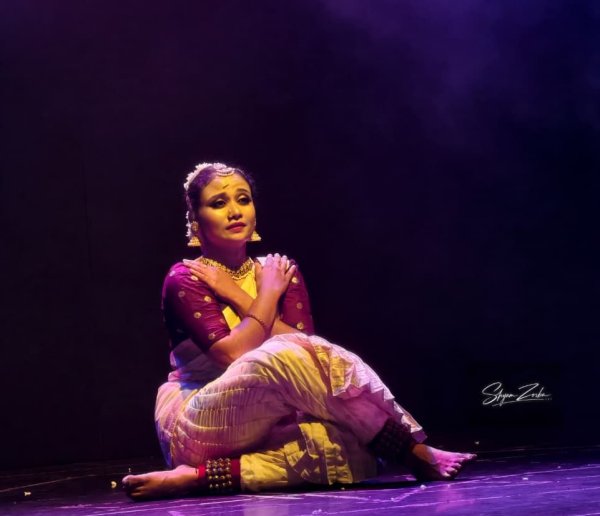 From the devotion and helplessness of the first work to the intense love and longing of the heroine in Varnam, then to the memory of Radha and the sorrow of separation in Ashtapadi, and the harmonious exhilaration in Thillana, the performance traveled through different emotional worlds. The moderation evident in the way she handled the acting was especially noticeable. Without relying on excessive facial expressions or body movements, the characters' inner states were conveyed to the audience through subtle glances, facial expressions, and subtle changes in posture. The collective presence of the musicians behind the performance's excellence is worth mentioning. The musical atmosphere created by Kavya Harish on the nattuvangam, Bijeesh Krishna on vocals, Kalamandalam Charudutt on the mridangam, and Sreejith G. Kammat on the flute added depth and emotional density to the dance performance. This musical accompaniment never overshadowed the dancer's performance but rather supported and highlighted it. This performance, staged in the unique atmosphere of the koothambalam in Tripunithura, conveyed the inner beauty of Bharatanatyam through its moderation and intensity of expression.  Dr. Shyam Prakash M is an Assistant Professor, Department of Fine and Performing Arts, GITAM University, Hyderabad. He can be reached at shyam.zorba@gmail.com |
