
|     |
|
| |

REVIEW / REPORTWhen the five fundamental elements of Nature become Sri Krishna- Swapnanil BaruaPhotos courtesy: Sattriyakristi September 7, 2026 Sarvabhutatma Sri Krishna - Five Elements, One Krishna offers a contemporary choreographic reading of Krishna through the elemental philosophy of the Panchabhuta, while remaining anchored in the aesthetic and devotional vocabulary of Sattriya. There is something inherently challenging about creating a new production around Krishna within Sattriya. The repertoire is already rich with narratives, images and established modes of representation, leaving little scope for merely retelling familiar episodes. The more interesting question is how these stories can be approached afresh without losing their connection with the philosophical and aesthetic foundations of the tradition. 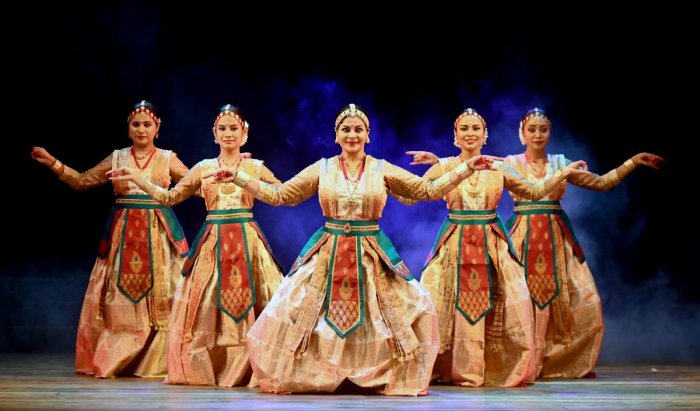 Sarvabhutatma Sri Krishna - Five Elements, One Krishna, presented by Sattriyakristi at the Sri Sri Madhavdev International Auditorium, Srimanta Sankaradeva Kalakshetra, Guwahati, on August 23, 2026, attempts such a re-reading. Conceptualised and choreographed by Krishnakshi Kashyap, the production places Krishna's leelas within the framework of the Panchabhuta - Prithvi, Jal, Agni, Vayu and Akash - and gradually leads the viewer from the physical manifestations of Nature towards the idea of the divine as an all-pervading consciousness. The conceptual architecture is clearly defined. Govardhan Dharan becomes an evocation of Earth; Kaliya Daman is associated with Water; Krishna's encounter with the forest fire with Fire; the sound of his flute with Air; and the Vishwarupa Darshan with the limitless expanse of Space. These associations become successive portals through which Krishna is perceived. The episodic treatment of Krishna's leelas provided some of the production's most striking choreographic moments. The lifting of the mighty Govardhan Parvat was particularly arresting, translating the sheer scale of the moment into a compelling ensemble image. Kaliya Daman, conceived in a group format, was both vigorous and evocative, lending a fresh dimension to a familiar episode. The passage depicting Agni traversing the forests of Vrindavan was especially distinctive in its visual conception, suggesting the elemental force of fire through movement rather than relying solely on literal representation. In the Vayu segment, Krishna's flute became more than an instrument of melody; its resonance was evoked as an expression of bhakti, surrender and the devotee's inward movement towards the divine. The production culminated in the Vishwarupa Darshan, where Arjuna encounters Krishna in his cosmic form. This was a magnificent culmination, expanding the choreographic canvas from the intimate and familiar Krishna to the vast, all-encompassing presence suggested by the production's central idea. The choreography moves between Suddha Nritya and abhinaya, creating a balance between the kinetic demands of a group production and the narrative requirements of the Krishna episodes. The Suddha Nritya passages were among the more engaging aspects of the presentation. They moved beyond a straightforward dependence on familiar Saali movement patterns, exploring a broader choreographic canvas while retaining the essential grace and buoyancy of the Sattriya idiom. The technical execution was assured, but what gave these passages character was the presence of Ulaah - the lightness and elegance integral to the aesthetic personality of Sattriya. 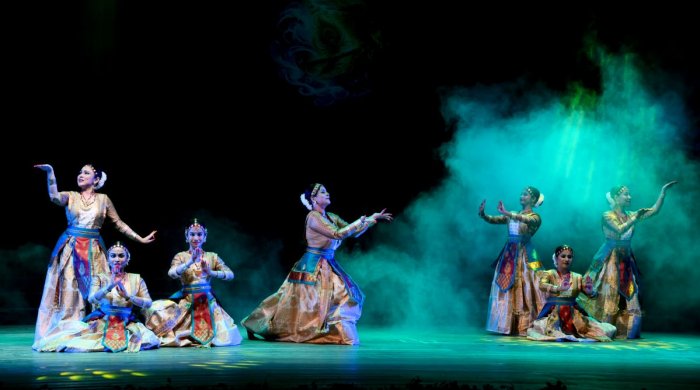 The production brought together a sizeable ensemble, with Krishnakshi Kashyap accompanied by Alangkrita Mahanta, Archita Kakati, Bhagyasri Talukdar, Suraj Gogoi, Dhruba Talukdar, Hiyajuri Kalita, Daisy Deka, Shyamontika Dutta, Lydia K. Marak, Leeja Kashyap, Pallabi Phangcho, Lupamudra Bora, Ankita Amchi and Mimon Mahanta. The ensemble discipline further strengthened the choreography. The dancers maintained considerable synchronisation through the changing sections, with the group functioning as a coherent unit rather than as a collection of individual performers. Such uniformity requires not only technical preparation but also an internalised understanding of the choreographic structure. The abhinaya sections were equally important in bringing the mythology and its underlying philosophical message to the audience. The challenge for a choreographer is not simply to narrate the familiar stories of Krishna once again, but to find an interpretative frame that allows them to acquire renewed meaning. By placing each episode within the Panchabhuta framework, Krishnakshi attempts precisely such a re-reading. The expressive work of the dancers gives the narrative immediacy while allowing the elemental associations to emerge without becoming excessively didactic. 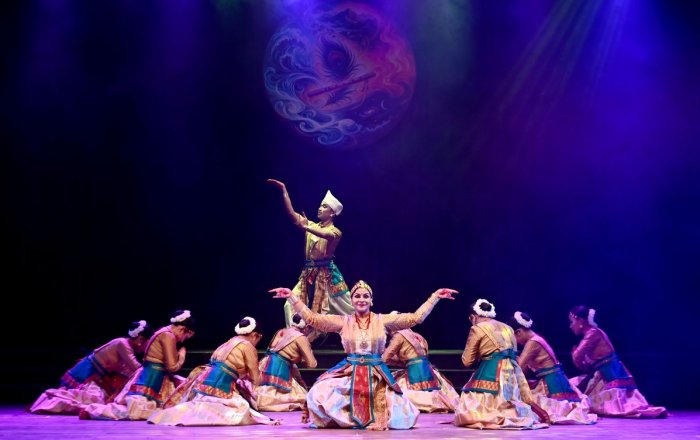 The production is also firmly located within the literary and musical heritage of Assam. Its textual material, assembled and translated from diverse sources and partly composed by Sangeet Natak Akademi Awardee Bhaskar Jyoti Ojah, draws from the Srimad Bhagavata, Srimanta Sankardeva's Kirtan Ghoxa and Sri Sri Madhavdeva's Naam Ghoxa. Ojah, who also directed the music, brings together Borgeet, Bhatima, Prasangia Sur, Dihanam and Malita. This musical vocabulary does more than establish atmosphere; it anchors the production in the devotional culture from which Sattriya emerged. An interesting dimension of the evening was the juxtaposition of tradition in transmission and tradition in reinterpretation. The programme opened with Krishna Nritya and Mati Akhara, performed by the youngest students of Sattriyakristi. Their presence provided a glimpse into the foundational training through which the grammar of Sattriya is passed from one generation to another. The progression from Mati Akhara to an ambitious ensemble production offered a quiet reminder that innovation in a classical tradition is meaningful only when supported by rigorous training. Sattriyakristi, under Krishnakshi's leadership, combines pedagogy with repertory-building. This dual emphasis is significant at a time when Sattriya is increasingly finding a place on the national and international stage. The challenge before contemporary practitioners is not simply to preserve inherited material, but to discover ways in which its aesthetic principles can continue to generate new work. Sarvabhutatma Sri Krishna is valuable in this context. Its central proposition - that the five elements are diverse manifestations of one sustaining consciousness - is not new in itself. What gives the production relevance is its attempt to make that philosophical idea speak through the specific vocabulary of Sattriya. The journey from Prithvi to Akash, and from the multiplicity of the elements to the unity of Krishna, ultimately becomes both a philosophical and choreographic progression. In negotiating that journey, Krishnakshi's production demonstrates that a classical tradition can remain rooted in its devotional inheritance while continuing to search for new ways of seeing, interpreting and experiencing the divine. 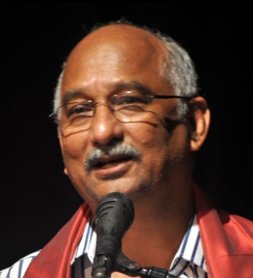 Swapnanil Barua is a retired IAS officer and former Commissioner of Culture, Govt of Assam. A keen connoisseur of the performing arts, he has a longstanding interest in Indian classical dance and cultural heritage. |
