|     |
|
| |

REVIEW / REPORTDancing the Divine: Krishna Priya- Mahima Raoe-mail: mahimaprao@gmail.com September 6, 2026 On July 25, 2026, as a sultry Ohio summer pressed against the doors of the Medina Performing Arts Center, the world inside seemed to turn toward Chennai. Silk costumes flashed beneath the lights, jasmine scented the air, and salangai answered the opening pulse of rhythm. The occasion was 'Krishna Priya: An exploration of the five bhavas of Krishna Bhakti,' an ambitious Bharatanatyam production created to showcase the next generation of dancers. Under the guidance of Guru Sujatha Srinivasan, three senior disciples Nithya Kasibhatla, Sita Vakkalanka, and Sweta Balaji demonstrated how to preserve, nurture, and develop individual artistry within classical tradition, supported by a distinguished live orchestra. The evening's success lay in its seamless synthesis of creativity, choreography, and conservatory training. Across the shanta, dasya, sakhya, vatsalya and madhurya bhavas, the dancers and musicians rendered bhakti both visible and audible. The graceful lines and dramatic nuance of the Vazhuvoor bani met the rigor of araimandi, precise teermanams, and lucid hasta viniyoga, turning technical command into a vehicle for rasa. Emcee Dr. Shriya Srinivasan, an accomplished dancer and choreographer, provided an eloquent narrative backdrop that added an extra jewel to the program. A shared invocation and sweeping canvas The collaborative Krishnanjali Pushpanjali immediately announced the production's generous spirit. Guided by Guru Sujatha and co-choreographed by the trio, it introduced shanta bhava through a Brindavan at peace: birds, animals, and the natural world rejoicing in Krishna's presence without expectation. Nithya, Sita and Sweta moved with ensemble unanimity while retaining distinct stage presences. Symmetrical formations opened into buoyant jatis, while clean angashuddham kept the imagery anchored in classical grammar. That balance deepened in the Vanajaksha Varnam, Sujatha's exploration of madhurya bhava. The varnam's demanding alternation of nritta and abhinaya gave the dancers room to demonstrate both stamina and interpretive intelligence. Princess Rukmini's appeal for rescue, the humility of the Tulabharam, and the nayika's longing for the Divine Beloved unfolded with narrative clarity. Brisk korvais never felt detached from the sahitya; the geometry of movement heightened the inner drama rather than interrupting it. In their self-choreographed solos, the performers emerged as young dance makers entrusted with lineage. Nithya Kasibhatla (Dasya Bhava) 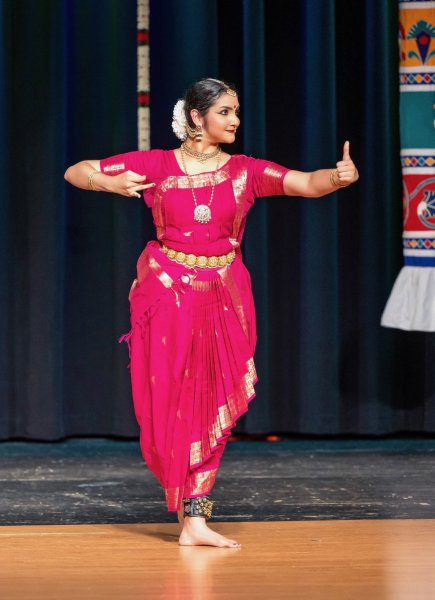 Nithya Kasibhatla Nithya Kasibhatla brought dasya bhava to life in "Dasana Maḍiko," interpreting Purandara Dasa's theme of renunciation and sacred surrender. Her compelling narrative arc capturing a worldly identity yielding to seva unfolded through controlled sanchari bhavas and an intimate sensitivity to the lyrics. With every character she portrayed, Nithya showcased a complete command of abhinaya. Having begun her training under Guru Sujatha in 2006 and completed her arangetram in 2016, she infused her performance with mature musicality, further enriched by her formal Carnatic vocal studies under Aparna Devaguptapu and Lalit Subramanian. Her performance history including awards from the Cleveland Thyagaraja Festival, New Jersey Natya Sangamam, and St. Louis Natya Idol showed in her stage assurance. The culminating plea to be accepted as Krishna's servant arrived with emotional restraint, bringing tears to the eyes of many audience members. Her parallel journey through neuroscience, English writing, and medical school reveals an artiste uniquely alive to both structure and human vulnerability. Sita Vakkalanka (Sakhya Bhava) 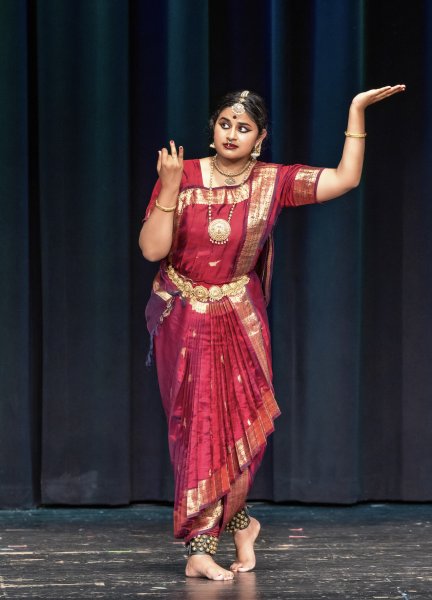 Sita Vakkalanka Sita's "Smarati nu mam" turned toward the sacred friendship of Krishna and Sudhama. Her abhinaya favored subtle detail: a shift of drishti, a softened torso, a measured pause. Through these conscious choices, she conveyed a profound bond that asks for nothing yet gives everything. A disciple since 2008 and an arangetram graduate since 2015, Sita brought the poise of a seasoned soloist and principal dancer with Anubhava Dance Company. Her advanced Carnatic training with Malladi Ravikumar was evident in how her movements breathed with the composition. Honored with national recognition including top placements at the Cleveland Thyagaraja Festival, National YoungArts, New Jersey Natya Sangam, and the 2026 title Yuva Kala Purna, Sita sustains a rigorous artistic life alongside her career in finance and her pursuit of the CFA designation. Sweta Balaji (Vatsalya Bhava) 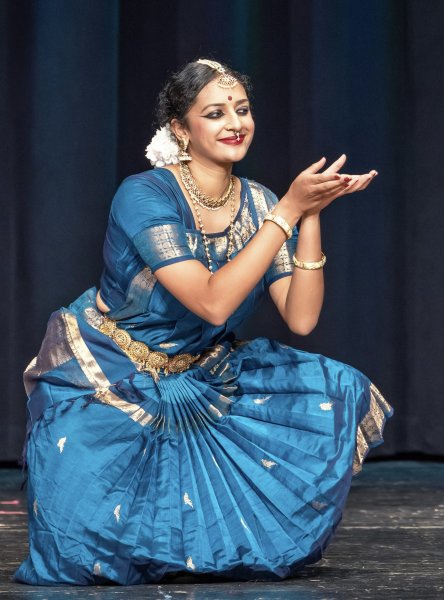 Sweta Balaji Sweta brought warmth and comic sparkle to "Madu meikkum Kaṇṇe," depicting the dynamic between Yashoda and the mischievous child Krishna. She moved deftly between maternal and child personas, using mukhaja abhinaya, distinct gaits, and spatial focus to make the exchange legible. Her sparkling eyes captured child-like playfulness while her restrained maternal love demonstrated strong command over abhinaya. With over 16 years of study under Sujatha, an arangetram in 2022, and selection for advanced study through the 2026 Ohio Traditional Arts Apprenticeship grant, Sweta exemplifies the evening's theme of transmission. Her Carnatic vocal training with Dr. Shankar Srinivas Ganapathy sharpened her rhythmic phrasing. The Guru at the center At the center of the evening was Guru Sujatha Srinivasan, choreographer, educator, nattuvanar, and cultural institution-builder. For more than three decades in North America, the founder and artistic director of Shri Kalaa Mandir has cultivated dancers who preserve a bani without treating it as a static artifact. In Krishna Priya, her mentorship was visible in the balance between a shared movement vocabulary and individual artistic agency. Her nattuvangam supplied the production's spine. Precise sollukattus guided transitions and sharpened rhythmic tension without overpowering the dancers. Sujatha's accolades - including the Ohio Arts Council Heritage Fellowship, the 2024 Individual Excellence Award for Choreography, the Cleveland Arts Prize Martha Joseph Award, and the title Nritya Seva Mani reflect a career uniting artistic excellence with community service. Yet the deeper accolade stood before her: three disciples fully equipped to extend the lineage. An orchestra that danced The four accompanying musicians functioned as dynamic theatrical partners: K. Hari Prasad (vocal): Recipient of the 2025 Sangeet Natak Akademi Award for music in Bharatanatyam and a former professor at Kalakshetra Foundation, his vocalism carried both narrative weight and emotional tenderness, shaping sahitya to mirror the dancers' abhinaya. Chenda Kesavan (mridangam): Drawing on over three decades of performance and cross-genre experience with artists like A. R. Rahman and Ilaiyaraja, he articulated nadai changes and teermanams with muscular clarity while remaining acutely sensitive to footwork. Muthukumar (flute): An All India Radio Chennai "A Grade" artist and disciple of Dr. N. Ramani, his flute work naturally evoked Krishna's flute, coloring the performance with supple sangatis and delicate emotional shading. Laya Raghav (violin): Trained in the Lalgudi bani under Lalgudi Vijayalakshmi, her alert melodic accompaniment provided rich contour and timing, creating a chamber-like intimacy within the theater. From Viraha to Ānanda The production's emotional summit arrived in Sujatha's choreography of Jayadeva's aṣhṭapadis. In "Nindati Chandana," Radha's sakhi conveyed the anguish of separation; in "Priye Charushile," Krishna approached Radha seeking forgiveness and reunion. The trio's expressive movement reframed longing (viraha) as spiritual hunger, suggesting the cosmic meeting of jivatma and paramatma. The Madhuvanti Tillana released that inward intensity into pure ananda. Co-choreographed by the performers, the finale sparkled with swift adavus, sculptural poses, and tightly coordinated korvais. The pure dance stood not as a mere postscript, but as the joyful consequence of the devotional journey of peace, service, friendship, parental love, and divine longing resolving into celebration. Krishna Priya offered a persuasive answer to a question facing every classical tradition: how inheritance remains alive. Sujatha's approach was not to dilute Bharatanatyam's vocabulary, but to deepen her students' ownership of it. Together, dancers and musicians made an Ohio stage feel connected to Brindavan, Chennai's Margazhi season, and a vibrant diasporic future presenting a clear portrait of parampara in motion. 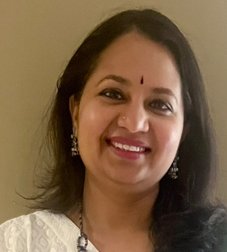 Mahima Rao is a practicing Bharatanatyam artiste rooted in the Kalakshetra and Vazhuvoor traditions. She actively performs Vazhuvoor style across Northeast Ohio and serves as a local newsletter editor. Professionally, she brings over twenty years of experience in finance to her corporate career and remains dedicated to championing regional talent and cultural heritage. |
