
|     |
|
| |

REVIEW / REPORTUpasana's Monsoon Festival- Tapati Chowdhuriee-mail: tapatichow@yahoo.co.in Photos: Arijit Roy September 4, 2026 Upasana Centre for Dance, headed by its artistic director Ashimbandhu Bhattacharya, presented the Monsoon Festival at Gyan Manch in Kolkata on 3rd August. Sangeet Natak Akademi supported them in this venture. Odissi Guru Ratikant Mohapatra of Srjan was given the stage first. The evening started with Srjan Ensemble's presentation of Rupantaram that celebrated the transformative journey of Odissi - where timeless tradition evolves through creative renewal while preserving its classical soul. In the march of time, and in the effort of human beings to become civilized, every step taken is a step forward. Evolving sensibilities and opening oneself to new vistas is the nature of civilization. Rooted in the enduring legacy of Guru Kelucharan Mohapatra, the production harmoniously blended modern day demands and changing tastes through expressive abhinaya and pure dance. It merged the contemporary within the ancient, embracing transformation as the essence of a living tradition rather than a departure from it. Respecting the rich grammar and vocabulary of Odissi, the work presented neo-classical interpretations that retain authenticity while offering fresh artistic perspectives. Featuring a thoughtfully curated repertoire of vibrant compositions, Rupantaram showcased intricate footwork, refined technique, expressive depth, and dynamic body kinetics. Conceived and choreographed by Guru Ratikant Mohapatra, with music composed by eminent maestros, the production offered an immersive experience, reflecting Odissi's relevance and its continual evolution for contemporary audiences. 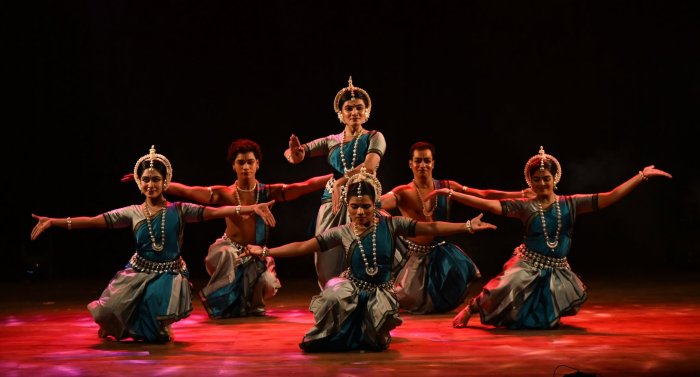 Srjan ensemble Shiva Tandava Stotram, in Ratikant Mohapatra's newly found vocabulary of Odissi, reflected vibrancy at every turn. Its opening, traditionally attributed to Ravaṇa, is composed in the Panchacamara metre (chandas). It is a syllabic metre of 16 syllables per pada, arranged as eight alternating laghu-guru pairs, which lent itself well to the evolved technique and gave it a new dimension. The chanting of this stotram on Shiva, "Jatatavi galajjala pravaha pavita sthale", is a means to purify the mind and body, and to bring peace, prosperity, and longevity to the ardent devotee. With vibrant movements and intricate rhythmic sequences, the dancers paid their obeisance to Shiva. The glory to Lord Shiva - who dances eternally to the deeply sonorous notes of the mridangam, at whose feet the impassioned devotee offers prostrations for his auspicious blessings - was set in raga Bhatiyar and talas adi and khemta. Music was by Pt. Bhubaneswar Mishra. "Jeevana madhu sangeeta maya" embodied the unbridled joy of music through dance. It was an exploration of the enchanting nature of music through the innate, transformational power of dance. The choreographer and dancers took immense joy in presenting a kaleidoscope of new and energetic dance movements that flowed in tandem with the music and rhythm, while providing a vibrant contrast in their exposition. With a distinctive musical backdrop, this dance painted the canvas of a life full of harmony that comes together as Geeta, Vadya, and Nritya to form Sangeeta. Heightening the appeal of novelty were the intricate rhythmic patterns of the Odissi mardala, embellished by the unique sound effect of playing this distinctive percussion instrument on the leather thongs that bind it. 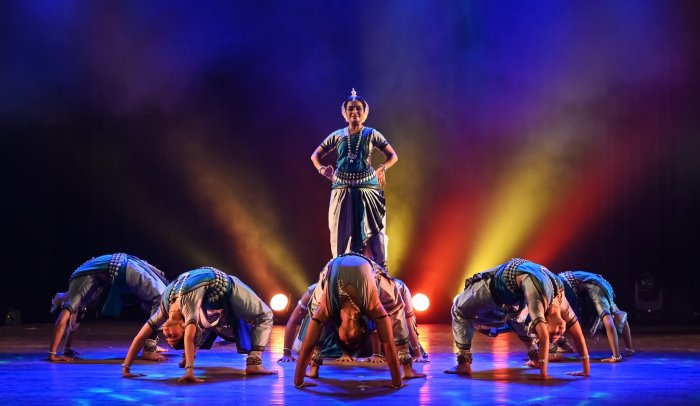 Srjan ensemble As adherents of the rich classicism of Odissi dance, the performers appealed to the rasikas not only for its sensory delight but also as a means of spiritual enlightenment. Elements of music and dance merged in their expression and were exquisite in their exhibition. Dance and music were composed by Guru Ratikant Mohapatra and Rupak Kumar Parida. Sanskrit lyrics were by Pt. Nityananda Misra. "Shri Ramachandra krupalu bhaja mana" by Tulsidas, describing Lord Rama, was sung and danced in adoration of the hero of the Ramayana, who expiates the myriad sins of mankind and drives away the many fears lodged in the human heart. In this piece, the choreographer extended the dramatic element by using, in sanchari bhava, the two episodes of Sita Swayamvara and the Rama-Ravana conflict to relive scenes so familiar. Ragamalika and jati and adi talas were most appropriately used. With "Vande Suryam," the first part of the evening concluded. The divine light of Surya Devata was praised in manifold ways. The choreographer once again dived deep into the Gotipua movements to give cadence and beauty, and to draw on the aesthetic details from which Odissi has drawn sustenance. Some of the formations were watched in awe. Surya, bedecked in his very own light, his eternal lustre bathed in an aura of crimson, could not have been better rendered. Surya's light shines on all creation, generously bathing humanity with unending kindness. In a glorious journey across the skies, astride a grand chariot pulled by seven horses from end to end of our consciousness, Surya moves on his resplendent journey. All the dances presented were choreographed by Guru Ratikant Mohapatra. Music for Surya was by Agnimitra Behera. Light designer Debiprasad Mishra enhanced the beauty of the pieces. 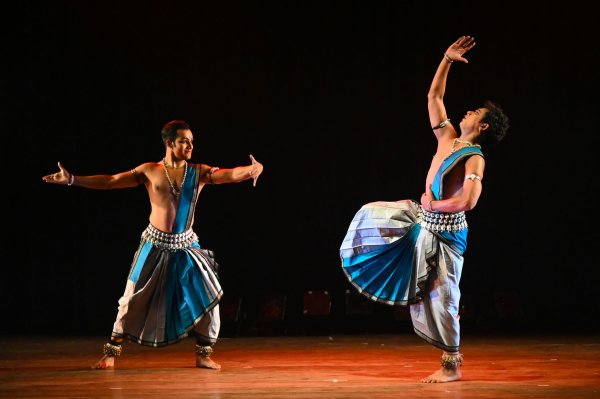 Srjan ensemble Guru Ratikant Mohapatra played the mardala; Rupak Kumar Parida and Satyabrata Katha were the narrators. Violin was by Ramesh Chandra Das and Agnimitra Behera, while flautist Srinibas Satapathy and sitarist Rabishankar Pradhan were in fine form. The performance featured Rajashri Praharaj, Aishwariya Singdev, Preetisha Mohapatra, Madhabi Rout, Daina Ghose, Pallishri Priyadarshini, Prachi Mohanty, G. Sanjay, and Rajkumar Kar. In the second part of the evening, Kathaka Ashimbandhu Bhattacharya commended himself and his troupe as excellent storytellers. As raindrops kiss the earth and drape every tree in vibrant renewal, the peacock unfurls its feathers in joyous dance - and so did the dancers. Gentle showers, blooming lotuses, playful deer, and emerald landscapes awakening in the fragrance of new beginnings were translated into dance. 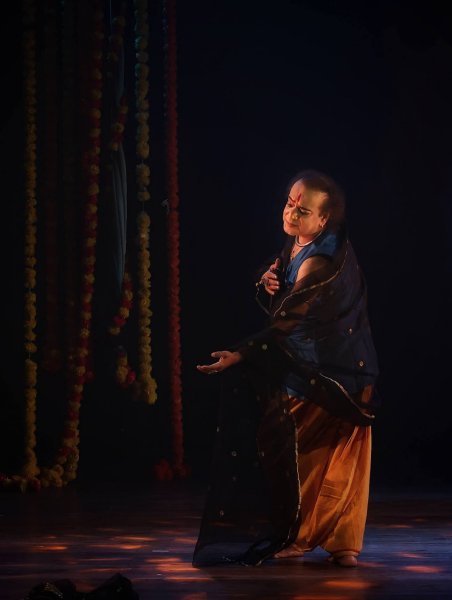 Ashimbandhu Bhattacharya The eternal romance of the monsoon, which comes alive in an enchanting tapestry of rejuvenation, love, and devotion, was showcased. Upasana Centre for Dance celebrated the season's timeless poetry - where yearnings blossom into union, and movements find solace in the rain, rhythm, and melody. This Monsoon Festival was dedicated to Guru Kelucharan Mohapatra on his centenary. The Upasana Centre for Dance is one of the prestigious dance institutes in the subcontinent. It has not limited itself only to performances, but has also engaged in various other activities to foster international cultural relations. Upasana Centre for Dance presented Geeta Govind, a work composed by the 12th-century poet Jayadeva. It describes the relationship between Krishna, Radha, and the gopis of Vrindavan. The Geeta Govind comprises 12 chapters, and each chapter is elaborated into divisions called prabandhas. The prabandhas contain couplets grouped into eights, called ashtapadis. The text also elaborates the eight moods of the heroine, the Ashta Nayika, which has been an inspiration for many compositions and choreographic works in Indian classical dances. 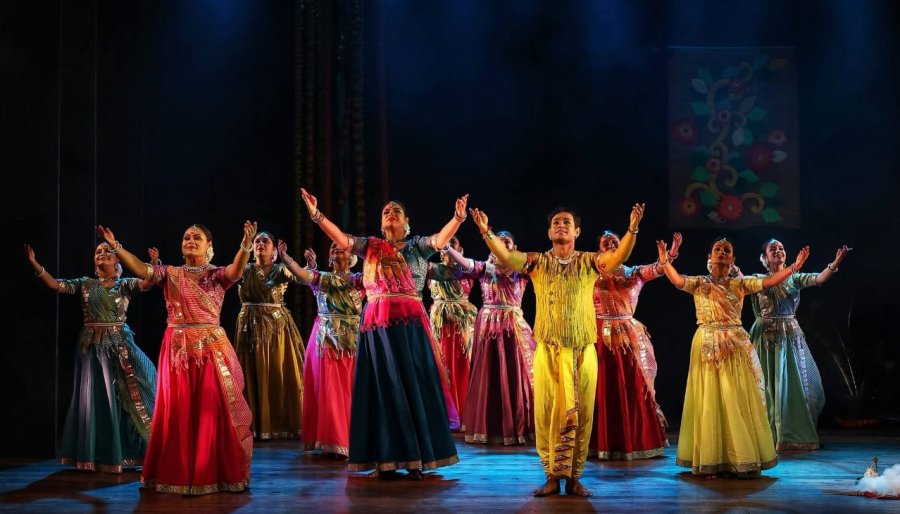 Ashimbandhu Bhattacharya's disciples The exposition of the Geeta Govind in Kathak was conceptualized by Ashimbandhu with his unique interpretation. Nonetheless the evening was enriched by the rasas that were enumerated with richness. Direction, recreation, interpretation and choreography were by Guru Ashimbandhu Bhattacharya. Performers Ranjani, Avik, Anamika, Srijita, Trisha, Durjaya, Debasmita, Srishty, Nandini, Ankana, Gongotri, and Guru Ashimbandhu himself mesmerized aficionados. Lights were by Soumen Chakraborty and Sunando Mukherjee.  Tapati Chowdhurie trained under Guru Gopinath in Madras and was briefly with International Centre for Kathakali in New Delhi. Presently, she is a freelance writer on the performing arts. She is the author of 'Guru Gopinath: The Making of a Legend.' Tapati received the Sangeet Natak Akademi Award for 2024 for Art Critique in Performing Arts. |
