
|     |
|
| |

REVIEW / REPORT'Sare Jahaan Se Achcha' - A tribute to India's cultural heritage- Manjari Sinhae-mail: manjari@sinha.com August 28, 2026 Immaculate presentations of Odissi, Bharatanatyam and Kathak by renowned Gurus and their disciples reached 'Sare Jahan Se Achcha' festival to its climax. It was the 21st edition of the two-day festival conceived and presented around the Independence Day of Bharat by Odissi dancer Ranjana Gauhar and her prime institution the Utsav Educational and Cultural Society, presented as their annual tribute to India's vibrant cultural heritage, specifically the rich classical dance traditions of India. The festival's theme this year was 'Vande Mataram: Bharat Ki Virasat - Bharat Ka Gaurav' presented on the 10th and 11th of August at the Stein auditorium, India Habitat Center, New Delhi. The inaugural evening witnessed the presentation of the Utsav Samman: Lifetime Achievement Award, a regular feature of this festival, honouring three distinguished personalities for their exceptional contribution to Indian arts and culture. This year the Utsav Samman was bestowed upon Guru Darshana Jhaveri, renowned actress, lawyer and Kuchipudi exponent Rashmi Vaidyalingam and eminent Odissi Guru Ratikant Mohapatra. Earlier the festival opened with 'Chitrangada the Warrior Princess', a choreographic production conceived, scripted, directed and choreographed by Guru Ranjana Gauhar. Drawing from the Mahabharata and inspired by Rabindranath Tagore's Chitra, the dance drama Chitrangada explored the idea of a complete woman, a woman who embodies love, courage, dignity, independence and freedom of expression. The Manipuri princess Chitrangada, whose love for Prince Arjuna leads her on a journey of self-discovery, ultimately realises that her true strength and potential lie beyond external beauty in her dignified identity. Vrinda Chadha and Ankita Bakshi in the role of Chitrangada ably portrayed the two phases of the protagonist's life, the lovelorn Nayika and the self-confident, dignified princess. Vinod Kevin Bachan as Arjuna and Archisha Arya as Madana were convincing. The music was composed by Saroj Mohanty. The captivating production brought back cherished memories of its premier, when Ranjana herself appeared in the role of Chitrangada. 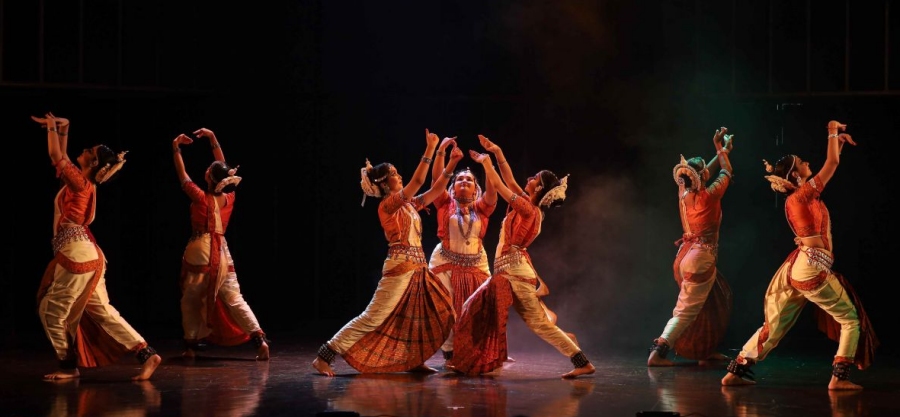 'Vande Mataram' by Ranjana Gauhar's ensemble The concluding evening brought together some of India's finest classical dancers, musicians, Gurus and their disciples in Odissi, Bharatanatyam and Kathak performances, celebrating India's rich artistic heritage of Indian classical dances, placing the timeless tradition of Guru-Shishya Parampara at the heart of the festival. Opening on a patriotic note with 'Vande Mataram' presented in Odissi style by seven well-trained disciples of Guru Ranjana Gauhar, beautifully captured the spirit of devotion and love for motherland. The music by A R Rahman had inputs by Saroj Mohanty who imaginatively interspersed Pallavi of raga Desh and Bol-Padhant of ukkutas in varied laya in-between, bringing an authentic flavour of Odissi for the dance choreography by Guru Ranjana Gauhar. 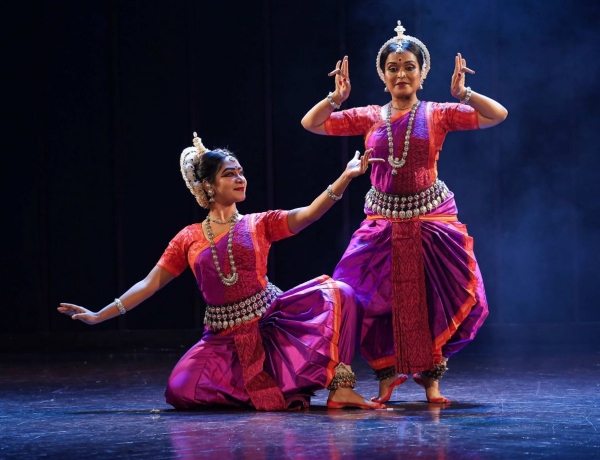 Preetisha Mohapatra & Rajashri Praharaj The artistic presentation of Odissi by the chiseled disciples of Guru Ratikant Mohapatra from Srjan, Bhubaneshwar, was a class apart. Presented as a duet by Rajashri Praharaj and Preetisha Mohapatra, the invocatory Vishnu Vandana “Shantakaram Bhujaga shayanam....” offered obeisance to Lord Vishnu - the serene, all-pervading sustainer of the universe, beloved consort of Goddess Lakshmi and the destroyer of fear, gracefully presented by the duo. Composed by Bijoy Kumar Jena in raga Gurjari Todi and set to triputa tala, the beautiful prayer was choreographed by Guru Ratikant Mohapatra. This was followed by 'Ardhanareeshwara', presented as a duet based on the well-known lyrics of Adi Shankaracharya. Originally choreographed by Guru Kelucharan Mohapatra with music by Pandit Raghunath Panigrahi, the iconic choreography was presented under the artistic direction of Guru Ratikant Mohapatra. The aesthetically appealing, powerful portrayal of the divine union of Shiva and Shakti received standing ovation from the audience. 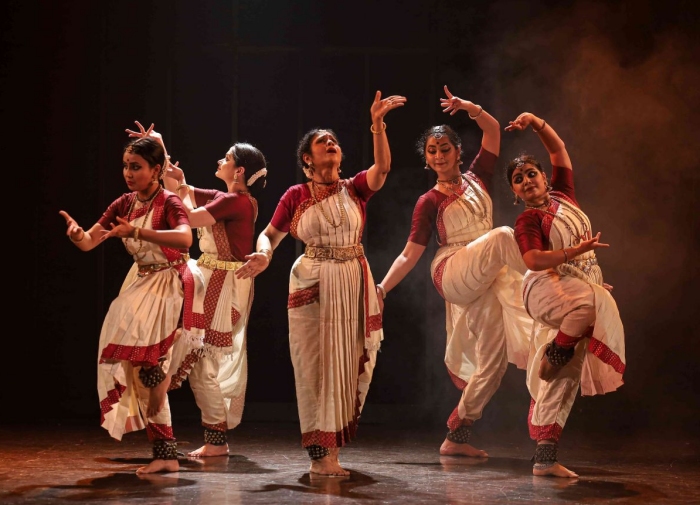 Dr. Ananda Shankar Jayant and group The evening then moved on from the devotional to emotional level with 'Navarasa - Expressions of Life', a lovely presentation conceived and choreographed by Dr. Ananda Shankar Jayant. Indian aesthetics and dramaturgy speak of the nine rasas, Shringara, Hasya, Karuna, Raudra, Veera, Bhayanaka, Bibhatsa, Adbhuta and Shanta corresponding to emotions of love, humour, grief and compassion, valour, fear, disgust, wonder and peace respectively. Bharata in his Natya Shastra also speaks of the Purvarang as a preface to the theatrical presentations where the Indra Dwaja / Jarjara, is placed for purification and consecration of the performance space and to avoid any obstacle. Ananda very imaginatively followed the Natya Shastra and used this significant ritual of 'Purvaranga' by placing the 'Jarjara' on one side of the stage. The performance opened with Ananda reciting the Navarasam Shloka, emoting all the nine rasas, before her disciples danced emoting individual rasa, carrying an Uttariya of corresponding shade, and hanged their Uttariya of that particular rasa on the Jarjara before exiting. This was done for all the nine rasas emoted by Ananda and her chiseled disciples one rasa at a time and hanging the Uttariya on the Jarjara, the Indra dwaja. The music composed by Prema Ramamurthy in nine different ragas enhanced the captivating choreography, performed by Ananda herself and her competent disciples Aditi Rao, Archita Bhat, Neha Sathanapalli, Srividya Sripathi and Avani Chetluri. The unique presentation explored the multi-hued dimensions of human emotions through movements, nritta, abhinaya, and the expressive vocabulary of Bharatanatyam. The evocative presentation was met with tremendous applause heralding standing ovation. 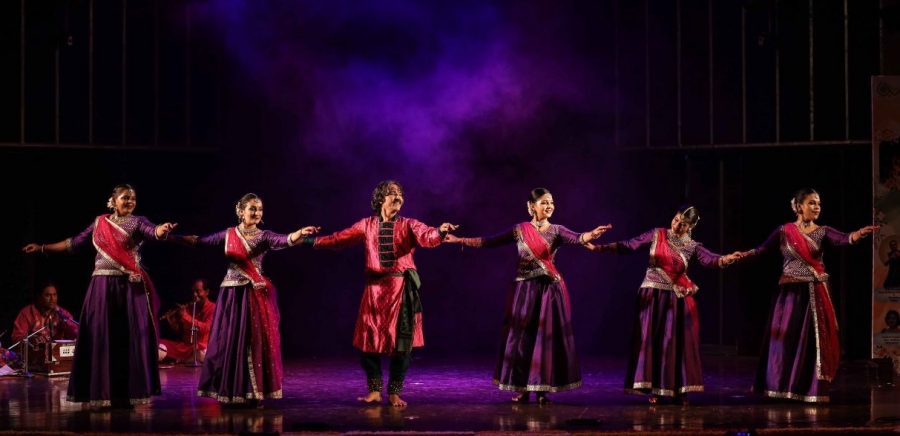 Pt Rajendra Gangani and disciples The festival culminated with 'Anand Utsav', the joyous abandonment of Kathak by Guru Rajendra Gangani and his disciples Anjana Singh, Ipsa Narula, Priyanka Kapil and Aditi Bharadwaj. The live orchestra comprising vocal and harmonium by Janab Samiullah Khan, tabla by Yogesh Gangani, sarangi by Janab Nasir Khan, flute by Atul Shankar, padhant by Neelakshi Khandekar Saxena and vocal support by Anshika Pandey added extra charm to the rare gems of Jaipur Gharana presented by Guru Rajendra Gangani from the treasure trove of his rich repertoire. "Sabmil gao Desh Raag" followed by 'Vande Mataram' and the concluding Tarana in raga Desh presented by Rajendra and his disciples did full justice to the festival's theme. The competent compere Sadhana Shrivastava not only underlined the journey and vision of Saare Jahan Se Achcha, but also spoke about the significance of India's Independence, the meaning of freedom and the enduring spirit of Vande Mataram, the theme of the 21st edition of Saare Jahan Se Achcha, the brainchild of Guru Ranjana Gauhar to celebrate and preserve India's classical arts. 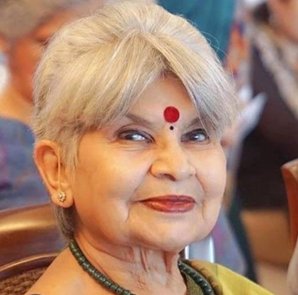 Manjari Sinha is a musicologist and an acclaimed classical music and dance critic. She has an MA in Sanskrit from Allahabad University, MA in Music from Vikram University, Ujjain; Sangeet Prabhakar in Hindustani Vocal, Tabla, Sitar and Kathak dance from Prayag Sangeet Samiti, Allahabad; and further training in Sitar under Guru Pt. Arvind Parikh in the lineage of Ustad Vilayat Khan. She has authored a book on Ustad Bade Ghulam Ali Khan, commissioned & published by Roli Books. She has contributed the chapter on Kathak for 'Indian Dance: the Ultimate Metaphor'. Her articles in English and Hindi on Music, Dance, Art & Culture are regularly showcased in a variety of leading journals and periodicals. |
