
|     |
|
| |

REVIEW / REPORTBeyond lasya: Reimagining Mohiniyattam through Poothapaattu- Dr Shyam Prakash Me-mail: smattumm@gitam.edu August 21, 2026 Edassery's 'Poothapaattu' is a poem that has found a place in the popular memory and literary history of Malayalam. This poem, which intertwines the beliefs, mythologies, and human emotions of the Valluvanadan land, does not present the transcendental concept of Pootham as a mere form of fear. It reinterprets Pootham as a human experience that delves into the depths of love, motherhood, loss, and waiting. Mythili Anoop and her team presented 'Poothapaattu' in Hyderabad under the banner of Alai Arts, recreating this poetic world in the collective language of Mohiniyattam and drama. The method adopted here is not a continuation of a typical Mohiniyattam solo dance performance, but rather a collective dance-drama performance that further expands the poem's dramatic possibilities. When the movements and expressions of Mohiniyattam, the drama's characterization, the music, and the stage visuals come together, the world of Poothapaattu, as conceived in Edassery's words, acquires a new body language on stage. In the traditional understanding of the art form of Mohiniyattam, what mainly appears are sensuality, soft movements, a one-person presentation, and female-centric expression. However, on the contemporary stage, Mohiniyattam is transcending these limits and moving towards broader dramatic possibilities. In this change, which translates poetry, mythology, folk tales, and social experience into the body language of dance, Mohiniyattam becomes an active stage language of storytelling rather than a mere presentation of steps and gestures. When the characters, conversational body movements, visuals, music, and group movements interact with the traditional structure of dance, the expressive range of Mohiniyattam also expands. This dance drama, 'Poothapaattu,' is a striking example of this change. From a solo performance in which the story moves through the body of a single artiste, Mohiniyattam shifts to a group performance in which various characters and collective bodies advance the story. As characters like Pootham, Nangeli, and Unni take shape on stage through different bodies, the dance evolves from an individual expression to a collective dramatic expression. Such experiments do not reject the tradition of Mohiniyattam. Rather, they reimagine it as a contemporary performance language that encompasses character, conflict, place, memory, and popular culture while maintaining its core sensuality, expression, and physical beauty. Dr. Mythili's 'Pootham' does not appear on stage as an ordinary character entry. Accompanied by classical dance Jathis and powerful movements, Pootham embodies the fear and transcendental concepts of village life. A major change gradually unfolds in the story of the Pootham, who lives in a cave among the rocks on the outskirts of the village, terrifies and seduces passersby, and traps humans under the palam tree. The cause of that change is seven-year-old Unni. 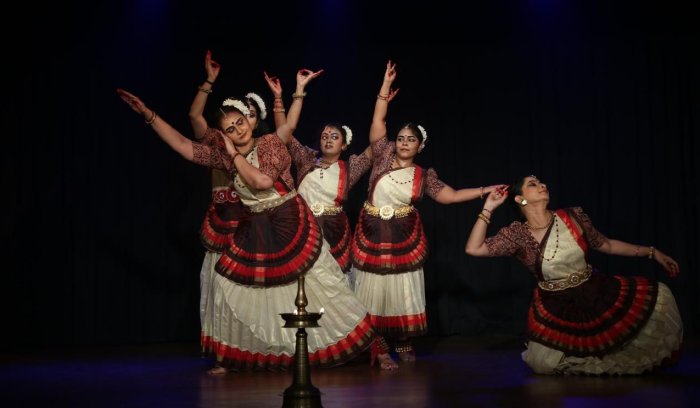 Pootham's first experience of motherly love with Unni is a pivotal moment that invites the audience to feel the transformation from fear to affection, fostering empathy and emotional engagement through Mohiniyattam's expressive body language. From there, Nangeli's journey begins. Another strong point of the story is the pain of the mother who lost her much-desired and long-awaited son. During Nangeli's journey in search of her son, Pootham frightens her in many forms - as a hurricane, a forest fire, and a tiger. She also tries to dissuade her by offering gold and jewelry. But all the powers of Pootham fail in the face of the firm stand of motherhood. The appearance of Nangeli, who is ready to sacrifice even her own eyes for her son, further heightens the intensity of maternal love on stage in Poothapaattu. At this stage of the story, Pootham's change is also complete. The moment she recognizes the fake baby given to Nangeli, Pootham, realizing that her magic has been recognized, returns Unni. She also restores Nangeli's sight. Pootham transforms from a frightening supernatural power to a being who surrenders to the affection for the baby. Here, 'Poothapaattu' transforms from a horror story into one of love, loss, and motherhood. The fifty-minute presentation begins with the famous lines 'Kettittille.....' (Have you not heard...). After this opening, which introduces Pootham's amazing form and splendor, the story unfolds through a frame sequence featuring a mother and a child who are praying in front of a lamp in the evening, and the stage enters the larger mythology of the Pootham song from that small domestic setting, where it is not yet time for dinner. Through this, a visual connection is created between the poem's mythological world and ordinary human life. Towards the end of the story, Pootham comes back to the village. The Pootham, who comes to the village after the harvest in the month of Makara, is no longer a symbol of fear but of blessing, abundance, and memory. Nangeli invites her to come every year. But Pootham, who does not know which house is Unni's, goes up and down from house to house looking for him. Her search, following the rhythm of the thudi and the sound of the chilamb, finally merges into the form of a folk ritual. The boundary between poetry and folk art form disappears where the voice of Thudi becomes the heartbeat of Pootham, and the flute song becomes the sigh of her longing. 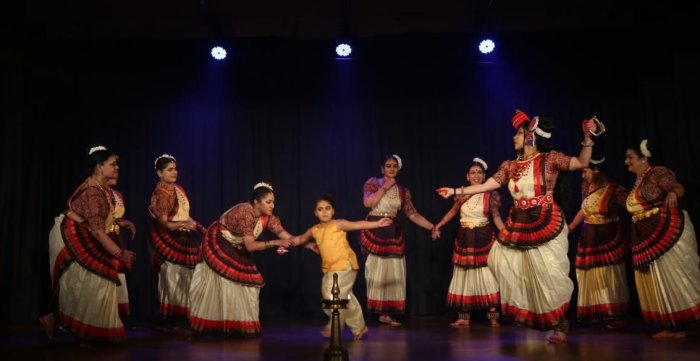 The uniqueness of this performance lies in its collective body language. Originally, 'Poothapaattu', which Dr. Mythili performed in 2025 as a solo, arranged by Guru Dr. Sugandhi Prabhu, has been expanded in the current performance to include new performers and group movements. The poetry that traveled through the body of an artiste in the solo is divided here into many bodies. Through this, not only the characters, but also a village and its memories, fears, beliefs, and collective experiences are formed on stage. The relevance of such an experiment is not in simply presenting Mohiniyattam 'differently', but in rethinking the question of what the identity of Mohiniyattam is. The traditional sensual language of Mohiniyattam is no longer limited to expressing only the beauty and softness of a woman but also serves as a body language that can convey complex experiences such as fear, desire, loss, conflict, and transformation. Similarly, acting expands from presenting a particular expression to creating characters and developing the story. In the ensemble performance, each body is no longer an isolated performance element, but creates characters, spaces, relationships, and conflicts with other bodies. In this sense, 'Poothapaattu' is not just a performance that transfers a literary work to dance. It also becomes an investigation into how far the performance potential of Mohiniyattam can be expanded. At the same time, such interventions also raise a crucial critical question: when does expansion become transformation? While dramaturgy, multiple characters, group movements, and narrative structure offer new possibilities for Mohiniyattam, the boundaries of the traditional form are also redefined. The artistic significance of 'Poothapaattu' lies in this conflict between tradition and innovation. Rather than seeing Mohiniyattam as a repetition of a fixed aesthetic, this performance approaches it as a living performative language that can respond to new stories, bodies, and stage situations. Therefore, it is more than a dance performance, it is also an artistic discussion about how the grammar of traditional art forms is reinterpreted over time. At the same time, the inclusion of Telugu narration in the performance is very notable. 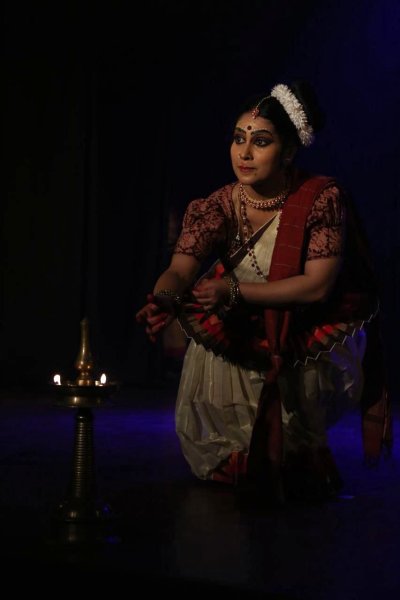 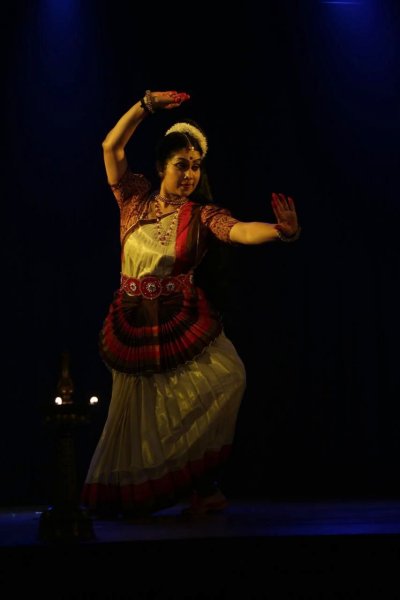 This dance drama combines Nimesh Sharma's musical interpretation of Edassery's poetry, Mohiniyattam's movement language, dramatic character portrayal, and collective visual direction. Prasanna Prakash narrated the performance in Telugu. Veena Unnikrishnan played the role of Sutradhara, Mythili Maratt Anoop as Pootham, Neema Nikhil as Nangeli, Parinika Anoop as Unni, and Avni Nair as Kutty Pootham. Sangeetha, Sithara Nambiar, Sreeja Gopakumar, and Unnati Tiwari were among the mothers in the group. Ultimately, 'Poothapaattu' tells not only the story of a Pootham. It is also the story of how love overcomes fear in humans. A story in which even a transcendental being surrenders to the love of a mother. Therefore, as Pootham travels through the stage looking for homes again and again, she is not only searching for a child but also for the memory of a love she once felt. When the rhythm of the thudi, the sound of the chilamb, and the movement of bodies provide that search, Edassery's poetry comes to life again; this time not only in words, but also in the body, movement, music, and collective memory.  Dr. Shyam Prakash M is an Assistant Professor, Department of Fine and Performing Arts, GITAM University, Hyderabad. He can be reached at shyam.zorba@gmail.com |
