
|     |
|
| |

REVIEW / REPORTCrucible of Honor: the essence of the Ramayana in 90 minutes- Dr Ganga Lakshmi Srinivase-mail: gangalakshmi@gmail.com August 20, 2026 At the Gartner Auditorium, Cleveland Museum of Art, on August 2, 2026 What does it take to make an exhaustively well-known story fresh again? And at the same time make it accessible to those who may at best have a glancing familiarity. How do you present an ancient epic with no dilution for modern sensibilities through an ancient dance in a manner that is still alive and relevant? Guru Sujatha Srinivasan did it by cleaving to the original - the Ramayana of Valmiki - in the great poet's elegant spare Sanskrit verse, choosing core stanzas to convey the story. In a packed and thrilling 90 minutes, Sujatha Srinivasan and Shriya Srinivasan reintroduced the Ramayana to us in brilliant choreography and fresh compositions. This production was commissioned by the Cleveland Museum of Art to spotlight their special exhibit of about 40 Pahari paintings dating to the 1700s titled the Epic of the Northwest Himalayas: Pahari Paintings from the 'Shangri' Ramayana. Visit if you can. Sujatha's Shri Kalaa Mandir company depends on middle and high schoolers to fill out the cast. They were delightful - clearly young, but with clean fluid movements imbued with musicality, on beat, and on point in use of abhinaya. The youngest struck the perfect note as the little mischievous vanaras (Aradhya Balaji, Rhea Anil), squabbling and disorganized, desperately needing a nap, then coming awake to bounce around while wise Jambavan and the older vanaras (Anushree Muralidhara, Samyutha Polaconda, Yuvha Karthikeyan and Janaki Nair as Hanuman) troubleshoot to build the impossible bridge to Lanka from nothing. The next higher tier of dancers moved effortlessly from elegant court companions for Sita in the earlier scenes (Vedanshi Bhat, Saadhika Shankar, Rajanya Bishi) to believable rakshasa guards and soldiers (Aaryaa More, Amudha Pazhanisamy, Chinmayee Ramaswamy and Hima Teegala) strutting in recognizable tropes of swaggering brutality without tipping into caricature. Sujatha's adherence to her Vazhuvoor tradition is evident in every movement - with abhinaya even in the nritta passages, and the pause and silence that gives the audience time to reflect, absorb and receive the next jolt to the emotions. 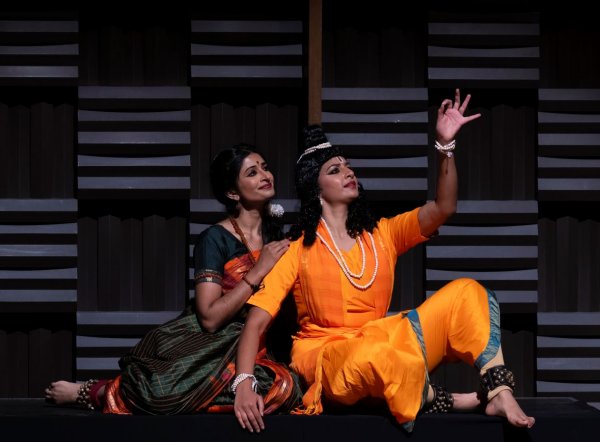 Sita & Rama in Chitrakuta There was plenty of high action and complex jathis but also plenty of sensuousness between the newly wed young Rama and Sita, and years later when Sita coaxes Rama to go after Maricha. These sensuous interludes reinforced the connection between the two at every level - of body and of spirit - accentuating Rama's despair when Sita is abducted. Rama's humility after defeating the rakshasas, and in Janaka's audience hall after he breaks the bow laid the foundation of his character. Sweta Balaji made a commanding Rama, a likeable boy who you can easily see leading the country, physically vigorous and strong, not above rejoicing in his victories but appropriately and believably humble. Sweta visibly matured through the production, from charming princeling to grieving dignified prince, putting his duty to his people and their expectation that their queen would be above reproach before personal joy in Sita's return. Shriya as Sita was grace and elegance, the epitome of womanhood that Sita is supposed to embody, but also not a ninny when she is abducted, displaying presence of mind to lay a trail with discarded jewels. Manthara (Samyutha) portrayed the stereotypical evil hunchback with nuance as a woman looking out for her beloved nurseling Kaikeyi (Guru Sujatha), a bubbly butterfly quickly swayed to self-interest. Lakshmana (Nandita Srikumar) was faultless as the younger brother who never put himself ahead. 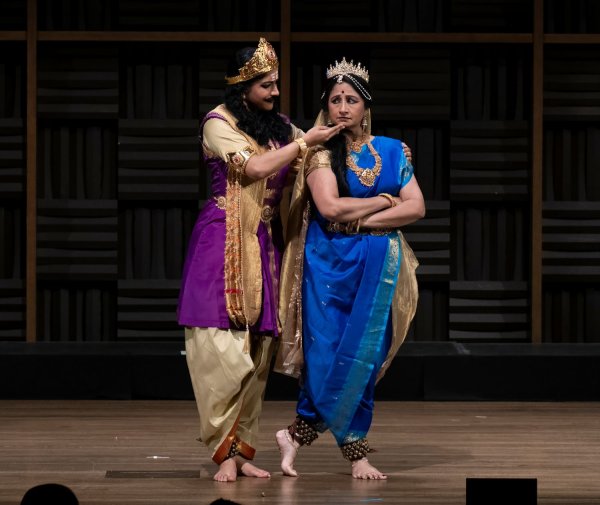 Dasaratha tries to placate Kaikeyi The live music was a treat in and of itself. Senior artist K. Hariprasad composed the music, and his melodious neraval of the key lines of Valmiki's original Sanskrit wove a meditative web around the audience. Simple words - "Iyam Sitā mama sutā" - This is Sita, my daughter - were repeated for the wedding, echoing memories of every father who has sent his daughter away with essentially a stranger, in hope of good fortune for her. "Kanden Kanden" by Arunachala Kavi was transformed into a triumphant anthem of hope that Sita had been found - I had never realized its full impact until sung on that stage with Hanuman racing onstage to present Rama with his beloved's chudamani, her crown jewel. A Pahari folk tune honored the Shangri Ramayana painting collection. 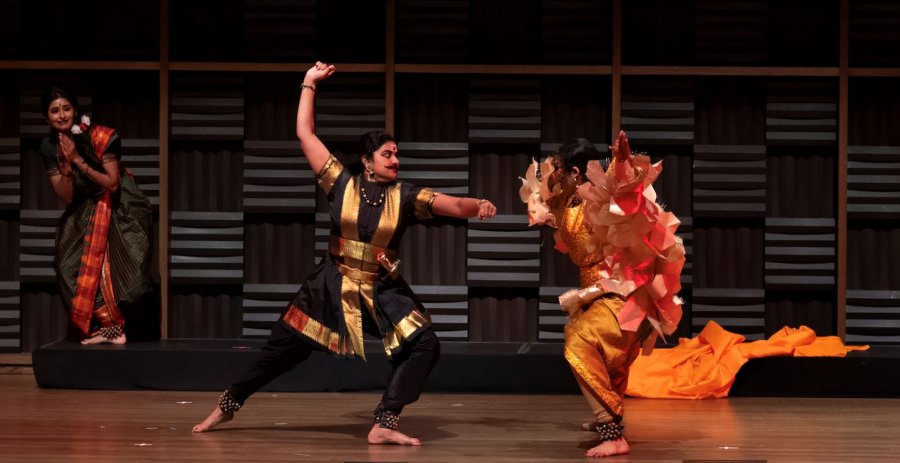 Jatayu confronts Ravana after he abducts Sita Mridangam artiste N. K. Kesavan was extremely effective, using his deep voice synchronized with his mridangam to pound out the heavy jathis for the battle scenes. The nattuvangam was ably handled by Lalit Subramanian until Sita was kidnapped, after which Guru Sujatha took over. Flautist Muthukumar laid a melodious note through the performance, lifting the ensemble. I must make a special mention of young Laya Raghav whose soft violin underpinned the emotive narration by senior dancer Nithya Kasibhatla. The production itself was of high value. Sound and lighting were well balanced and modulated. Scene changes were slick and spare. The costumes for the soldiers and the vanaras were especially effective. Some props worked well, like cloth in shades of red for Sita's agni pariksha, and Ravana's (Sita Vakkalanka) quick drape of a saffron shawl to disguise himself as an innocuous sanyasi before abducting Sita. Some others were distractions. Bharatanatyam has a rich vocabulary to shower affection on a baby - dolls in the queens' arms were incongruous, and in one instance, awkward, as was Maricha wearing fuzzy antlers. Maricha (Aaryaa More) as the golden deer was otherwise a lithe athletic presence, bounding across the stage with swift grace. These are small quibbles. Crucible of Honor enthralled the audience. The silence after the applause as people struggled to come back to the mundane spoke for itself. Sujatha and Shriya Srinivasan are a mother-daughter duo who have delivered in spades in previous productions. This was several levels above previous efforts. I sincerely wish this production could go on the road to a wider audience. 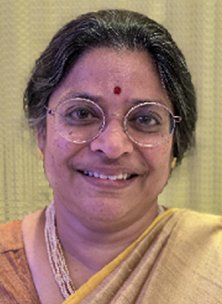 Dr. Ganga Lakshmi Srinivas is a practicing pediatrician in Cleveland, Ohio. Her love for the Indian performing arts began in childhood growing up in a family that reveres music, and has continued to be nurtured in the rich landscape of tenacious teachers and performers who keep traditional arts thriving in the United States. |
