|     |
|
| |

REVIEW / REPORT36th Raindrops Festival- Chandra Anande-mail: chandra6267@yahoo.co.in August 19, 2026 Sam Ved Society for Performing Arts and Uma Dogra presented the 36th Raindrops Festival at the Mini Auditorium of Ravindra Natya Mandir, Mumbai, on July 25, 2026. It is commendable, that a program for the young dancers, giving them a platform to showcase their talent, is being conducted by veteran Kathak exponent Uma Dogra for past 36 years, reverently dedicating it to her Guru Durgalal. This platform started as service to cultural scenario of classical dance, for all genres, is well coveted by performers, choreographers and established artistes alike. Definitely, it ran a full house, as artists of reckoning were curated hosting a treat to the artist fraternity assembled at the event. 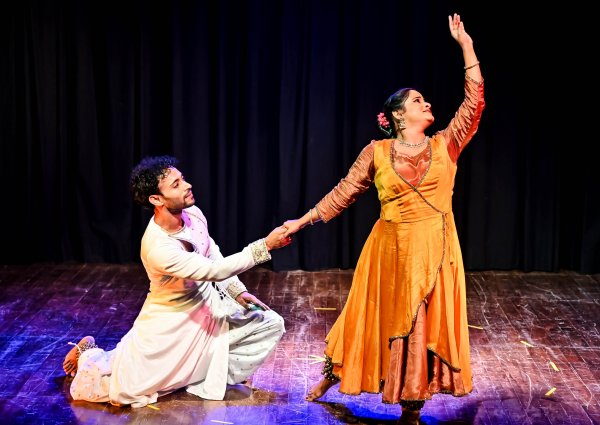 Karthika Unnikrishnan and Avenav Mukherjee 'Beyond' in the Kathak style was presented by Karthika Unnikrishnan, disciple of Guru Uma Dogra, Avenav Mukherjee, disciple of Guru Geetanjali Lal and guest artistes of contemporary genre, Nikhil Dhanke and Nishaasmita. The theme was philosophical expressing oneness of all beings in the universe, the influence of many wonders of nature that nurtures a beautiful life, then comes the awareness that there is an end to all this experience of beauty which is the ultimate truth. And one seeks to go beyond death that gives the lived life a glory through service to society. The theme initiated from a new life of a girl, her growth, the joy she finds in the falling of rain, graceful movement of animals and birds, fragrance of flowers, flow of rivers and her seeking her partner, all tastefully done. The physical intimacy portrayed got a bit stretched out and the point when the protagonist starts to discover the volatilities happening around was not clearly marked. Units of nritta were inserted at the right time. Through a tarana is comprehended the joy of Being. The 4 artistes gave sound performance that was consistent to the dignity of the festival. The recorded music was composed by Manoj Desai, padant recitation was by Uma Dogra, poetry lyrics was by Indrayanee Mukherjee, while the concept and dance choreography was of Guru Uma Dogra assisted by Sumeet Nagdev. 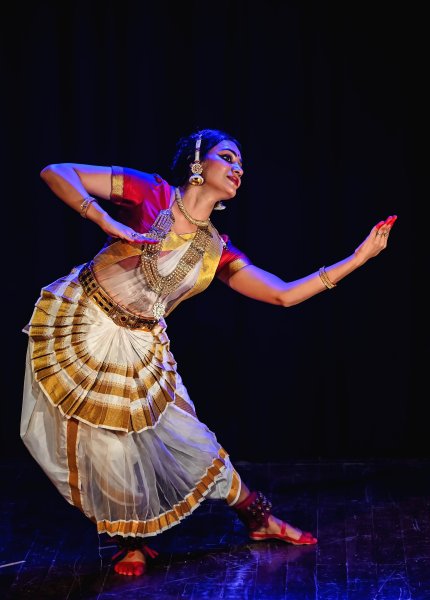 Aneri Sheth Aneri Sheth, student of Guru Mandakini Trivedi, a senior Mohiniattam exponent, presented an ode to Surya, the Sun God. "Prachandam shweta Padma trayam" (Ragamalika, talamalika). Aneri depicted through clear cadences of movements, the mythological imagery of the resplendent Lord Surya Narayan, as the main source of element of fire, the life-giver and nourisher, mounted on his 7 horses. Her angasuddam was good. The music composition was of Kavalam Narayana Panicker. In contrast to the masculine Surya, Aneri honoured 'Basant' as prakruti, the feminine energy. To delineate this, a poetic piece from the Ritu Samhara of Kalidasa was employed, where beautiful imagery of Basant that described lotuses on lakes and lush greenery around gave rise to the intense kaama that is felt in women. This desire is explored in 3 ways in the performance - as a young girl going to the temple only to exchange glances with her beloved, as a beautiful woman, quietly going in the middle of the night to be with her beloved, and third, after a night of lovemaking, a couple wakes up only to find that they ended wearing each other's clothes. The sweet banter that followed, where they dress each other up and dance celebrating Basant, was very entertaining. Music composition was by K.V. Maniappan. Aneri presented 'Jiva' in Anandabhairavi, adi. Through the rising crescendo of the rhythm, it symbolized the merging of the Jivatama with Paramatma. Music composition was by Kavalam Narayana Panicker. The presentation was graceful and gentle. The movements were so choreographed giving a new and fresh look to Mohiniattam genre. All items were choreographed by Guru Mandakini Trivedi. 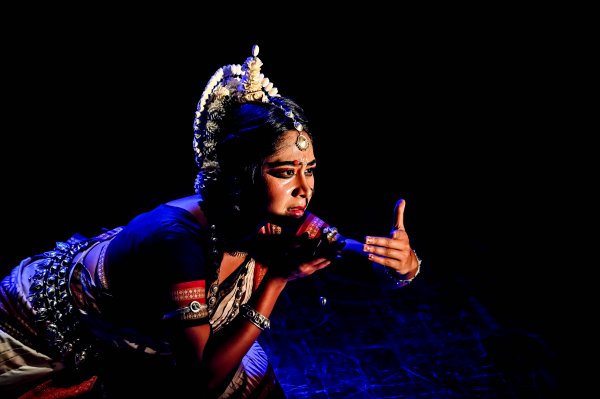 Preetisha Mohapatra Preetisha Mohapatra, student of Guru Ratikant Mohapatra and granddaughter of Guru Kelucharan Mohapatra, presented Pancham Sawari Pallavi. This pallavi, named after its tala rather than its raga, has a complex 15-matra beat, which was innovatively adapted to 4-3-4-4 anga pattern. This pallavi set to raga Chandrakauns, introduced intricate rhythmic patterns that were fast paced. Preetisha's performance was very lively and graceful. In 'Varsha', (Ragamalika / Talamalika), Preetisha rhythmically explored the life giving and nurturing qualities of rain and also its destructive nature through floods etc. The artiste enacted the movements of the animals, the union of lovers in this beautiful season, and the destruction and the tragedy in the aftermath with clarity and aplomb. Here too one can see a modification in make-up application by the artiste. She had worn it like the visage of the idols put up during Durga Festival of Navaratri. Overall, Preetisha proved her mettle in the art form ingrained in her since childhood. In the recorded music, the music composition was by Pandit Raghunath Panigrahi and dance choreography was by Guru Ratikant Mohapatra. 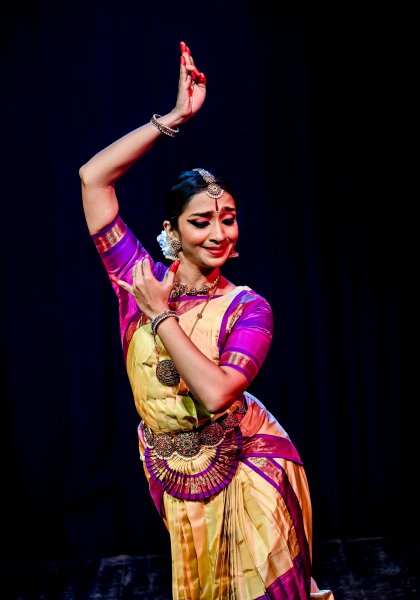 Ramya Suresh Ramya Suresh has learnt from many gurus - Deepa Ganesh, Annapurna Murali, Prabha Ramesh, Nagamani Srinivasa Rao, B. Bhanumati and Sheela Chandrasekhar. She is now under the tutelage of her mother-in-law, acharya Indira Kadambi who is a renowned Bharatanatyam performer, choreographer and teacher. Ramya performed a Kannada varnam, "Swamiye kare thaare" (Amritavarshini, adi) composed by Geeta Seetaraman, with Mannargudi Rajagopala as the hero. The nayika expresses her longing for Venugopala - one who loves to play the flute. She confides in her sakhi, Amritavarshini. She related many stories of Krishna to define his greatness as protector. She described his majestic presence, enchanting smile and other features through a painting. The immersion in the canvas could be simile to doing meditation on the image of god. The korvais and jathis were concluded with beautifully conceived rhythmic and melodic teermanams, effortlessly executed by Ramya. The dance choreography was by Indira Kadambi. It was a very melodius live music ensemble - where on nattuvangam was acharya Indira Kadambi, on vocals was Sujesh Menon, on mridangam was Satish Krishnamurthy and on the flute was Sanjay Shashidharan. 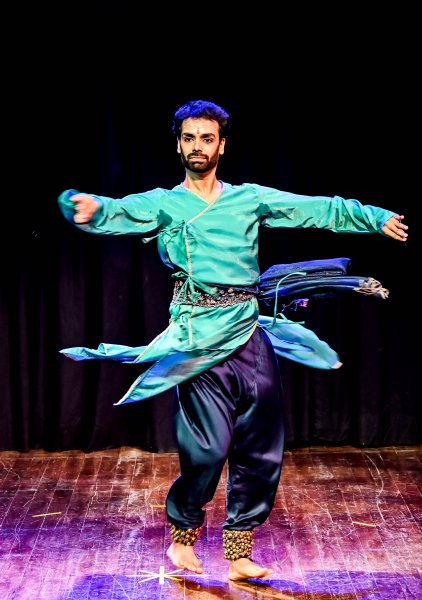 Ravi Yadav The second half of the performance held on same day after an hour interval was also mind blowing. Ravi Yadav, disciple of Guru Pt. Rajendra Kumar Gangani and Dheerendra Tiwari, showcased the Jaipur Gharana. He performed a brief shloka on trinity, followed it with the Chautaal presentation where he performed upaj, thaat, uthaan, paran, aamad and parmelu on tabla bols and pakhawaj bols and a tihai in dhol ke andaaz with aplomb. He performed chakradar toda of Pt. Kundanlal Gangani, and a favourite bandish of Pt. Durgalal in which peacock gaits were represented. The bhajan "Hanuman lalla mere pyare lalla", written by Pt. Jasraj, was presented with great devotion. He charmingly posed as Hanuman, very briefly depicted the story of Hanuman setting fire to Lanka and the attentiveness with which Hanuman brought mountain containing sanjeevani booti that gave life to Laxman was magnificently done. The performance riveted the attention of the audience. 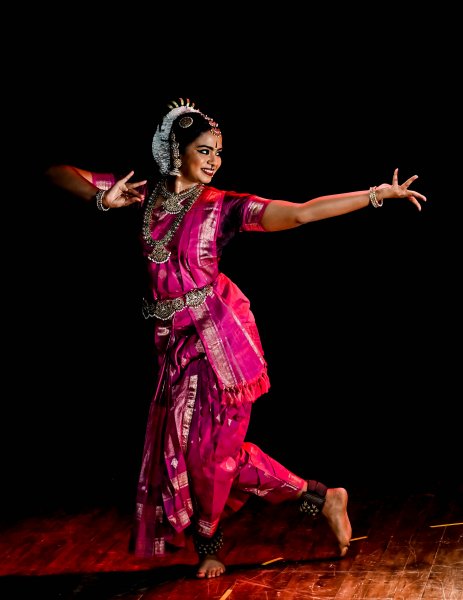 Lekshmi Reghunath Lekshmi Reghunath, disciple of gurus Jaikishore and Padmavani Mosalikanti, and Irina Strahavenka presented Kuchipudi. She enchanted the audience with the rare tarangam "Jaya Jaya Durge", (Ragamalika, adi), an ode to Goddess Durga, written by Narayana Theertha. Lekshmi delineated with clarity, the creation of the Goddess through the combined aura emanating from Lord Brahma, Lord Shiva, and Lord Vishnu. The song goes on to describe the beauty of the anklets adorning her lotus-like feet, out of which the Sama Veda was born. Good poses and padhartha bhava were appreciated. A jati to show confrontation between Durga and Mahishasur was done with aplomb. The balance and grace she exhibited confirmed her strong practice of dancing on the plate. The intricate rhythmic patterns were clearly heard. The recorded music has been jointly scored by Ramesh Jetty and Jaikishore Mosalikanti and dance has been choreographed by Guru Jaikishore Mosalikanti. 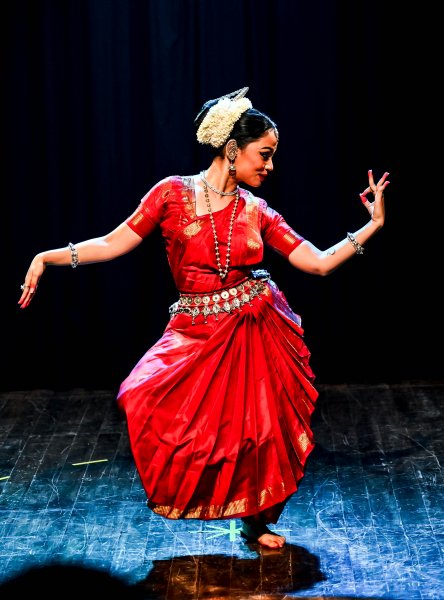 Anoushka Rahman Odissi dancer Anoushka Rahman, disciple of Guru Surupa Sen and Dona Ganguly, is part of the Nrityagram Dance Ensemble. She performed a pallavi exhibiting good energy and vitality maintaining proper chowka and angashuddam. The recorded music composition was by Pt. Raghunath Panigrahi and dance choreography by Surupa Sen. "Sun maiyyā" bhajan written by Sant Surdas relates the story of Krishna. A gopi complains to Yashodha that her son has harassed her many times while Krishna proves his innocence in several ways. Yashodha believes her son to the extreme shock of the gopi. The compere performance was humorous and the performance of the item was stellar. The item was choreographed by Guru Kelucharan Mohapatra. He taught this piece to Protima Bedi who taught to Surupa Sen, who in turn taught it to Anoushka. It was a wonderful treat. Recorded music ensemble had the legend playing mardal and reciting chants. 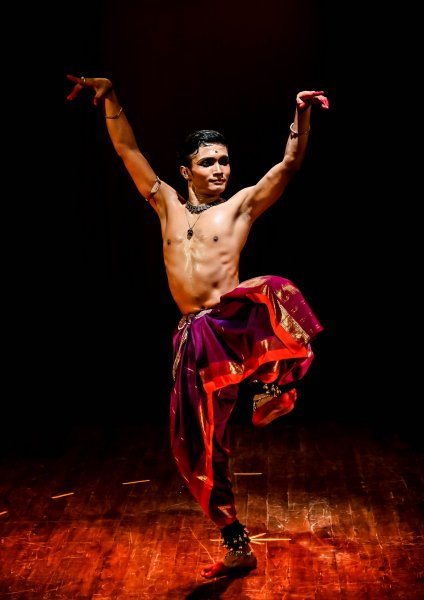 Pritam Das Pritam Das, disciple of acharya Rama Vaidyanathan and acharya Jayita Ghosh, performed Bharatanatyam presenting a thematic presentation, titled 'Adi Purna', which explored the polarity within the Dasa Mahavidya tradition through two seemingly contrasting yet inseparable manifestations of Bhagawati. Sri Kamala is adorned with jewels, Sri Kali is adorned with skulls. Sri Kamala is seated upon the lotus, Sri Kali stands upon Sava (cremation ground). While Kamalamba is the embodiment of compassion, abundance and divine grace, Kalika is the force that dissolves illusion, ego and fear, revealing the eternal truth beyond all appearances. The lotus and the skull symbolise beauty and terror, abundance and transcendence, together reveal the wholeness of the Divine Feminine force. Sri Kamala, the Purna (complete and auspicious) form of the Goddess, and Adya Parameshvari Kalika, the primordial (adi) power that transcends all notions of beauty, fear, life and death. "Hiranmayeem Lakshmi" (Lalita, rupakam) composition of Muthuswami Dikshitar, where music was scored by Dr. S. Vasudevan, to adapt in accordance to give an ethereal ambience to the performance, was utilised to present the form of Sri Kamalamba. And for the form of Sri Kali, the composition of Sadhak Ramprasad Sen was taken, where the music was composed by Dr. S. Vasudevan assisted by Debopriya Adhikary. The dance choreography was by Pritam Das himself. Pritam alternated between the two characters of the bhakta and the Goddess herself. His devotion towards the Goddess was very ingrained in him, witnessed in the way he sacrificed his own head to Kalikadevi, and a certain madness was seen, as he went in circles for his portrayal of the different features of the divine forms. Thus, the Raindrops Festival 2026 stood its mark making the audience promise themselves to return next season.  Chandra Anand is a Bharatanatyam artiste and teacher. She has an MA in Bharatanatyam from Tilak Maharashtra Vidyapeeth, and her series on 'Education in spiritual values through Bharatanatyam' is featured in narthaki.com. |
