
|     |
|
| |

REVIEW / REPORTVimalotsava: A dance tribute to a doyen of the Arts- Satish Surie-mail: satishism@yahoo.co.in Photos: Prof. K.S.Krishnamurthy August 17, 2026 The Seva Sadan Association commemorated the second anniversary of the passing of the late Vimala Rangachar, doyen of the arts, tireless champion of Karnataka's crafts and theatre traditions, and a name synonymous with Malleswaram's cultural life, with 'Vimalotsava' on 1 July. At the heart of the evening was a thoughtfully conceived Bharatanatyam production by Praveen Kumar and his ensemble, who wove together the many dimensions of Vimala Rangachar's life and legacy into a cohesive and evocative dance offering. PRAVEEN KUMAR AND ENSEMBLE 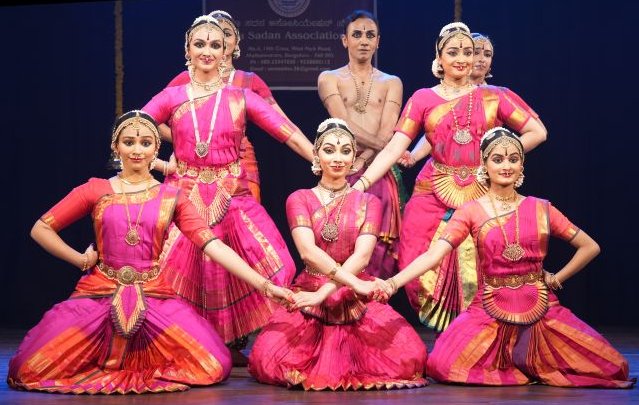 Praveen Kumar and ensemble The performance commenced with a Mallari, whose stately rhythms established the tone for the evening. Rather than serving as a purely abstract invocatory piece, it was imaginatively reinterpreted as a tribute to Vimala Rangachar's personal grace and her lifelong affection for the Kanjeevaram sari, a garment she wore with characteristic elegance. The choreography extended this idea by portraying the very process of weaving. Through synchronised group formations, the dancers suggested the interlacing of warp and weft, transforming the stage into a living loom. It proved a fitting opening that celebrated not only her refined aesthetic sensibility but also her lifelong commitment to preserving India's rich textile and craft traditions. The nurturing and maternal dimensions of Vimala Rangachar's personality were explored through "Kanchadalayadakshi", the piece a metaphor for her own life of service. The compassion embodied by the Goddess found resonance in Vimala Rangachar's contributions to the fields of art, craft, theatre, education, and cultural preservation, reflecting the many institutions she established, guided, and nurtured over several decades. The central presentation was the Daru Varnam set to "Maathe malayadhwaja", in raga Khamas, composed by Harikesanallur Muthiah Bhagavathar. The choreography celebrated the divine energies of Lakshmi, Saraswati, and Parvati while extending to the manifestations of Ganapati and Kartikeya. Alternating passages of intricate nritta and expressive abhinaya, interspersed with vigorous teermanams, sustained the dramatic momentum throughout. The portrayals of Shankari and Chandrakaladhari revealed the serene and compassionate aspects of the Goddess through graceful movement and restrained expression, while the depiction of Chamundeshwari contrasted sharply with commanding energy. Wide eyes, expansive arm movements, and powerful stances effectively conveyed the fierce majesty of the warrior goddess. The descriptive epithets Ruchir Geet, Vividha Samarasa, Sulabh Hridaya, Madhur Swara, and Karuna Sagar were woven seamlessly into the narrative as divine blessings bestowed upon King Krishna Rajendra, celebrated as Sakalajiva Sarvabhaume under the protective grace of the cosmic mother envisioned within the Shashimandala. The ensemble's geometric formations enriched the visual appeal of the Varnam, while imaginative stagecraft added another layer of sophistication. Carefully choreographed entrances and exits culminated in striking tableaux that resembled sculptural temple friezes. The measured interplay between movement and stillness allowed each visual image to linger, giving the audience moments of contemplation before the choreography flowed into the next sequence. 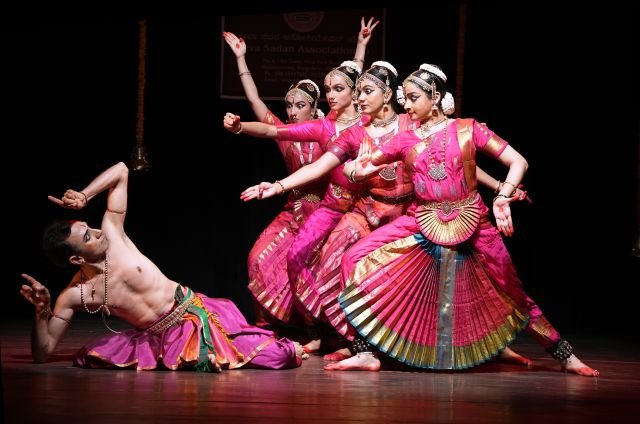 Praveen Kumar and ensemble The dramatic climax arrived with the depiction of the slaying of Mahishasura. Praveen Kumar assumed the role of the buffalo demon with compelling theatrical presence, bringing intensity and dramatic conviction to the confrontation between good and evil. His portrayal heightened the emotional impact of the episode and held the audience's attention until the Goddess's ultimate triumph. The performance concluded with an exuberant Thillana, into which was seamlessly woven a specially composed tribute to Vimala Rangachar by Dr Shatavadhani Ganesh. The verses celebrated her elegance, generosity of spirit, unwavering commitment to the arts, and enduring cultural legacy, bringing the evening to a deeply moving and celebratory conclusion. The success of the production was reinforced by an accomplished live orchestra. Maneesha Parthasarathy's authoritative nattuvangam anchored the rhythmic structure with precision, while Eeshwer Iyer's expressive vocal rendering lent emotional depth to every composition. Harsha Samaga provided a resonant and assured foundation on the mridangam, and Raghu Simha's evocative flute added lyricism and meditative beauty. Together, the musicians created a rich musical landscape that elevated the production into an immersive artistic experience. Taken as a whole, Praveen Kumar's choreographic vision, realised with his ensemble comprising Shreema Upadhyaya, Navyashree, Srujana Purohith, Shreya Gururaj, Akhila Balu, Snigdha Krishna, and Kruthika Menon, transformed biography into dance with remarkable sensitivity. Through the expressive vocabulary of Bharatanatyam, the production spoke of silk and loom, maternal compassion, cultural stewardship, institutional legacy, and the eternal triumph of dharma. Vimalotsava emerged as a fitting homage to a woman whose life had become inseparable from Karnataka's artistic and cultural heritage. NRITYAGANGA PRADARSHAKA KALA KENDRA The second half of the evening featured an engaging Bharatanatyam ensemble presentation by the students of Nrityaganga Pradarshaka Kala Kendra under the meticulous guidance of Guru Roopashree Madhusudhan. The young dancers - Adithi Praveen Koundinya, Ankitha G. Bhat, Lesha S., Meghana M., Shreya Kashyap, Shreya Dixit, Shrinidhi S., and Shriya D displayed commendable discipline, synchronisation, and artistic commitment in a recital that seamlessly combined devotional fervour, technical accomplishment, and expressive refinement. 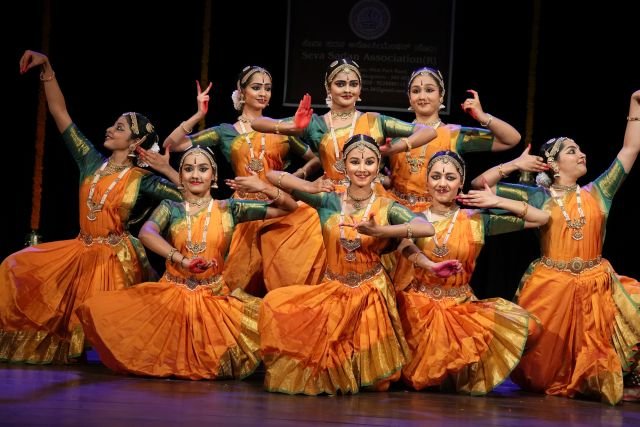 Roopashree Madhusudhan and ensemble The recital commenced with a graceful Pushpanjali in ragam Nattai, interwoven with the Ganesha Bhujanga Stotram. The invocatory piece established an atmosphere of serenity and reverence as the dancers offered floral salutations through elegant movements, balanced geometry, and well-coordinated group formations. Their poised stage presence and clean execution reflected careful training and immediately drew the audience into the spiritual ambience of the performance. This was followed by "Nrityaathi Sambashivo", the celebrated composition of Maharaja Swathi Tirunal in ragam Shankarabharanam set to adi tala. The choreography effectively captured the majesty and exuberance of Lord Shiva's cosmic dance. Vigorous nritta passages, precise footwork, and rhythmic clarity blended harmoniously with expressive sequences that conveyed the divine attributes of Nataraja. The ensemble maintained admirable cohesion while allowing individual dancers brief moments to shine, creating a visually engaging and musically satisfying presentation. The emotional and artistic pinnacle of the recital was the Padavarnam on Goddess Mahakaali in raga Shubhapantuvarali and adi tala, composed by Harshan Sebastian, with intricate jathis composed by Srihari Rangaswamy. The dancers embodied the many dimensions of Mahakaali, portraying her fierce power, protective compassion, and cosmic energy through expansive movements, commanding araimandis, vigorous rhythmic passages, and expressive abhinaya. Their ability to negotiate the complex jathis with precision while sustaining dramatic intensity demonstrated disciplined rehearsal and growing artistic maturity. The carefully crafted choreography balanced vigorous group sequences with expressive narrative episodes, making the varnam the defining highlight of the evening. 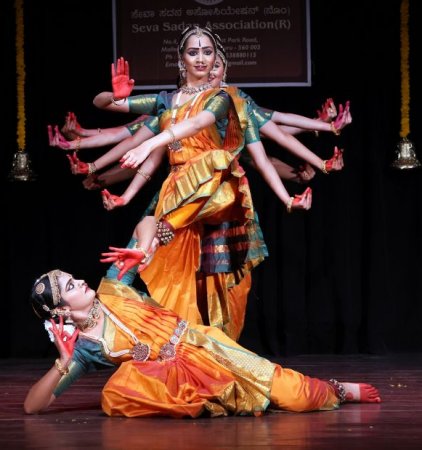 Roopashree Madhusudhan and ensemble A welcome change of mood followed with the evocative Ashtapadi "Sakhi he keshi mathana mudaram". The dancers sensitively portrayed Radha's yearning for Krishna, bringing tenderness and emotional restraint to the stage. Graceful body lines, delicate hastas, expressive glances, and measured pacing allowed the poetry to unfold naturally, revealing the ensemble's ability to move beyond rhythmic virtuosity into nuanced emotional interpretation. The recital concluded with a spirited Thillana in raga Sindhubhairavi set to adi tala, composed by Lalgudi G. Jayaraman. Brimming with youthful energy, the dancers negotiated the brisk rhythmic patterns and intricate choreography with enthusiasm and confidence. Their vibrant stage presence, symmetrical formations, and precise execution created an exhilarating finale that was warmly received by the audience. The concluding Mangalam in raga Madhyamavathi provided a tranquil and auspicious close, returning the performance to the devotional spirit with which it had begun. Throughout the recital, Guru Roopashree Madhusudhan's thoughtful choreography and rigorous training were evident in the ensemble's cohesion, disciplined execution, and confident stagecraft. The production reflected a careful balance between the traditional grammar of Bharatanatyam and aesthetically pleasing group choreography. 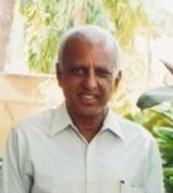 Bangalore based Satish Suri is an avid dance rasika besides being a life member of the Music and Arts Society. |
