
|     |
|
| |

 The Weight of Belonging: Surjit Nongmeikapam's Fountain- Sriradha Paule-mail: sriradha.paul7@gmail.com Photos: Rana Banerjee August 14, 2026 On 1 August, contemporary dancer/performance artist/curator and artistic director of the Nachom Arts Foundation, Surjit Nongmeikapam presented his solo work Fountain at the Goethe-Institut / Max Mueller Bhavan, Kolkata, as part of the Be.long.ing theme. The presentation was curated and produced by Paramita Saha of At the Still Point (ATSP), a community-funded arts platform, and co-founder and director of Artsforward. Fountain was conceptualized, installed, edited, and performed by Surjit Nongmeikapam. The soundscape features Chaoba Thiyam and NAF Collective Sounds, with text by Babina Chabungbam and Suresh Khurajam. The video footage draws from Nongmeikapam's previous works. The presentation was supported by Prakriti Foundation and Nachom Arts Foundation and was originally created for W.I.P. Alt.Fest, Bangalore. 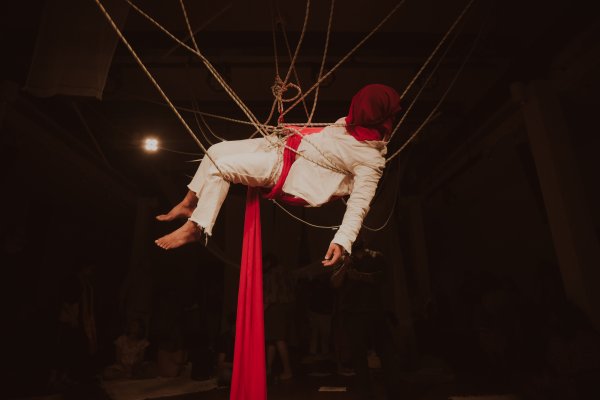 A multimedia performance centered on the theme of belonging, the work unfolded as an immersive environment. As the audience entered, strobing lights illuminated the space, revealing the artist suspended from a single hook attached to his waist. Thick ropes, or cables, formed a web around him, while a red cloth covered his face, one end hanging down. Dressed simply in a white T-shirt and white jeans, his body became the central site of the work. Before the performance began, volunteers informed us that we were free to interact with the work, walk around, and explore the space. Yet almost no one chose to move. The audience collectively remained seated, watching the suspended body. That hesitation immediately became part of the performance for me. The Imphal-based artist Nongmeikapam’s act of suspension unfolded alongside projections that fragmented across moving curtains. His movement was remarkably slow, reflecting his artistic practice as Yangshak Movement—The Art of Practice, a process that reflects his ongoing research and creative exploration. It was a stretched, ongoing exploration in suspension. The physical rigor required to suspend oneself, to entangle and detangle from the web, and to negotiate gravity was evident in every restrained gesture. Watching from a dance and kinesthetic training lens, I found myself thinking about the strength, endurance, discipline, and preparedness required to sustain such a body not only physically but also affectively. How does one remain present while inhabiting a space that is neither fully here nor there? 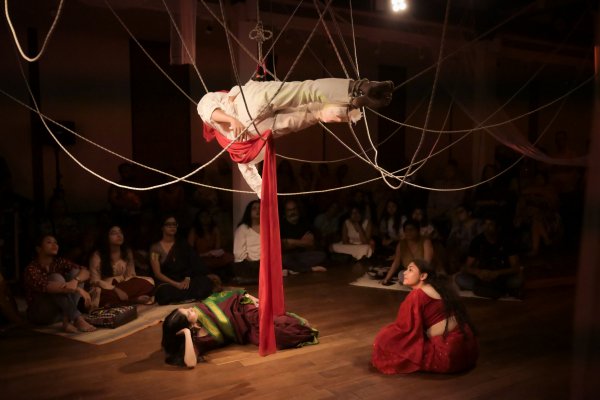 During the introduction, Saha posed a simple yet resonant question: Where do we actually belong? Throughout the performance, Nongmeikapam's suspended body became an embodiment of that liminal condition. Neither grounded nor entirely free, his body occupied an in-between space. The architectural formations he created through suspension transformed the web into a constantly shifting spatial structure. One of the projected texts recalled someone telling him that, to create beauty, he first needed to understand pain. Rather than representing pain, the performance amplified it until it became collective. The discomfort was not confined to the performer; it slowly settled into the room. As this discomfort accumulated, several volunteers quietly walked near the performer, passed by him, and sat close to witness him from different positions. Having met one of them before the performance, I recognized they were part of the event. Their movements and changing postures subtly expanded the choreography of the space. This also made me wonder about the invitation extended to the audience. Why were we given the freedom to move? Was the performance also observing us and our responses? Other than the volunteers, hardly anyone left their seat. Was our stillness a reflection of uncertainty, hesitation, or the political condition the work evoked? Midway through the performance, loose printed texts drifted through the room, further unsettling the relationship between spectator and participant. The soundscape, together with Surjit's question-mark-like suspended body, eventually compelled me to stand up and support him. Initially, it came from concern; he was suspended only from his waist but the gesture quickly became my response to the work. As I held him, I felt him release part of his body weight. Soon afterwards, two other women joined in. Holding him became a shared act. Gravity constantly pulled him downward. In one of the texts, he wrote that he was confused. So was I, and perhaps many of us. His suspended body became a mirror, asking each of us, ‘Where do we belong?’ How do we accept our present condition? Can our movement make any difference? Can dialogue itself become a form of response? Towards the end of the performance, the appearance of the old Doordarshan logo alongside the steadily increasing numbers projected onto the curtains, likely representing the death toll, grounded these questions within a broader political reality. 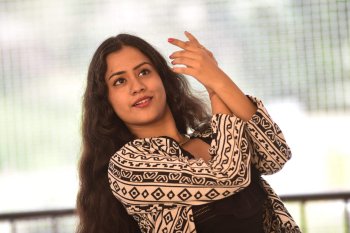 Sriradha Paul is a dancer-scholar specializing in Odissi and third-year PhD student in Critical Dance Studies at the University of California, Riverside. |
