
|     |
|
| |

REVIEW / REPORTGrace in motion: Kavya Deepak's Mohiniyattam recital- Gayathri Vasudevan Arune-mail: gayathrivdevan25@gmail.com August 5, 2026 Every Mohiniyattam recital offers a fresh perspective on a shared classical vocabulary. While the traditional repertoire remains familiar, each dancer brings individual experiences, training, and artistic choices to the stage. Kavya Deepak's recital reflected this balance between tradition and personal interpretation, presenting an evening that combined technical discipline with expressive storytelling. Kavya's artistic journey is rooted in rigorous training across multiple classical traditions. Her Mohiniyattam foundation was established under Guru Kalamandalam Kshemavathy and later refined under Guru Kalamandalam Akshara Bijeesh. The grace, aesthetic sensitivity, and expressive maturity evident throughout the recital reflected the sustained guidance of her Mohiniyattam gurus. In particular, the artistic vision of Akshara Bijeesh was evident in the seamless integration of movement and expression, lending the performance both structural clarity and emotional coherence. Kavya's earlier training in Kathakali under the veteran Guru Kalanilayam Gopi Ashan has further enriched her understanding of classical performance, complementing her artistry while remaining true to the distinctive aesthetics of Mohiniyattam. 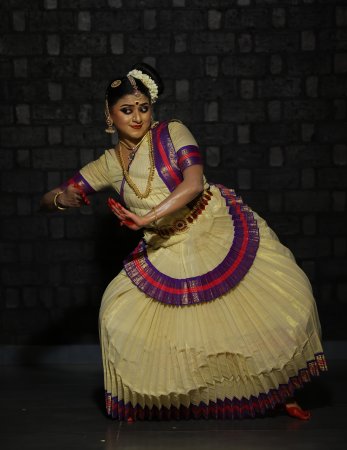 Kavya Deepak performing Mohiniyattam The recital opened with the traditional Cholkettu, set to Ragamalika in adi tala, with music composed by Bijeesh Krishna, chollu by Thrissur Ajith Kumar, jathis by Kalamandalam Charudutt, and choreography by Kalamandalam Akshara Bijeesh. As an invocatory piece, it established a devotional atmosphere while introducing the audience to the structural and musical framework of the performance. Kavya presented it with a steady sense of laya, controlled body movements, and measured execution, reflecting her strong grounding in the fundamentals of the form. The recital then moved to the Varnam, composed by Kilimanoor Madhu, set to music by Payyannur Jagadeeshan Master, and choreographed by Acharya Leelamma Teacher. Rendered in raga Charukeshi and adi tala, the Varnam formed the emotional and artistic centrepiece of the recital. Based on the story of the celestial maiden Urvashi, it explored emotions ranging from longing and pride to devotion and surrender. Kavya approached the role with restraint, allowing the character to evolve through subtle yet effective abhinaya while sustaining emotional continuity without theatrical excess. 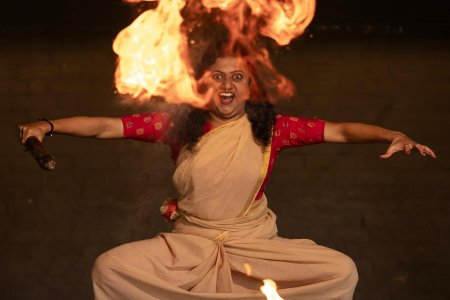 Kavya Deepak in Navarasa Sadhana One of the most compelling aspects of the recital was the maturity of Kavya's abhinaya. Her expressions unfolded with quiet restraint, allowing emotions to emerge naturally while preserving the introspective elegance that defines Mohiniyattam. The influence of the Navarasa Sadhana training conducted by Guru Venu G. at Natanakairali was particularly evident in the emotional clarity, nuanced use of the eyes, and layered interpretation of the characters. Guru Venu G. emphasises that the eyes are the artiste's most powerful medium of emotional communication, and the disciplined eye exercises that form an integral part of the Navarasa Sadhana practice were clearly reflected in Kavya's performance. This training enhanced the communicative power of her abhinaya, enabling subtle emotional transitions to register with remarkable clarity. Its impact was especially evident in the Varnam and the Surutti Padam, where her expressive control brought depth, authenticity, and emotional resonance to the portrayal of the characters. The Varnam also demonstrated her ability to balance nritta and abhinaya. Clean footwork, fluid torso movements, and seamless transitions between pure dance passages and expressive sequences resulted in a presentation that remained cohesive throughout. The emotional atmosphere continued with the Surutti Padam, Alarshara Parithapam. Kavya portrayed the Virahotkanthita Nayika, who confides in her sakhi about the anguish of separation from her beloved Padmanabha. As memories of their time together return, she speaks of being struck by the flower arrows of Kamadeva. Kavya's restrained abhinaya allowed the emotions to unfold naturally, while the concluding moment, in which the sakhi agrees to carry the heroine's message, offered a gentle transition from longing to hope. The Tillana, composed by the violin maestro Lalgudi Jayaraman in Madhuvanti raga, brought a vibrant contrast to the programme. Even as the tempo increased, Kavya retained the softness that characterises Mohiniyattam. The choreography was deceptively simple, demanding precision and command over laya, which she negotiated with confidence while maintaining clarity of movement and technical control. The accompanying orchestra contributed significantly to the success of the recital. Kalamandalam Akshara Bijeesh's nattuvangam provided a firm rhythmic foundation, while Bijeesh Krishna's vocal support complemented the dancer's interpretation with sensitivity. Naveen Anand's mridangam sustained the musical vitality of the performance, and Adarsh Ajaykumar's violin added warmth and lyrical depth. The coordination between the dancer and the musicians remained consistently assured throughout the evening. The recital concluded with a Vandana shlokam. As Kavya offered the final prayer, her eyes glistened with emotion, revealing a quiet sense of fulfilment that resonated deeply with the audience and brought the performance to a graceful close. What stood out over the course of the evening was Kavya's unwavering commitment to the aesthetic essence of Mohiniyattam. Her performance did not depend on dramatic effect or elaborate presentation. Instead, it drew its strength from measured movement, controlled expression, and a clear understanding of the form. The recital reflected the influence of her gurus while also revealing an artiste steadily shaping her own artistic identity. Kavya Deepak's recital served as a reminder that Mohiniyattam continues to find renewed expression through dancers who remain deeply rooted in tradition while engaging with it thoughtfully. Supported by an accomplished orchestra and strengthened by years of dedicated training under her gurus, she presented a recital that remained true to the spirit of the form and left the audience with an evening of refined, evocative, and memorable classical dance. 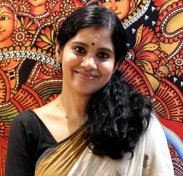 Gayathri Vasudevan Arun is a software engineer by profession and a Mohiniyattam practitioner based in Frankfurt, Germany. |
