
|     |
|
| |

REVIEW / REPORTBhanakam- Tapati Chowdhuriee-mail: tapatichow@yahoo.co.in Photos courtesy: Chidakash Kalalay July 25, 2026 Sangeet Natak Akademi, New Delhi, an autonomous of body of the Ministry of Culture, Government of India presented Uparupakam Bhanakam in Sanskrit, Brajabuli and Hindi on the 9th of June 2026, a 75 minute long drama performance as a part of the Festival of Performing Arts, featuring recipients of the Sangeet Natak Akademi Awards for the years 2022 and 2023. Artistic Director and Guru Piyal Bhattacharya presented his disciples in his unique composition Uparupakam Bhanakam: From Avyakta to Prapanca. There are performances that seek to entertain, performances that seek to impress, and performances that seek to communicate an idea. Bhaṇakam, conceived and directed by Piyal Bhattacharya, belongs to a rarer category. It functions less as a performance in the conventional sense and more as an unfolding process of sadhana - a sustained inquiry into the nature of manifestation, perception, and embodied knowledge. Rooted in the Indic performance traditions yet refusing the rigidity of categorization, Bhaṇakam occupies a unique position within the contemporary performing arts landscape. When Piyal Bhattacharya returned from Kerala Kalamandalam more than fifteen years ago and began his journey within the wider diaspora of Natya, the destination may not have been fully charted. Yet there was never any ambiguity regarding the foundations of that journey. His work has consistently reflected a deep faith in Indic knowledge systems and in the transformative possibilities of sampradayabhimukhi shiksha - a mode of learning grounded in lineage, practice, and lived experience. Around 2016, Bhaṇakam emerged as one of the principal vehicles of this artistic exploration. Derived from the Sanskrit root bhaṇ - to speak, utter, or articulate - the form belongs to the rich tradition of the Upa-rupakas. Under Bhattacharya's stewardship, however, it has evolved beyond a dramaturgical category. It has become a pedagogical tool, a space for experimentation, and a means of articulating insights accumulated through decades of training across multiple disciplines. At the heart of the production lies a simple yet profound movement: from Avyakta to Prapanca, and from Prapanca to Laya. The performance began in a state of primordial repose. Before names, forms, and actions had emerged, there existed the Avyakta - the unmanifest source from which all experience arose. In that state there was neither narrative nor character. There was only latent possibility, an interior pulsation, a subtle spanda awaiting articulation. The imagery recalled the silent resonance of a veena before the first note was struck and when sound existed only as potential. Gradually this latent vibration unfolded into Prapanca - the manifested world of names, forms, movements, and relationships. The production does not present this process as a linear story but as a progressive revelation. Through movement, rhythm, gesture, and voice, the audience witnessed the emergence of differentiated existence from an undifferentiated source. The ascent of Kundalini served as both metaphor and performative structure, suggesting the gradual awakening of awareness through successive layers of experience. What distinguishes Bhanakam is that these ideas are never reduced to intellectual propositions. Philosophy here remains embodied. The body becomes a site of remembering. Rhythm becomes a mode of cognition. Gesture becomes a vehicle of revelation. The production's success lay precisely in its ability to transform abstract concepts into lived theatrical experience. The journey ultimately returns to its point of departure. The manifest world dissolves into the unmanifest. The articulated note merges once more into anahata nada. Movement settles into stillness. Form returns to formlessness. This movement from Avyakta to Prapanca and finally to Laya became not merely the thematic structure of the production but it became the reflection on the larger rhythms that govern individual existence, artistic creation, and civilization itself. Bhattacharya's vision has been shaped through decades of engagement with an extraordinary range of disciplines - Rudra Veena, Dhrupad, Kuṭiyaṭṭam, Kathakali, Kalaripayattu, Bharatanatyam, Mohiniyattam, and sustained encounters with Western theatre traditions across Europe and North America. Yet these influences never appear as a display of eclecticism. Rather, they have been absorbed into a coherent artistic language whose unity arises from practice and lived experience rather than theoretical synthesis. 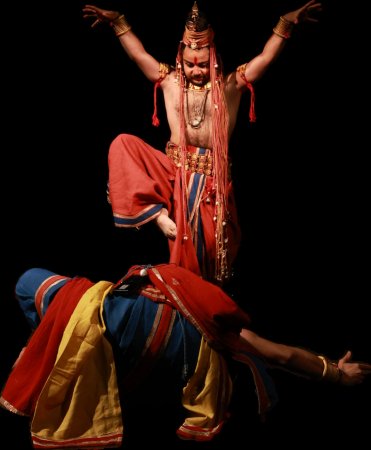 Akash Mallick & Pinky Mondal 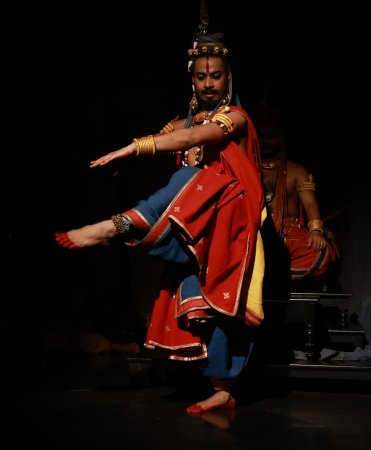 Sayak Mitra The performers - Sayak Mitra, Akash Mallick, and Pinky Mondal - occupy a vital place within this evolving tradition. Having trained under Bhattacharya for well over a decade, they demonstrated not merely technical accomplishment but an internalization of process. Their performances revealed individual artistic identities while remaining deeply rooted in a shared discipline. One senses not the repetition of a style but the continuation of a lineage. Sayak Mitra and Akash Mallick have been conferred the Ustad Bismillah Khan Yuva Puraskar by the Ministry of Culture, Government of India. The recognition arrives as a fitting acknowledgment of years of perseverance, dedication, and disciplined practice. Those familiar with their journey may view this honour not simply as an award but as the natural fruition of a commitment to kala-seva - a mode of engagement in which artistic practice becomes an offering rather than a profession. Within the broader narrative of Bhanakam, the recognition serves as a reminder that authentic artistic traditions continue to flourish through devotion, patience, and transmission. Equally indispensable to the production is its Kuṭapa - the musical ensemble. Bharata's conception of the Kuṭapa as a collective creative force finds meaningful expression here. Abhijit Ray's Kacchapi Vīṇa, Subhendu Ghosh's Mattakokila Vīṇa, Shiuli Chakraborty's voice, Mithun Chakraborty's mṛidaṅga, and Rik Mukherjee's flute create a sonic environment that moves fluidly between meditation and dramatic intensity. This year's presentation is further enriched by the addition of Dipanwita Acharya's vocals and Khokon Das's dhak. Together they created not accompaniment but atmosphere, not background but presence. The music breathed with the performance and often became its emotional and philosophical anchor. 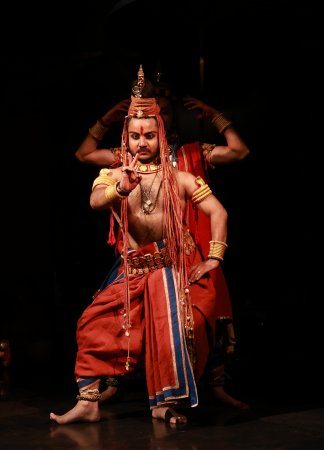 Akash Mallick 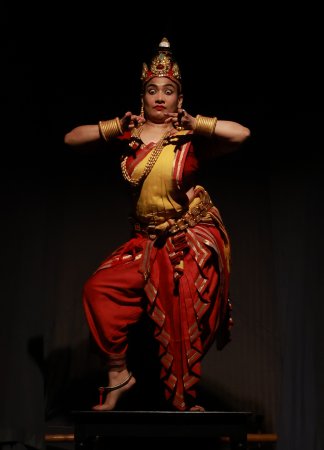 Marga Natya A special mention must be made of the lighting design by Rudrarup Mukhopadhyay. In a production so deeply concerned with manifestation and concealment, illumination assumes a role far beyond technical necessity. Mukhopadhyay approaches light not as ornamentation but as a philosophical medium. His design participates actively in the dramaturgy, entering into dialogue with the performers, the music, and the conceptual architecture of the work. Particularly striking is his nuanced negotiation between light and darkness. Darkness is not treated as absence but as a fertile field from which perception emerges. Equally memorable are the luminous blues that repeatedly shape the visual atmosphere of the performance, evoking states of inwardness, contemplation, and transcendence. Most remarkable, however, is the uncompromising white cast upon the umbrella in crucial moments of the production. Through this simple yet powerful intervention, an ordinary object is transformed into a symbol of extraordinary evocative power. The image remained suspended in memory long after the performance concluded. Mukhopadhyay's design demonstrated how light can become a mode of thought, capable of articulating ideas that language itself often struggles to express. Taken as a whole, Bhanakam resists easy categorization. It is neither dance-drama nor theatre in the conventional sense, neither ritual nor concert, though it draws nourishment from all these domains. In many ways, this resistance to fixed definition is precisely what makes the work significant. Like the Upa-rupaka tradition from which it derives inspiration, it remains open, fluid, and exploratory while remaining firmly anchored in discipline. In an age increasingly governed by speed, fragmentation, and spectacle, Bhanakam offers something rare: a performance that asks not merely to be watched, but to be inhabited. It invites the spectator into a contemplative journey - from Avyakta to Prapanca, from Prapanca to Laya - and in doing so reminded us that the deepest function of art may still lie in its ability to reconnect practice with knowledge, experience with meaning, and the individual with the enduring rhythms of civilization.  Tapati Chowdhurie trained under Guru Gopinath in Madras and was briefly with International Centre for Kathakali in New Delhi. Presently, she is a freelance writer on the performing arts. She is the author of 'Guru Gopinath: The Making of a Legend.' Tapati received the Sangeet Natak Akademi Award for 2024 for Art Critique in Performing Arts. |
