
|     |
|
| |

REVIEW / REPORT'Kundalini' and 'Bhoomi' by Yamini Muthanna- Satish Surie-mail: satishism@yahoo.co.in July 22, 2026 KUNDALINI Photos: Prof. K.S.Krishnamurthy Yamini Muthanna's thematic Bharatanatyam presentation 'Kundalini', held at the Bangalore International Centre on the 26th of May, was an ambitious and deeply considered work that traced the awakening and ascent of Kundalini Shakti through the seven chakras of the human body. Drawing on the rich philosophical traditions of Tantra, Yoga, and Hindu cosmology, Yamini constructed a performance that was as intellectually rigorous as it was visually compelling, offering her audience both an aesthetic experience and a meditative journey through the inner universe. The production opened with a striking and memorable image. The artiste was discovered curled within a cradle suspended from the ceiling, her body folded inward in a posture of dormancy. As her hands and limbs slowly unfurled, reaching outward into space, the gesture carried unmistakable symbolic weight. This was the awakening of the Muladhara, the root chakra, the very seat where Kundalini Shakti lies coiled at the base of the spine in its primal, sleeping state. The image was arresting precisely because of its economy. Without a word, without a beat of music, Yamini had already communicated the essence of her subject, the transformation from inertia into becoming. The performance was supported throughout by explanatory slides that illuminated the attributes of each chakra as the dancer progressed upward through them. Far from being a distraction, this curatorial choice proved thoughtful and generous. The slides anchored the performance in the classical framework of the seven energy centres, from the earthy density of Muladhara ruled by Dakini Shakti, through the fluid emotionality of Svadhisthana, the fiery will of Manipura, the compassion that blooms at Anahata, and the luminous wisdom of the higher centres, until the journey reached the Ajna chakra, the seat of perception and intuition where duality begins to dissolve. Each station was rendered with care, and the slides ensured that even those new to this philosophical terrain were drawn into the logic and wonder of the ascent. 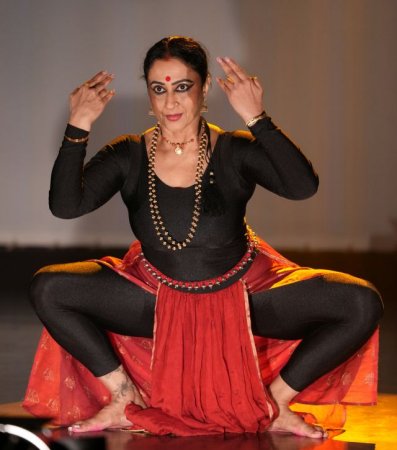 What distinguished the work was Yamini's choreographic vocabulary. She wove together yogic postures, the classical grammar of Bharatanatyam, and the freedom of contemporary movement into a single, coherent language. The transitions between these modes were handled with skill and sensitivity. The classical abhinaya of Bharatanatyam, with its precise hand gestures and expressive facial language, gave form to the mythological and symbolic dimensions of the chakras. The yogic sequences grounded the work in the somatic reality of pranic energy, lending the body's stillness and extension a meditative quality. The contemporary idiom, meanwhile, allowed for a rawness and immediacy that connected the ancient tradition to the present moment and to the lived experience of the body in motion. The second segment of the performance turned its attention to the Muladhara chakra with renewed intimacy and detail. Yamini evoked the presiding deity Rakini, whose four arms shone with a radiant beauty and whose eyes blazed with a brilliant red intensity. Rakini, the guardian of this primal threshold, was presented not as a fearsome figure alone but as a bearer of revelations, a conduit of ever-pure intelligence emerging from the densest layer of earthly existence. The choreography captured this paradox with eloquence, suggesting that even at the root, where matter is heaviest and consciousness most dormant, the seed of illumination already dwells. The transition into the Svadhisthana chakra brought with it a shift in atmosphere and elemental quality. Yamini introduced the governing presence of Varuna, lord of the ocean, riding upon his vehicle, the Makara, that ancient sea creature whose fluid and mysterious nature perfectly embodied the watery essence of this centre. The association of the chakra with the moon was made palpable through the quality of movement itself, which took on a softer, more undulating character. The dancer established the youthful form of Vishnu as the presiding deity and invoked the intoxicated, ecstatic aspect of Goddess Lakshmi in her Shakti form as Rakini, a presence trembling with creative and sensory abundance. The most visually memorable moment of this segment arrived when Yamini took up a ball of light to articulate the full power of the womb as it is understood within the philosophy of this chakra. The device was used with restraint and to powerful effect. The luminous sphere became a symbol of the lunar feminine, of the deep generative intelligence housed within the body's most intimate centre. It was a gesture that spoke across the boundary of classical convention into something immediate and felt, reminding the audience that the chakra system is not merely a cosmological abstraction but a living map of human experience. As the Kundalini energy continued its ascent, Yamini made a deliberate and perceptive choreographic choice. Recognising that the energy becomes progressively subtler as it rises through the upper chakras, she shifted her approach to one rooted in the register of human emotion. For Manipura, the solar plexus chakra with its fierce fire and concentrated will, she drew upon the language of power and self-assertion. Moving into Anahata, the heart centre whose very name speaks of the unstruck sound and of bliss, the quality of expression opened into tenderness and an expansive compassion that seemed to enlarge the space of the performance itself. At Vishuddha, the throat chakra wherein sound becomes the supreme element and truth its governing force, Yamini's movement took on a quality of clarity and purification. The body seemed to refine itself, as though the dancer were herself becoming an instrument of vibration rather than merely a performer moving through choreographed space. The final station of the evening's journey, Ajna, the third eye chakra whose name means both to command and to perceive, was rendered as an awakening to light. Here the duality of performer and performance, of dancer and dance, appeared to thin. The audience was drawn into a state of heightened attention that mirrored the dissolution of ordinary perception that the Ajna chakra itself is said to bring about. It was at this supreme moment that Yamini gave the evening its most quietly devastating image. With the release of the Rudra Granthi, the third and most formidable of the energetic knots whose piercing demands the surrender of all psychic power and intellectual pride, the artist collapsed to the ground in a final oblation of peace. The fall was not one of defeat but of complete dissolution, the body offering itself entirely, emptied of striving, emptied of self, returned at last to stillness. In that single gesture, the entire philosophy of the Kundalini journey was made visible. The long ascent through earth, water, fire, air and ether, through attachment and longing and illumination, arrived not in triumph but in surrender, and it was in that surrender that the deepest peace resided. It was an ending of rare integrity, and it left the auditorium in a silence that felt, for a moment, wholly sacred. 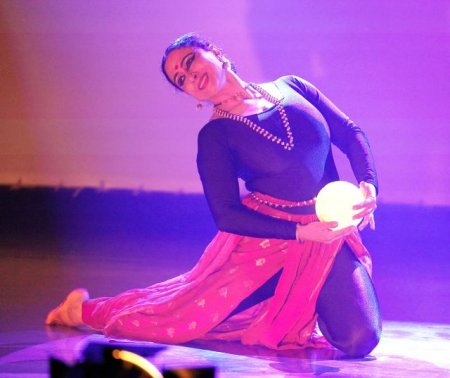 Taken together, this progression through the upper chakras demonstrated Yamini's most assured artistic instinct. Rather than attempting to illustrate each energy centre through external symbol or narrative device alone, she allowed the rising arc of human emotion to become the vehicle of understanding. Joy, longing, compassion, awe, clarity and finally the stillness of inner vision were not described but enacted, making the invisible journey of Kundalini legible through the most universal of languages, the feeling body itself. The performance was elevated considerably by the hypnotic presence of a live orchestra, whose contribution proved to be far more than accompaniment. Composer and flautist Ramakrishna Raghunandan led the ensemble with assured command, and his flute traced the arc of the Kundalini's ascent with a voice that seemed to move between the earthly and the ethereal with extraordinary ease. The flute, always an instrument associated in the Indian tradition with the divine and the transcendent, was a particularly felicitous choice for a work of this nature, its breath-born sound echoing the very pranic energies that the dancer was giving form to on stage. Supriya Raghunandan's vocals brought warmth and spiritual depth to the soundscape, her voice serving at times as an invocation and at others as a current of feeling that ran beneath and through the choreography. There were moments when the interplay between voice and movement felt genuinely symbiotic, as though the dancer and the singer were tracing the same inner landscape from different directions simultaneously. Kartik Vydhatri on the percussion held the rhythmic foundation of the performance with sensitivity and intelligence, never overwhelming the meditative quality of the work but providing the pulse that kept the journey grounded even as the energy ascended toward the more rarified reaches of the upper chakras. Shashidhara Narasimha Swamy's cymbals added a ceremonial dimension to the sound, their shimmering resonance marking moments of transition and arrival with the quality of ritual punctuation. Together, the musicians created an immersive sonic environment without being intrusive and devotional without being didactic. The live orchestra transformed the evening from a dance recital into something closer to a sacred offering, and in doing so, it honoured the profundity of the subject that Yamini had set herself to explore. Yamini brought considerable verve and vitality to the work throughout. It was a fully integrated offering in which the physical and the philosophical informed each other at every turn. The ascending structure of the piece, mirroring the rise of Kundalini through the sushumna nadi toward its final union with pure consciousness, gave the work a sense of gathering momentum and spiritual urgency. Kundalini was a work of genuine ambition, and Yamini met that ambition with artistry, scholarship, and a performer's instinct for the stage. It was an evening that reminded its audience that the body, in the hands of a committed dancer, could become a map of the cosmos itself. BHOOMI Photos: V.B.Suresh The stage at Medai received, on the eleventh of June, a work of quiet ambition. 'Bhoomi' choreographed and performed by Yamini Muthanna, took as its thematic spine the life of Sita, tracing her from her miraculous emergence from the earth to the moment she sat captive in Lanka, held in the grip of a force she had not invited and could not yet escape. The production framed this ancient narrative not as scripture merely retold but as an inquiry into the feminine condition as it moves through grace, displacement and an inexorable reckoning with power. 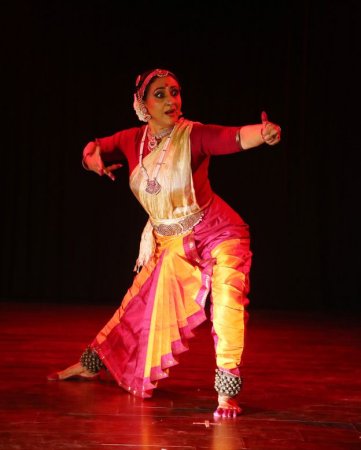 The work opened with cosmological necessity. King Janaka, pressed by a devastating drought, resolved to perform a Yagna to propitiate Goddess Lakshmi. The choreography rendered the ritual with measured solemnity, the body becoming both supplicant and vessel. It was in the act of ploughing the parched earth that the king discovered a box, and within it a child. The naming of Sita, child of the soil, who called herself Bhoomi, carried in Yamini's rendering a tenderness that grounded everything that followed in the literal earth of her title. The girl grew, and the production charted her education with a fluency that moved between domains - music, the arts, the domestic knowledge of the kitchen and, strikingly, the martial discipline of warfare. This breadth of formation mattered because it established Sita not as a passive heroine awaiting her fate but as a figure of cultivated capability. The pivotal encounter with Shiva's bow arrived through the most domestic of accidents. A ball, errant in play, rolled into the chamber where the great bow rested. Sita moved the bow to retrieve it, the gesture unremarkable to her, and was observed by Janaka. The svayamvara that followed was no mere dramatic convention; in Yamini's hands, it became an acknowledgement that the earth's daughter carried within her an elemental force that recognised itself in celestial weight. Rama lifted the bow. The marriage was sealed. The two registers of the narrative, the terrestrial and the heroic, had found their axis. The forest sequences unfolded with a gathering dread. The golden deer, that most irresistible of illusions, drew Rama away, and the false cry that mimicked his voice compelled Lakshmana to follow. The Lakshman Rekha, those three lines drawn in protection that became a line of fatal consequence, was rendered with precise choreographic tension. Ravana arrived in the guise of a mendicant, and the hospitality that Sita extended, the reaching across the threshold, was portrayed as an act of moral instinct weaponised against her. The abduction carried the weight of a world overturned. Jatayu's battle with Ravana was among the production's most kinetically arresting passages. The aged eagle, guardian and witness, fought until his wings were clipped, and the image of his broken resistance lingered as the narrative moved into the desolation of Lanka. Sita's confinement was rendered not with operatic grief but with a contained sorrow, a dignity that refused collapse. 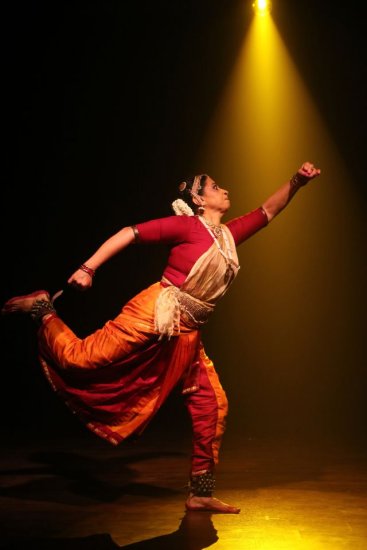 Hanuman's arrival rewove hope into the telling. His crossing of ocean and mountain, conveyed through movement that seemed to compress vast geography into the body's own arc, culminated in the presentation of Rama's signet ring. The ring passed between outstretched hands as an act of metaphysical tethering, and Yamini made palpable the surge of relief and renewed will that it carried. Hanuman's burning of Lanka punctuated the moment with an emphatic shift in the production's emotional register. The final movement brought Bhoomi to its most unexpected and resonant destination. Mandodari, wife of Ravana, petitioned her husband for Sita's release. He refused. Mandodari then chose to visit Sita herself, and what she encountered arrested the production in its tracks: Kali, dancing. The image closed the narrative without resolution, offering instead an aperture, a vision of the fierce feminine that neither captor nor the logic of possession could contain or account for. It was a finale of considerable dramatic intelligence, one that transformed the recounting of Sita's suffering into a statement about the nature of power itself. The musical composition by Karthik Hebbar provided the production with a layered sonic architecture. Karthik Vydhatri on the mridangam and pads gave the rhythmic passages their muscle and pulse, while the flute, by Nithish Annamayya, threaded a lyrical softness through the more intense sequences. Hebbar's vocalisation ranged across Sanskrit, Telugu, Kannada and Tamil, and this multilingual movement was not mere stylistic variety but a dramaturgical choice: each language brought its own tonal colouration and cultural resonance to the story, reminding the listener that Sita belongs to no single telling. Bhoomi was, in sum, a work of considered craft and genuine feeling. Yamini wove movement, mime and rhythm into a continuous expressive fabric, and the string of anecdotes that constituted the narrative cohered into something more than an episodic sequence. The earth claimed Sita at the beginning. By the end, it was apparent she had never truly left it.  Bangalore based Satish Suri is an avid dance rasika besides being a life member of the Music and Arts Society. |
