
|     |
|
| |

REVIEW / REPORTShadows in the black box: Choreographing the triptych- Dr Rajiv Rajamanie-mail: rajivrajamani@yahoo.com Photos: G5A July 16, 2026 BIJAYINI SATPATHY'S "TRIKAYA" G5A ARTIST IN RESIDENCE, JUNE 2026 Residency Greenhouse Can a brief residency truly bend a classical Odissi vocabulary to meet the modern urgency of gender fluidity? What happens when a single body navigates the vast emotional spectrum between Arjuna's vira rasa, Urvashi's shringara, and Brihannala's profound duality? And does the score merely replicate a traditional template, or can we hear the fresh imprint of the studio cauldron in the mardala's shifting ukutas and unconventional vocal phrasing? 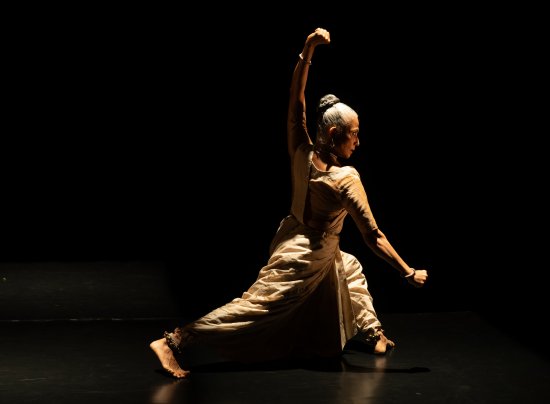 Sinew and Silk The performance opens with the unyielding scale of Arjuna the warrior. We witness the martial efflorescence of a kshatriya receiving his weapons - each one tested with a fierce, exaggerated fluidity that pauses only to freeze the sheer geometry of power. Bijayini Satpathy anchors the heroic stature of Arjuna in a remarkably deep, expansive chowka, transforming Odissi's foundational square stance into a potent locus of warrior authority. Her superbly conditioned body - an absolute pleasure to watch in its muscular precision - carries this weight effortlessly, utilizing sharp torso deflections (bhanga) and commanding footwork to project an unshakeable, epic grandeur. But the true genius of the choreography lies in its sudden, radical compression of scale. From the grandiosities of combat, the movement dissolves into a shimmering flutter of the left hand near the navel. With absolute narrative mastery, Bijayini's gaze tracks the microscopic trajectory of a creature in flight; the specific, micro-rhythmic flits of her gaze convey the exact weight and cadence of a butterfly, distinguishing it instantly from a bird before it settles softly on the back of her wrist. This transition marks a brilliant subversion of the traditional masculine narrative. The choreography avoids the trap of predictable mythological exposition while it unearths emotional interiority. The butterfly is the catalyst: it is the exact moment the warrior realizes that supreme strength is entirely hollow unless it is driven by the grace to protect the fragile. 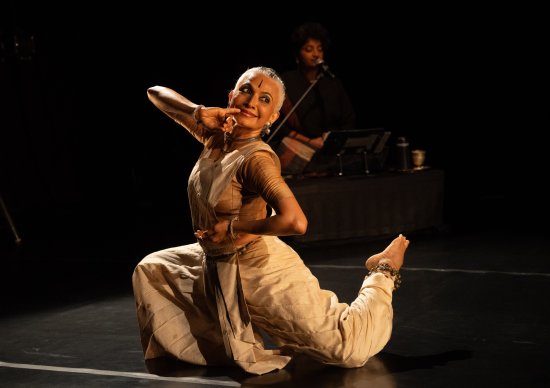 Desire and Devastation In the second act, the stage shifts from the expansive tandava of the warrior to the incandescent, turgid eroticism of Urvashi. This is not soft, decorative lasya; Bijayini's movement is thick with desire, her trained body executing flawless, hyper-extended bhangis filled with a muscular passion. The hand ceases to be a limp, decorative accessory to the torso and feet; it becomes the chief architect of the prose. Her hasta mudras are delivered with a clear-cut, muscular definition that mirrors a profound yogic flexure. Where other styles might indulge in soft, liquid transitions, Bijayini demands structural rigor. Each mudra is a firmly punctuated clause, executed with an unyielding tension that the audience feels all the way down to the tips of her fingers. The transitions between them are masterfully parsed - devoid of any kinetic blur or emotional dilution - creating a crystalline physical vocabulary where drishti follows hasta with absolute, arresting inevitability. The air in the theater grows heavy and palpable - "Your hands are cool like sandalwood paste. Please draw figures on my breasts which are like Manmatha's sacred pots." Using Jayadeva's Kuru Yadu Nandana as her sonic canvas, Bijayini embodies the ultimate Vasakasajja Nayika - the heroine who is ornately adorning herself, in an absolute bounty of expectation. Yet, when this unbridled offering meets the cold stone of Arjuna's ascetic refusal, the passionate seductress shifts through the agonizing grief of a Vipralabdha Nayika (the rejected woman) before hardening into the cosmic rage of a cursing fury. In her mounting frustration, she violently divests herself of her ornaments, tearing off her bangles, belt and ghungroos (ankle bells), hurling them to the floor. Then comes the stroke of choreographic genius: the very jewelry she discards becomes the weapon of her retribution. Gathering up the invisible, scattered ornaments from the floor, she binds Arjuna with them, forcing the bangles onto his wrists and the ankle bells onto his feet as she pronounces her curse. The use of imaginary jewelry as metaphorical shackles sits exquisitely within the emotional outburst of the storyline, transforming the passive decorations of a woman's body into the active instruments of a warrior's exile. Liminal Limbs Act Three stages a radical philosophy of the flesh - a lived interrogation of gender and freedom. Was Arjuna, now metamorphosed as Brihannala merely tempering the celestial femininity of Urvashi's curse, or was this a profound, internal awakening? Was the warrior paradoxically liberated by exile, allowed to inhabit a grace that the rigid armour of a prince had long denied him? This liberation manifests in pure physical texture - the Rajahamsa (swan like) gait, heavy with the sensuous grace of Vidyapati's poetry, dissolving into joyful, rhythmic interludes with the mardala. Here, the body is no longer just a warrior in masquerade; it becomes an instrument of unadulterated bliss, operating on a plane of pure, defiant energy where male and female aspects merge seamlessly. Then, the inevitable fracture: the cue to return to the battlefield. As the rhythmic euphoria collapses, the dancer stands staring at her reflection, frozen by a diminishing spotlight. This is no trick of the imagination; it is a devastatingly clear, liminal vision between male and female. The choreography achieves a sublime poetry as the mudras begin to morph - from moon to lotus, fluidly dissolving, and back from lotus to moon. It is a brilliant, shifting iconography of an identity that refuses to stabilize, liquefying the moment society tries to pin it down. When the final image takes hold, the fluid movement ceases, and just the eyes are caught - wide, arrested, like a deer in the headlights. Yet, in that final gaze, the terror of the gendered trap softens into something far more haunting. As the light dies, it leaves behind a profound, unresolved ambiguity. Is that wide-eyed stare a look of entrapment, or is it the quiet hypnosis of a man who has looked into the mirror and realized he can never truly cast off the goddess he has become? The performance closes not on a note of horror, but on a lingering question mark, leaving the audience suspended in the beautiful, permanent twilight between Arjuna and Brihannala. 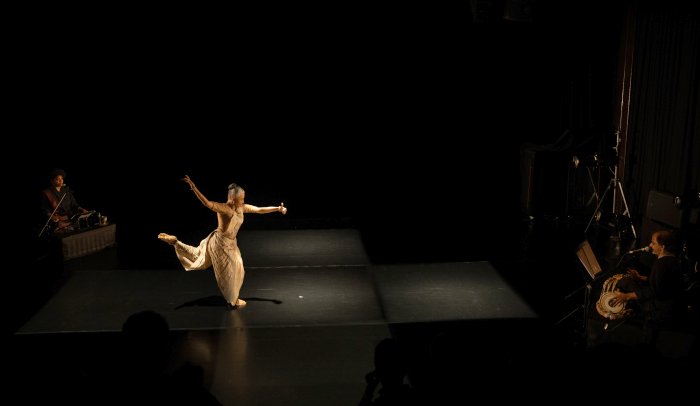 The Chemistry of Co-Creation A two-week residency is a specific pressure cooker - perhaps too brief for the depth the artists chase, yet the production's co-eval evolution of dance and music was a compelling marker of its potential. The visuals were embedded in the sound, emerging from and reposing back into the music. By positioning the musicians at three discrete corners of the stage, the production cleverly used the sonic landscape as a literal set design, creating a visual and acoustic anchor for the dancer. The Flute: Srinibas Satpathy's Jhinjhoti began with abstract notes, deliberately avoiding standard phraseology or consonant points. The randomness of this liminality echoed the theme perfectly, his mouthing intentionally unpolished at times, with breath sounds adding a rasping, visceral quality. The Vocal Texture: Bindumalini's taans were redolent of, but not quite bound to, Carnatic or Hindustani boundaries. Her delivery of the lyrics completely bypassed the ofttimes cloying vibrato of traditional Odissi accompaniment, giving the piece a modern, stark spine. The Percussion: When the choreography locked into the ukutas, the tandem of Sibasankar Satapathy’s mardala and dance became grandiloquent and lush. The lighting design was direct, unpretentious, and uncompromising. In the intimate confines of the G5A Warehouse, darkness was absolute, behaving exactly as it should in a true black box. While the stage felt a tad small - causing the dancer's position to occasionally overlap with the musicians stationed in their corners - this physical tightness only compressed the energy, making the performance feel dangerous and close. With this production, G5A once again honours its reputation as an arts venue dedicated to an enlightened, thinking approach to the arts. Kudos to Artistic Director Anuradha Parikh and her team for yet another successful, brave, and genuinely seminal Arts Residency. 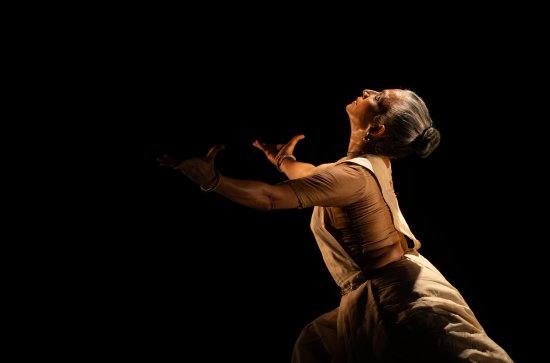 The Horizon As "Trikaya" matures beyond the residency cauldron, the true thrill will lie in watching the choreography dive deeper into its own rich questions, turning these conceptual provocations into an even more layered physical reality. How might future iterations further peel back the femininity of Urvashi versus that of Brihannala? Could this choreographic dialogue yield entirely new dynamics between the three characters? And how might this vocabulary expand if it is inhabited by multiple bodies?  Dr Rajiv Rajamani is a film maker, author and connoisseur of classical music and dance based in Bombay, Auckland and Chennai (during the season). |
