
|     |
|
| |

REVIEW / REPORTAn evening of Bharatanatyam- Tapati Chowdhuriee-mail: tapatichow@yahoo.co.in Photos: Rittik Chakraborty July 15, 2026 Aangikam Mahotsav 2026 was held at Mahajati Sadan, Kolkata, on 13 June. A disciple of Bragha Bessel besides others, Prantika Mukherjee is the artistic director of Aangikam Foundation. The Ministry of Culture, Government of India, sponsored the Mahotsav. 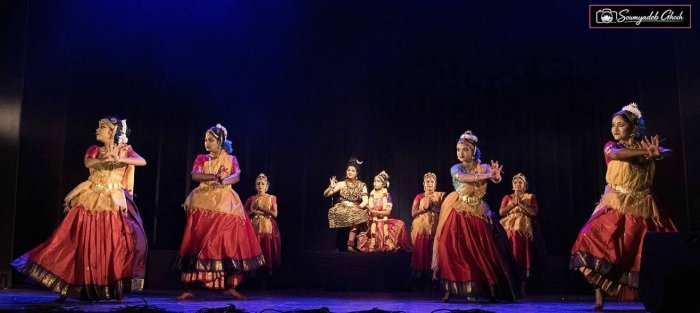 Some highlights of the evening included a Devi Keertanam in which the dancers devotedly extolled the virtues of the Devi through intricate facial expressions and body language. The piece was set at a medium tempo, structured with a refrain and korvais that increased its visual charm. The keertanam "Tamburi Meetidava" in praise of Vishnu, followed the Devi keertanam; both keertanams were commendably executed. CCRT scholarship holders enacted a bhajan that displayed pure, unmitigated bhakti. The students performed "Swagatham Krishna." As the title suggests, Krishna was welcomed warmly with the bhajan "Swagatham," penned in the 18th century by Oothukkadu Venkata Subbaiyer. The devotees, here portrayed by the dancers, welcomed Krishna and then surrendered to him, describing his charming divine appearance, his abode in Mathura, and his adornments, such as his sweet fragrance and the kasturi tilaka. The dancers recounted his heroic deeds in protecting Gokula. The hymn was in Mohana ragam and adi talam. It was a well-chosen piece for the young dancers of the school. 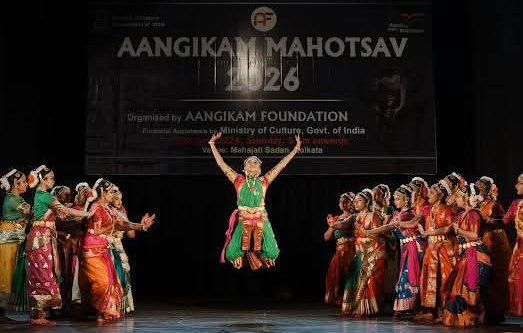 CCRT scholarship holders also had the privilege of performing Kumarasambhavam, authored by the ancient Sanskrit poet Kalidasa, which narrates the epic episode of Lord Shiva's marriage to Parvatī and the subsequent birth of their son Kumara (popularly known as Kartikeya), who was destined to kill the invincible Tarakasura - a demon who could be slain only by Shiva's son. This was a well-spun mythological story choreographed by Prantika for her students. The story of Simha Vaktra begins on Mount Kailash, where Goddess Parvatī asks Lord Mahadeva about the true nature of Shakti and her many forms of worship. Mahadeva explains that Shakti is the primordial cosmic energy that sustains the universe and manifests whenever evil threatens creation. He then narrates the story of Hiraṇyakashipu, a powerful asura whose arrogance and tyranny grew with his strength. Demanding worship from all, he is angered by his son Prahlada's unwavering devotion to Lord Vishṇu. When Prahlada declares that Vishṇu exists everywhere, even within a pillar, Hiraṇyakashipu strikes it. From the pillar emerges Lord Narasimha, the fierce half-man, half-lion incarnation of Vishṇu, who destroys the tyrant. 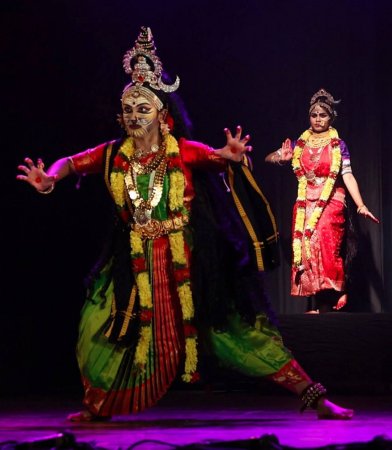 Simha Vaktra Narasiṃha's immense fury, however, shakes the cosmos. To restore balance, Lord Shiva manifests as Sarabheshvara, while Narasiṃha's energy assumes the form of Gandabherunda, the celestial two-headed bird. As these forces clash, Adi Shakti appears as Goddess Pratyangira, pacifying their rage, restoring harmony, and re-establishing cosmic balance. Thus, the eternal power of Shakti prevails, safeguarding righteousness and preserving the order of the universe. Abhishikta Gupta as Simhavaktra; Aratrika as Hiraṇyakashipu; Prapti Basu as Narasiṃha; Tista Mondal as Shiva; Aarainaa Khan as Gandabherunda; and Trishita Sengupta as Sarabheshvara were all spirited in their respective roles. The performance contained much sound, fury, and bloody combat to establish good over evil. Traditional, polished Indian dances that are known as "classical" in popular parlance call for a great deal of restraint, unlike folk dramas. The presentation was dramatic, with movements, jumps, and postures akin to traditional community based theatrical performances that combine music, dance, and storytelling. The piece was conceptualized and choreographed by Prantika Mukherjee, with music curation by Trishita Sengupta. Adrija Modak and Prapti Basu were in charge of sound editing. Prantika's school Aangikam Foundation is a popular name in North Kolkata and has more than two hundred students enrolled; many of them have gone on to earn accolades and scholarships.  Tapati Chowdhurie trained under Guru Gopinath in Madras and was briefly with International Centre for Kathakali in New Delhi. Presently, she is a freelance writer on the performing arts. She is the author of 'Guru Gopinath: The Making of a Legend.' |
