
|     |
|
| |

REVIEW / REPORTVaahini and Ritu Manjari: A commemorative presentation honouring fifty years of the dance journey of Minal Prabhu- Satish Surie-mail: satishism@yahoo.co.in Photos: Aryan Bayari July 14, 2026 Vaahini - A river runs through it The celebration of fifty years of an artiste's dedication to a classical form is itself an event of consequence. When Guru Minal Prabhu chose to mark this milestone not with a retrospective but with new choreographic work, the gesture spoke of a teacher who still reaches forward. 'Vaahini', the first of two thematic performances presented by her ensemble Mudrika Foundation, on the 29th May at the Seva Sadan, Bangalore, took as its subject the Kaveri, one of the great sacred rivers of the subcontinent, and traced its journey from misty origin to oceanic merger through Bharatanatyam's full range of expressive possibility. The structural ambition of the piece was immediately apparent. Rather than a loose thematic suite, 'Vaahini' was conceived as a pilgrimage in movement, with each geographical and spiritual station of the river given its own choreographic identity. The musical composed by G. Gurumurthy and rendered with warmth and precision by vocalist Balasubrahmanya Sharma, provided the scaffolding upon which the dancers could build. Sharma's voice carried the narrative weight of the evening, and the compositions, spanning Kodava verses, a Subramania Bharathi Tamil lyric, and the towering Carnatic trinity of Muthuswami Dikshitar, Syama Sastri, and Tyagaraja, gave the production a musicological sweep commensurate with its geographical tone. 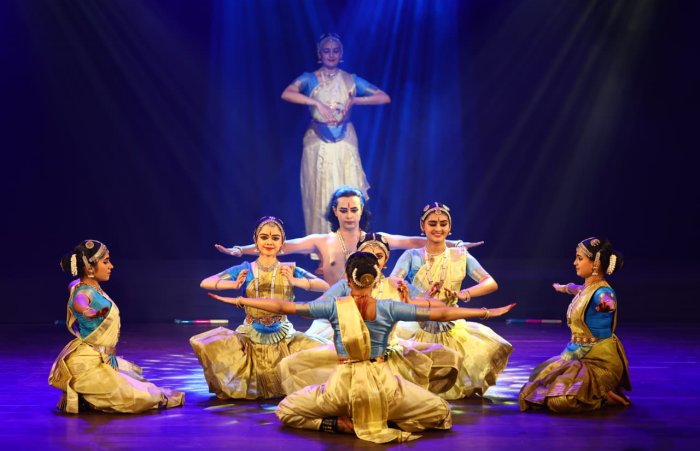 The opening sequence established the mythic register with deft authority. The river's entrapment in sage Agastya's kamandalu and its liberation through Ganesha's characteristic cunning were rendered through sancharis that balanced the playful and the cosmic. Kodava verses heralding this origin gave the evening an ethnographic texture seldom encountered on the Bharatanatyam stage - an acknowledgement that Coorg itself is a world, not merely a postcode. The river then gathered momentum, its tributaries joining in formations that suggested confluence rather than mere unison. The three Ranga Sthalas served as dramaturgical hinges. The first sangama at Srirangapatna was marked by a spirited kollattam, the percussive energy of the stick play translating the river's gathering force into kinetic joy. The Madhya Ranga at Sivasamudram shifted the mood; the falls there have a sublimity that demands reverence. Before the Kaveri crossed into Tamil Nadu, Subramania Bharathi's lyric opened new emotional territory and acknowledged the river's role in the cultural life of two great states. The journey's culmination at Srirangam, the great Vaishnava kshetra and the abode of Lord Ranganatha, brought the piece to its spiritual resolution with earned solemnity. Ananth Nagaraj, carrying the role of Krishna across the production, brought a presiding grace to the ensemble without overwhelming its collective character. The ensemble - Aditi Saralaya, Nikhita Sampath, Ankitha Gopalakrishna, Amita Sampath, Shruthi Harihara, Megha Balakrishnan, Ananya Bharadwaj, Varsha R. Vinod, Swara K. Rao, Amisha Pai, Shreya J., Radha Vinay, and Samyukta R. Sreenivasa - moved with the shared breath and spatial awareness that only sustained training under a single vision produces. The choreography deployed rhythm, mime, and nritta not as alternating modes but as a continuous weave: a meandering river does not stop to announce its mood before changing course, and neither did this ensemble. Guru Minal Prabhu's choreographic intelligence was most visible in precisely this integration, the sense that the abhinaya, the rhythmic passages, and the compositional architecture are not separate departments of the production but aspects of a single unfolding. Fifty years of practice distil into exactly this kind of invisibility: craft so thoroughly absorbed that the form appears to move of its own accord, like water finding its natural level. Kaveri was not without the textural complexity that ambitious multi-compositional works carry - holding together a Kodava folk invocation, a Carnatic trinity, a Bharathi Tamil lyric, and an ensemble of fourteen dancers across a single dramatic arc demands orchestration of a high order. That the evening achieved coherence rather than an anthology was a tribute to both the choreographic vision and the ensemble's collective commitment. As the river reached Srirangam and the production found its stillness, what remained was the sensation that the journey had genuinely been made. 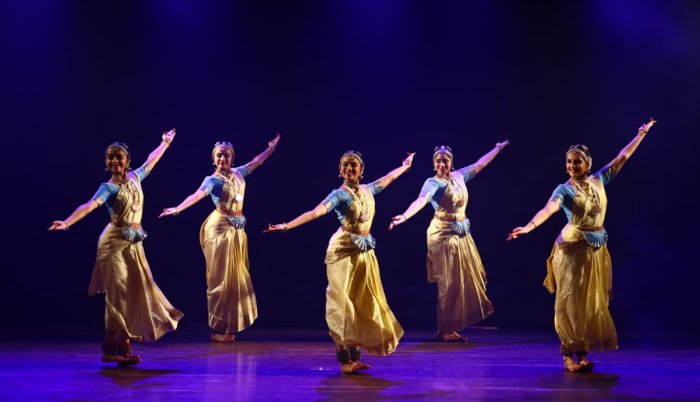 If 'Vaahini' traced the Kaveri through the devotional landscape of the Deccan and Tamil Nadu, the second work of the evening turned northward, in geography, in musical sensibility, and in mythic register .'Yamuna,' brought the ensemble of Mudrika Foundation to another of India's great sacred rivers, one whose story is inseparable from the stories told about her: daughter of Surya, the sun god, carried to earth by the Saptarishis, her waters renowned across the ages for their capacity to purify the mind and unsully the spirit. The production held this luminous legacy in one hand, and the river's present crisis in the other, and the tension between the two gave the evening its emotional depth. The opening sequence was a choreographic vignette of genuine charm. The image of glacial melt, the Yamuna's birth at the Himalayas rendered in movement as ice yielding to warmth, was handled with a delicacy that the subject demands. There was no literalism here, only suggestion: the body as water, weight shifting into flow, stillness giving way to the first tentative momentum of a river finding itself. It was an arresting beginning, and it established the production's willingness to let the poetic carry what the descriptive cannot. The mythological arc that followed drew richly from the Braj traditions that cluster around the Yamuna's banks. The gopis of Vrindavan, the playful divinity of Krishna, and the celebrated raas lila were woven into the choreography with a lightness of touch that kept the familiar luminous rather than predictable. The ensemble moved through these beloved narratives with evident pleasure, and the abhinaya in the Krishna sequences carried that particular blend of longing, mischief, and grace that the Yamuna's devotional world demands. The musical architecture distinguished Yamuna from Kaveri in ways that went beyond the geographic. Where the Kaveri had moved through the deep Carnatic tradition of the Deccan and Tamil Nadu, the compositions for Yamuna carried a discernible Hindustani inflexion, a tonal and melodic shift that was both dramaturgically apt and musically satisfying. The contrast reminded the audience that the subcontinent's rivers do not merely cross borders of soil and administration; they cross borders of raga, of devotional practice, of poetic imagination. The concluding Kalinga Narthana Thillana provided the production with its most urgent voice. The thillana form, with its brightness and kinetic exuberance, was here deployed in the service of something sobering: the Yamuna as she is today, carrying the weight of human carelessness, her purifying properties imperilled by the very civilisation she has nourished for millennia. The message of environmental conscience was embedded in the choreographic text without becoming polemic; the dancers did not abandon beauty to make the argument, but allowed beauty itself to become the argument for what stands to be lost. 'Vaahini' constituted an evening of ambition and genuine accomplishment. Guru Minal Prabhu's fifty years of artistic practice revealed themselves not in nostalgia but in the confidence to take on subjects as large as rivers, to find in Bharatanatyam's vocabulary the means to speak of origin and flow, of myth and ecology, of the divine and the devastated. That the Mudrika Foundation ensemble rose to both works with commitment and grace was the most eloquent tribute the occasion could have offered. The colourful costumes designed by Supriya Komandur, who also compèred the evening with warm authority, added lustre to the visual richness of the production. As the river reached Srirangam and the production found its stillness, what remained was the sensation that the journey had genuinely been made. Ritu Manjari - The grandeur of Seasons The second celebratory offering of Guru Minal Prabhu's golden jubilee season, Ritu Manjari arrived on the 7th of June at Alliance Française, Bangalore, as a meditation on time itself, not the biographical time of a fifty year dance journey, though that weight was present in the evening, but the cyclical time of nature, of season following season in the great wheel that India's poets have revered since antiquity. Where 'Vaahini' and Yamuna had traced rivers through geography and myth, this production turned to the sky, the earth, and the unending conversation between the human heart and the world it inhabits. 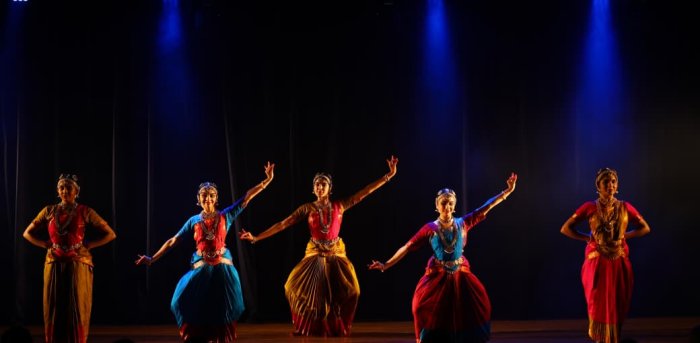 The evening opened with a bouquet of swaras in praise of Krishna, the invocation painting him in the colours his devotees have always loved: dressed in golden yellow, red lipped, the flute resting in his hands, his body carrying the dark luminescence of rain laden clouds. It was a portrait rendered in movement and music, and it set the devotional key in which the seasonal cycle would unfold. Vasantha, the season of spring, arrived in a burst of chromatic joy. Nature in bloom, the colours of Holi vivid in the choreographic palette, the gopis dancing with Krishna in the playful exuberance that the season demands,the ensemble brought to this opening ritu an infectious lightness, their interactions carrying the warmth of a world renewed after winter's quiet. The transition to Grishma, the heat of summer, shifted the mood with elegant economy. The gopis sought the cool waters of the Yamuna, and it was here that Krishna's mischief found its most celebrated expression, the stealing of their garments, their eventual surrender, and the depth of the bond that this playful transgression paradoxically revealed. The Ashtapadi Chandana Charchita from Jayadeva's Gita Govinda gave this sequence its musical and emotional architecture, its description of the gopis dancing with Krishna and their dawning realisation that he belongs to all, an insight at once joyful and humbling, tenderness shading into theology. Varsha Ritu, the monsoon, brought the production to one of its most vivid passages. Thunder and lightning animated the choreographic vocabulary, the earth's freshness after rain translated into a renewed energy in the ensemble's movement. The gopis decorated swings with flowers and awaited Krishna's arrival, and when he came, the blissful celebration that followed carried the particular quality of longing fulfilled of joy that is inseparable from the waiting that preceded it. 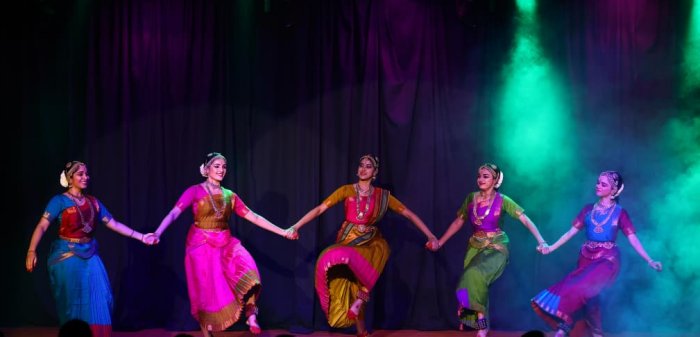 Sharad Ritu, the autumn, drew the cycle toward its spiritual culmination with a change of register, fallen leaves, bright moonlight, a quiet longing that the season's beauty only deepened. The Maha Raas sequence that anchored this section was the production's dramatic and philosophical heart. Each gopi believed, in the intimacy of the Raas, that Krishna was hers alone. His disappearance brought the beloved desolation of the viraha mood; the gopis turned to Devi Katyayini in their grief. And then the Maha Raas itself: Krishna's reappearance as the all pervading presence, the revelation that dissolved the illusion of exclusivity and returned the gopis to a joy larger than possession, the joy of realisation. The ensemble's rendering of this sequence honoured both the erotic and the metaphysical dimensions of the Braj tradition without reducing either. The evening closed with a Brindavani Thillana choreographed by the late Adyar K. Lakshman, a tribute within a tribute, the master's craft offered in homage by the next generation of dancers. It was a luminous conclusion, the thillana's formal brilliance a fitting frame for an evening that had moved between the sensory and the devotional with equal assurance. The music composition by Lakshmi Satyanarayana drew on a constellation of voices: Neela Ramanujam, Susheela Mehta, D.S. Srivatsa, Balasubrahmanya Sharma, and Guru Minal Prabhu herself, who lent her voice to the Jhulelal rendering with quiet authority. The jatis, composed by G. Gurumurthy, were rendered by Prasanna Kumar with rhythmic clarity. Jayaram Kikkeri on flute and J.K. Sridhar on violin contributed melodic colour to the recorded track. The colourful costumes designed by Supriya Komandur, who also compèred the evening with poise, added lustre to the renditions and brought a unified visual identity to the cycle of seasons as it unfolded on stage. The lighting design by Ananth Nagaraj shaped the atmospheric world of each season with a sensitivity that supported rather than competed with the choreography. The nine dancers - Aditi Saralaya, Ankitha Gopalakrishna, Amita Sampath, Megha Balakrishnan, Ananya Bharadwaj, Varsha R. Vinod, Swara K. Rao, Radha Vinay, and Amisha Pai, sustained across four seasons the collective attentiveness that ensemble Bharatanatyam demands. Ritu Manjari was, finally, a work that justified its ambition: an evening in which the grandeur of nature and the grandeur of a fifty year artistic life reflected one another with grace. 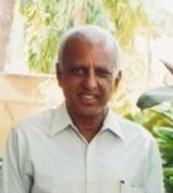 Bangalore based Satish Suri is an avid dance rasika besides being a life member of the Music and Arts Society. |
