
|     |
|
| |

REVIEW / REPORTFour dancers, four forms, one spectacle: Dashavatar and Deva Nartana- Shveta Arorae-mail: arorashveta1806@gmail.com July 12, 2026 On the evening of 26 May at the IHC in Delhi, Deva Nartana and Dashavatar were presented in four classical styles with pre-recorded music created by twelve celebrated musicians, all from Mumbai. The performing dancers were Saji Menon in Mohiniattam, Bhakti Deshpande in Kathak, Namrata Mehta in Odissi and Prachi Save Saathi in Bharatanatyam. Saji Menon began her training under her father, Kathakali artiste Kalamandalam Shankar Narayan, and learnt under Guru Dr. Kanak Rele in Mumbai. She performs and teaches Mohiniattam and was awarded the Ustad Bismillah Khan Yuva Puraskar for 2013-2014 by the Sangeet Natak Akademi. Bhakti Deshpande is an actress and Kathak performer who learnt from her parents Guru Vidyahari Deshpande and Guru Sunil Deshpande. She also received guidance from Pandit Birju Maharaj and Pandit Suresh Talwalkar at a young age. She is part of Sakhi, India's first classical all-girl band. Namrata Mehta is a senior disciple of Odissi's Guru Daksha Mashruwala and also teaches at her institute. She is empanelled with ICCR and has been awarded the Guru Kelucharan Mohapatra Yuva Pratiba Pursakar 2017 in Odissi dance. Prachi Save Saathi is a well-known voice artist and Bharatanatyam performer whose teachers and mentors include Gurus Vaibhav Arekar, Lata Raman and Rama Vaidyanathan. Prachi is a choreographer and the artist I have watched the most out of all four. All the artistes are from Mumbai. 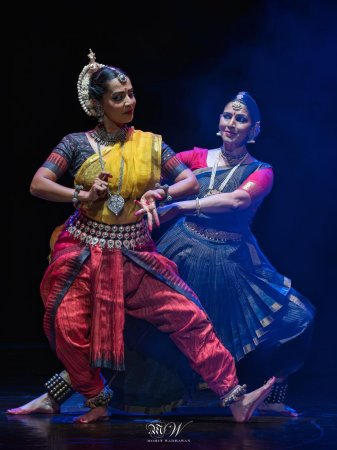
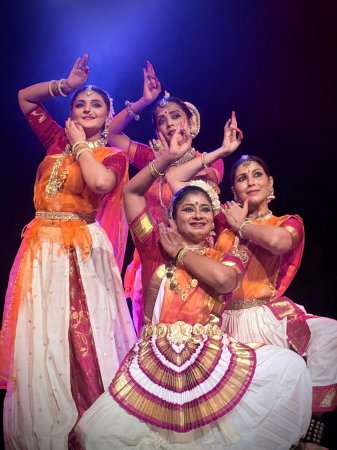
The first piece was 'Ganapati Nartana' in Mohiniattam by Saji. It was an obeisance to Ganapati, the remover of all obstacles. Here, the devotee describes the Anand Narthan Ganapati, the joyous dancing Ganapati. He is immersed in bliss, his form is pure consciousness, he resides in the Mooladhara chakra and takes the form of Om. The composition was in ragam Nattai, talam Adi. The lyrics were by Oothukkadu Venkata Subbaiyar, rendered in sopanam mode by M.S. Gireesan. Saji was in her traditional white and red aharyam with a very beautiful hair ornament. After the pushpanjali and nritta, swaying from right to left, she depicted the attributes of Ganapathi. He rides the mooshak as his steed and carries the modak in his hand. With ears that sway like a fan (chamar), he wears the holy thread on his body. The bhakta prays at the feet of Vighnavinayak. He has a trunk, he dances the Anand Nartana, plays on the mridangam, his form makes the Omkara. Next were Prachi and Namrata together, presenting Ardhanarishwara through Bharatanatyam and Odissi. The piece explored the duality of Shiva and Shakti. The male half stands for Purusha, Shiva, and the female half for Shakti or Prakriti. Purusha is passive and Prakriti is active. The two opposites are drawn to each other in an embrace and fuse with each other. The music composition was by Jatin Sahoo and Satish Krishnamurthy, with vocals by Chandana Balakalyan and Jatin Sahoo. Shiva was depicted by Prachi in Bharatanatyam and Shakti by Namrata in Odissi. Their costumes also complemented each other. Prachi wore a black sari with a red blouse, and Namrata wore a black blouse with a red lower and yellow odhni. The two dancers depicted the attributes of Shiva and Shakti, how they are opposite and yet complement each other when they come together. Prachi depicted the tremors of the damaru in Shiva's hand, chandra on his head, snakes on his body, jata and Ganga. Together, they depicted bhasm, agni and Namrata showing flower and jooda as she stood with the ghunghat stance. Prachi danced as Shiva with damaru in circles around her. One is the colour of champa flowers and the other gaur, or pale like camphor. One has her hair tied in a jooda; the other has jata or matted locks. The duo depicted, through expansive moves and hand gestures, coming together in a stance for the Namah Shivayai Cha Namah Shivaye sthayi. Shakti wears the chandan and kasturi, Shiva the bhasma. Maa Parvati has bangles, anklets and waist belt; Shiva wears snakes as ornaments. While the ornaments were shown in lasya, the snakes were shown by Prachi, displaying the roudra element with leaps, leg swings and hastas to show the snakes. They held each other at the waist, facing in opposite directions, as Shakti and Shiva. Shiva shakes the tree and collects flowers. He weaves it into a garland and offers it to her. He wears the mundamala. He wears divyambaraye, and she wears digambar, or rich saris. The stance they took was Prachi standing with a leg lift and Namrata squatting in front. Shakti has hair curled and black, and Shiva the matted jata. One is the goddess of the mountains and the other the lord of Kailash. Namrata depicted the various life forms that the Devi mothers: peacock, deer, all creatures and elements. Prachi, through her expansive moves all over the stage, depicted the destroyer of all creation and then took chakkars with the tremors of the damaru. They are the mother and father of the universe. As the last stance, Prachi stood behind with the damaru moves and Namrata squatted in front; she then got up, both raising one leg, and their feet joined in front. The two dancers created the magic of the stotra through their flawless, smooth movements. There was also the coming together of two singers for the piece, one male and the other female. 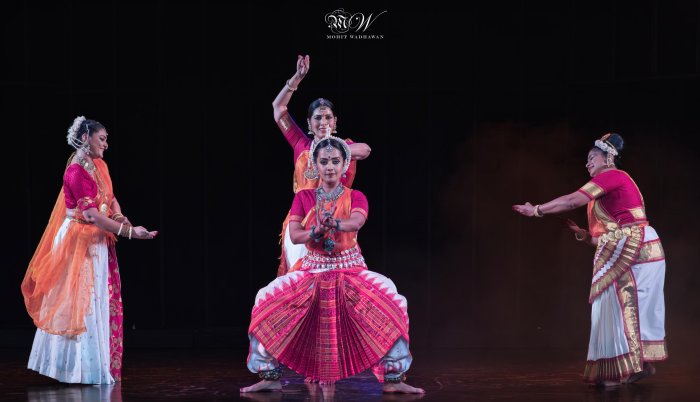 The next piece was a Kathak presentation by Bhakti Deshpande. She presented Rudrani, a powerful presentation of goddess Durga. The goddess is fierce yet compassionate. She balances good and evil by vanquishing the demon Mahishasura. The vocals for this piece were by Kaushiki Chakraborty. Bhakti's costume was red, but there was a deviation from the regular style - more like a sari tucked in. For Jai Jai Jag Janani Devi Mata, Bhakti used footwork and gestures to depict the attributes of Maa Durga. She is the one who carries the trishul and the kirpan; she grabs the asur and vanquishes him. Next, it was the much-awaited Dashavatar by all four dancers. The composition by Jayadev from Gita Govindam is oft visited. Here, the ten incarnations of Vishnu are described. Whenever there is cruelty towards his bhaktas, Lord Vishnu, or Krishna, takes on an avatar as a saviour to rid the earth of suffering and evil, and very interestingly, these avatars also conform to Darwin's theory of evolution. As the piece began with the chanting of the shloka 'Yada Yada Hi Dharmasya', the four dancers took the stage, looking astounding in white and red aharyam with orange odhnis worn in their respective styles. Lord Vishnu was shown lying on the Shesha in a reclining pose. The dancers did nritta in their respective vocabularies, moving in circles and leaps. When pralaya came and the seas rose to drown all, Hari appeared as a huge fish to save the Vedas and all creation. The Vedas were safeguarded and put on the Matsya, and various animals all mounted. Namrata moved forward in broad plie, showing the Matsya with her hastas. When the devatas and danavs tried to churn the Sansar Sagar with Mandrachal, or the mountain, as the mathani (churn), Vishnu had to appear to stabilize the mountain. While Bhakti whirred as the mountain and two dancers pulled and tugged, the mountain began to wobble. Keshav comes as the turtle who hoisted the mountain on his back. Prachi squatted, making the hastas of the kurma. The dancers together depicted the entire sequence. The tale goes that Hiranyaksha drowned the earth in the sea, and Hari appeared as a boar and retrieved the earth with his horns to save it. Namrata, as Earth, went around in rotations and then began to drown. Prachi depicted the Varaha avatar through mudras. 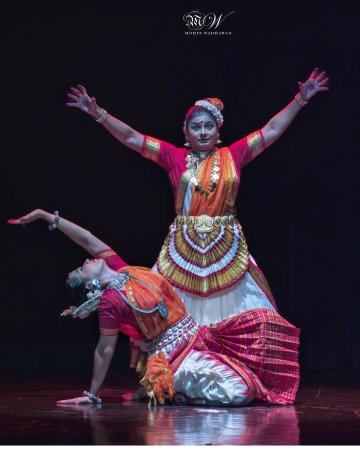
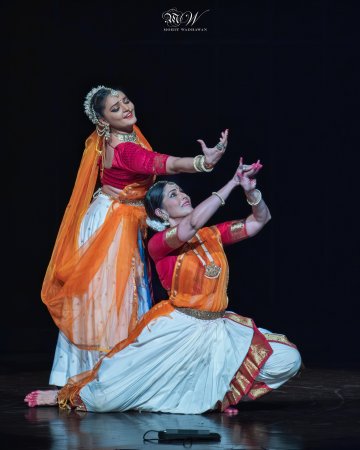
For the next episode, Saji depicted the Narsimha avatar. Bhakti, as Prahlad, goes around dancing and chanting the name of Hari. His father, Hiranyakashipu, tries to scare him and kill him. Namrata, as the demon, walked around with arrogance. Hiranyakashipu fights God Narasimha, who then puts him down on his lap, tears him with his claws and eats his innards like a man-eating lion. Prahlad walks up to the lord and sits in his lap to calm him. For the Vaman avatar, Saji walked in as Lord Vaman, hunched and walking with the aid of a stick, whereas Prachi, as King Bali, performs the yagya and with pride asks Lord Vaman to ask for his boon. In two steps, the three lokas are measured, and he asks where to put his third foot. Bali has to lower his head and offer himself for the third foot. The next incarnation of the lord as Bhagwan Parashuram was shown by Namrata. With his bow and arrow, he rid the earth of cruel Kshatriyas. Rivers of their blood flowed on earth. Rama avatar was depicted by all the dancers to show the various facets of Rama. Namrata, as Rama, freed Ahalya of her curse of being a stone, Kevat rowed them across the river; and then Ravan kidnaps Sita (with Prachi as Ravan). She throws her ornaments on the way as an indication of her passage. Monkeys come to their aid. Ravan and Rama fight a war, and in the final frame, all four dancers stood as Rama, Lakshman and Sita, with Hanuman in service. Bhakti, in Kathak, depicted the Balram avatar. He is muscular and wears a tilak. His attire is blue, as if Yamuna itself has come to clothe him. He carries the hal (used in tilling) on his shoulder. As Buddha, the lord condemned the ritualist killing of animals, promoting ahimsa. Bhakti, as King Siddartha, showed him giving alms while the other dancers performed yagya and bali in the centre. He was so pained that he left everything behind and embraced the path of meditation and ahimsa, or non-violence. Lord Buddha was shown through hasta mudras. The four dancers got together for nritta and hastas, showing shankh, chakra, gada and padma. And for the last avatar of Lord Kalki, Namrata stood in front as the horse, Prachi behind her as Kalki riding the horse. He will come with his shining sword, looking like a dhoomketu or comet, to eliminate evil. In the final dance, they all depicted all the avatars, and then the playing of instruments and the ecstasy of bhaktas. The last frame was that of Krishna, the avatar described in the shlokam Kasturi Tilakam; they enacted cows herded by Gopal, lotuses blooming, and him wearing the morpankh. The music for this piece featured a galaxy of musicians: music direction and arrangement by Satish Krishnamurthy; composition by Satish Krishnamurthy, Manoj Desai and Jateen Sahoo; vocals by Manoj Desai, Satish Venkatesh, Jateen Sahoo and Sangeet Murli; percussion - maddalam and edakkya by Nambisan, mridangam, ghatam, kanjira and others by Satish Krishnamurthy, mardala by Rohan Dahale, tabla by Vivek Mishra, pakhawaj by Omkar Dalvi; flute by Vijay Tambe; sarangi by Sangeet Mishra; violin by Shiva Kumar Anantharaman; sound engineering by Tapan da Trio Studio. Research guidance was provided by Rishiraj Pathak and Partho Pawgi. All four dancers did excellent work, especially in coordination and coming together and forming the various stances. It was a different energy and agility that they showed in their leaps, chakkars and footwork in nritta. It was a smooth and flawless coming together of four forms of dance, music and vocals. Milind Srivastava on the lights, assisted by Shubhamani, created magic. Amrita Lahiri was the compere for the show. There were four dancers, each from a different form of classical dance. Correspondingly, there were vocals and instrumentalists to go with each form, and yet they blended so seamlessly. The nritta and abhinaya for each avatar was done in confluence, understanding and coordinating with the other forms. And it was the same with the musicians. It was a beautiful amalgamation of the four forms to show Lord Vishnu, Krishna and the ten incarnations. It left the audience wanting for more. 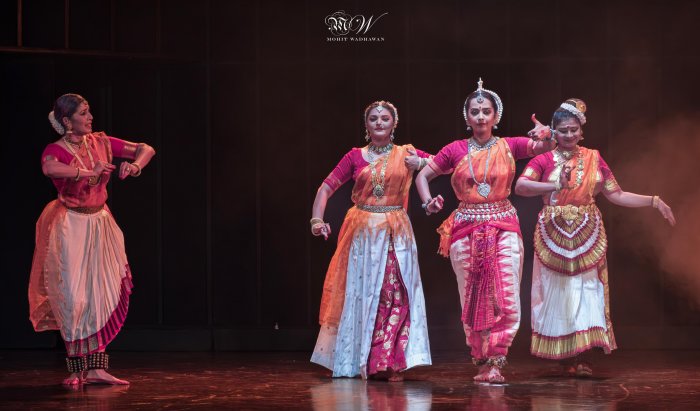 I later spoke to Prachi about the production. Q: Your say about the seamless flow and coordination… A: The main idea has been growing for many years. Dashavatar is a part of many repertoires and has been done to death. I kept asking dancers and senior gurus and everyone said, oh no, not another Dashavatar. But there were two reasons I wanted to do it. One is that I want to dedicate my life's work through dance to cultivating new audiences. We live in an age where there are too many performers and too much is available on the internet - short form, in all formats. But there is not enough audience. So how do you create work that will draw more audiences towards classical dance? And then I started asking everyone: have they seen a Dashavatar in multiple forms? And I haven't heard a yes up till now. And I have asked this question an endless number of times, senior gurus, young dancers, and I am asking you too: have you seen a Dashavatar composition in different styles? If there has been one which I don't know of, the dance might have been in different styles, but the music will be of one style only. So the attempt was to break this. We took the Gita Govindam because we wanted to end with Krishna, and I wanted to weave the music together in such a way that it doesn't jar, doesn't hurt the ear, is soothing and seamlessly traverses through different styles without the audience feeling that oh, now it has changed. Of course, a discerning ear will know that it has shifted, but it should be seamless. The idea was that we should do absolute justice to the authenticity because we are coming from the lineage of gurus who are looking at us. Today, Rama Vaidyanathan Akka was in the audience and I am accountable to her. I did not want to cross any line that makes her say "what have you done in this scramble for a mix style production?" Luckily, I was working with dancers who are committed to their forms - they know what can be done and what can't. I would go up to Saji and say sometimes, we can do like this, and she would tell me that they do not have it in their vocabulary. If it is not there, let's change. The choreography was a very difficult task, but it became easy because the camaraderie is there, we are close and have worked together a lot. It was just such a fun ride. The temperaments were the same, we were so united, and it came across in the production because nobody was trying to one up the other. Even the division of the characters - it all just happened seamlessly. Q: You had to come together and take the stances for each avatar. Ans: I wanted there to be a high point for each avatar. And as I said, we wanted to build more audience. I wanted to create a work which will appeal to a wider audience. With the movie Avatar, and the Dashavatar movie in Anant Ambani's wedding, Dashavatar had become a hot topic. We thought let's encash that popularity. Now what can we do while staying within the tenets and idioms of the art forms, but make it more appealing? Ashish Khokar ji was there when we did it in Bengaluru, and he said it was the perfect capsule for the ICCR to take on and showcase it to more people.  Shveta Arora is a dance-mad writer who chronicles classical dance events in Delhi (and also those online). In 2009, she started the blog Kala Upasana at delhiculturecomment.blogspot.com, where she began posting her own writing along with photographs clicked by Anoop Arora, her husband. She's been dancing all her life as a devotee, but resumed her formal training in Kathak in her 50s and has passed her fifth year Kathak exams. |
