
|     |
|
| |

REVIEW / REPORTCelebrating dance- Satish Surie-mail: satishism@yahoo.co.in July 3, 2026 A JOURNEY THROUGH ANDAL'S HEART: MRUDULA RAMANUJAN'S MARGAM Photo: Prof. K.S. Krishnamurthy Mrudula Ramanujan's margam presentation, held under the aegis of the Indian Council of Cultural Relations on the 22nd of May at the Bharatiya Vidya Bhavan, Bangalore, opened with a Pushpanjali in Gambhira Nattai that set a devotional tone. This was followed by a Ranjani mala, "Ranjani mridu pankaja lochani," composed by Tanjore Sankara Iyer, that eased the audience into the evening's emotional terrain with grace and intention. The narrative then shifted southward, drawing the audience into the enchanting world of Andal, one of the most revered figures in the Indian devotional tradition. Mrudula chose the Ragamalika adi tala varnam "Aatkolla vendum aiyyane," penned by G Vijayaraghavan, tuned by Hariprasad Kaniyal, and with jatis by Srihari Rangaswamy, as her framework, weaving into it Nachiyar sancharis that illuminated Andal's emotional landscape through the poet saint's own verses. The varnam unfolded as a beautiful expression of shringara bhakti, tracing Andal's longing, her agony of separation, and the tender world of her dreams with sensitivity and depth. The first verse explored the totality of Andal's devotion and how completely Narayana had taken over her very being. Details such as the placing of a flower in her hair, the lifting of a garland, and the act of soaking in its fragrance were brought alive with a vividness that made Andal's inner world immediate and intimate. These gestures, seemingly simple, carried within them the full weight of a devotee's surrender. 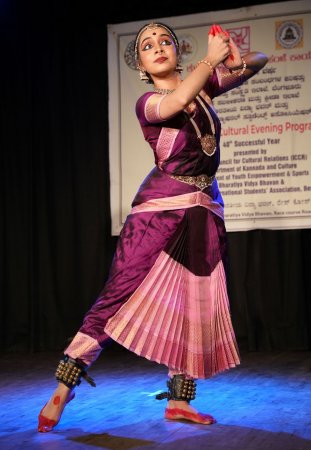 Mrudula Ramanujan One of the most memorable passages in the abhinaya was the contrast drawn between childhood wonder at Krishna and the mature, aching admiration of a young woman deeply in love. Mrudula navigated this transition with a maturity well beyond the expected, shifting between the two emotional registers with nuance and conviction, allowing the audience to witness not merely the content of Andal's feeling but its evolution across time. The verse addressed to the dark clouds carried a different emotional weight altogether. Andal questioned the clouds in anguish, wondering whether they had brought her Lord, and lamented the loss of her womanhood in separation. She cried out to Achyuta, invoking the green parrot as a messenger of her intense desire, and declared that for the sake of Lord Narayana alone, she had taken birth on this earth surrounded by oceans. Her suffering, she said, had crossed all limits, and she implored Manmatha, the God of Love, to unite her at the feet of Lord Madhava. Mrudula rendered this sorrow with a restraint that made it all the more affecting, the agony of separation surfacing not in excess but in the subtle collapse of hope visible across her face and form. Throughout the varnam, the intricate rhythms and melodic variations served as an ideal scaffold for the sancharis, allowing the audience to inhabit both the poetic and performative dimensions of Andal's expression simultaneously. The imagery she employed honoured the purity and unabashed quality of Andal's devotion, ensuring that the poet saint's words did not merely accompany the dance but breathed through every gesture, every glance, and every carefully rendered moment on stage. The Purandaradasa ragamalika "Chikkavane ivanu" provided a delightful change of mood, offering a sprightly representation of the young but naughty Krishna embarrassing the gopis with his outrageous questions and audacious behaviour. Well conceived and elegantly presented, this piece brought the mischievous spirit of Krishna to life through his playful exchanges with the gopis, and Mrudula moved through it with a lightness and wit that drew the audience into the warmth of the moment. She concluded with a Thillana in Ahir Bhairavi composed by Dr Balamuralikrishna, lively and precise, with neat movement lines that gave shape and clarity to the abstract dance. The fleeting expressional passages, rooted in poetic alliteration from the composer's ode to his beloved Krishna, "Manjula Mohana Murali," were rendered with genuine involvement and a luminous finish. The live music ensemble provided splendid orchestral support throughout the evening. Deepthi Srinath on vocals brought warmth and depth to the musical fabric; Radhika Ramanujan, mother and guru of Mrudula, on nattuvangam held the rhythmic architecture with authority; Srihari Rangaswamy on mridangam lent energy and precision, and Narasimhamurthy on flute added a lyrical quality that beautifully complemented the mood of each piece. DHYANA BY HEGDE DANCE ACADEMY Photos: Simha's Photography Naveen Hegde, Kathak exponent and disciple of the celebrated guru couple Nirupama and Rajendra, marked the first anniversary of his dance academy with 'Dhyana', a program conceived as a heartfelt offering to all gurus. The evening of the 23rd May at the Courtyard, Bangalore, unfolded as a meditative celebration of classical dance and disciplined artistry. The program opened on an auspicious note with an invocation to Lord Ganesha, setting the spiritual tone that would define the evening. This was followed by a Bharatanatyam presentation by Chaitra Hegde and Amrita Sinchana, who performed the Thodaya Mangalam, the traditional benedictory verse "Jaya Janaki Ramana." 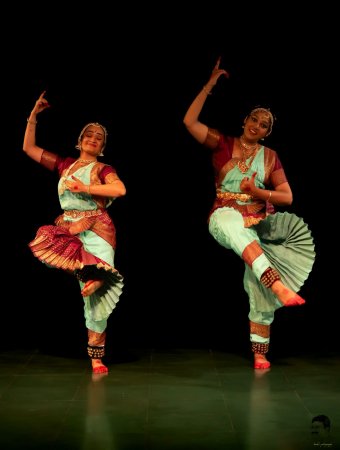 Chaitra Hegde and Amrita Sinchana The composition was a devotional hymn dedicated to Lord Rama, venerating him as the divine consort of Sita (Janaki) and invoking his grace and protection. The lyrics extolled the sanctity of Rama's lotus feet, his boundless compassion for the distressed, and his role as the ultimate refuge, as exemplified by his acceptance of Vibheeshana. As an opening piece, it could not have been more fitting, imbuing the auditorium with an atmosphere of reverence. Chaitra and Amrita rendered the piece with commendable depth. Their footwork was crisp and rhythmically assured, while their abhinaya conveyed the devotional fervour embedded in the text with clarity and sincerity. The choreography, which foregrounded the bond between Rama and Sita as a symbol of divine grace, was elegantly structured, allowing both performers to complement each other in movement and sentiment. Their emotional attunement to the material elevated the performance beyond mere technical execution. The evening reached a new level of intensity when Naveen Hegde himself stepped onto the stage, delivering a Kathak performance that was both technically commanding and deeply expressive. He opened with a Ganesha Vandana, set to music by Brahmananda and tuned by Faiz Khan, a collaboration that lent the piece both spiritual authenticity and melodic richness. The invocation celebrated Ganesha in his many dimensions: the remover of fear, the harbinger of Riddhi and Siddhi, the pot-bellied deity whose vahana, the humble mouse, spoke to the divine paradox at the heart of his form. Through precise and evocative abhinaya, Hegde brought these attributes to life with warmth and reverence, drawing the audience into an intimate communion with the deity. 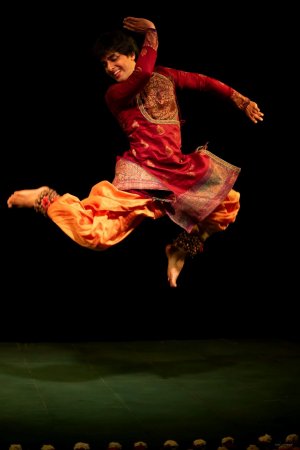 Naveen Hegde From the opening moments, he commanded the stage with quiet authority, transforming the invocation into a vivid tapestry of rhythm and emotion. The narrative passages were rendered with expressive fluency, each gesture economical yet layered in meaning. The performance then shifted gears with the Ganesh Paran, among Kathak's most demanding rhythmic compositions. Hegde's footwork was crisp and flawless, each bol articulated with unambiguous clarity. What distinguished his rendering was the seamless shift between slow, graceful storytelling and rapid spinning chakkars, executed with the ease that only years of rigorous training under masters like Nirupama and Rajendra could produce. The spins were controlled, centred, and visually arresting, drawing audible appreciation from the audience. The performance concluded with a final obeisance to Brahmananda, closing the circle of devotion with which it had begun. Naveen Hegde followed with a Shiva Vandana composed by Ustad Faiz Khan, built around the charged refrain "Hara Hara Mahadev," a chant that had resonated through centuries of devotional tradition as both a prayer and a proclamation. The composition painted Shiva in his most iconic aspects: the ash-smeared ascetic bearing the pinaka, the damaru, adorned with a serpent as an ornament, the cosmic consort who, together with Parvati, stood as the protector of the universe. In Hegde's rendering, these images were not merely described but inhabited, each attribute finding its corresponding gesture, each epithet its rhythmic counterpart. The choreography, anchored in the repeated invocation of "Hara Hara Mahadev," channelled raw spiritual energy with remarkable conviction. Hegde's abhinaya was especially compelling as his facial expressions, mudras, and body language coalesced into a coherent portrait of the cosmic Mahadev, simultaneously fearsome and benevolent, destroyer and sustainer. The recitations, with their appeal to Shiva to dispel ignorance and fear, were rendered with a fervour that communicated itself viscerally to the audience. Among the most arresting passages of the piece was Hegde's portrayal of the sacred descent of Ganga from the heavens. Filled with pride and immense force, the celestial river rushed towards the earth, her power seemingly boundless and untameable. Through precisely calibrated movement and expressive abhinaya, Hegde conveyed both the turbulent majesty of Ganga and the serene omnipotence of Shiva, who effortlessly received her within his matted locks, containing her mighty flow and channelling it for the welfare of the world. It was a moment of quiet theatrical power, the contrast between Ganga's fierce momentum and Shiva's calm sovereignty rendered through the dancer's body with remarkable economy and grace. What gave the piece its structural distinction was the juxtaposition of the Tandava, Shiva's vigorous cosmic dance of creation and destruction, with quieter introspective interludes. Hegde navigated between these contrasting registers with impressive physical endurance and expressive range. The Tandava sequences crackled with dynamic movement and thunderous footwork, while the gentler passages offered moments of meditative stillness. The piece stood as a demonstration of Kathak's remarkable adaptability, its capacity to absorb mythological narrative and devotional fervour into its formal vocabulary of rhythm, spin, and gesture without sacrificing technical rigour or spiritual sincerity. Returning to the stage in a change of costume, Naveen Hegde embarked on an exploration of Kathak's technical landscape through Teen Taal, traversing the full arc of its three tempos: Vilambit, Madhyam, and Drut. The exposition began with an upaj, an improvised passage that established the mood and framework for what followed, leading into a series of thaats and udans that showcased Hegde's command over posture, placement, and rhythmic instinct. Moving into the Madhyam laya, he presented tukdas and parans composed by Arjun Mishra of the Lucknow Gharana, punctuated by a precisely executed tihai that brought the section to a satisfying close, all accompanied by vibrant and assured footwork. The Drut laya section was where Hegde's technical authority was most vividly on display. Tukdas, parans, tihais, and tatkars followed in swift succession, the complex footwork executed with clarity and control even at heightened speed. The smooth transition through the three tempos, from the measured deliberation of Vilambit to the urgency of Drut, was a testament to Hegde's stamina, musicality, and years of disciplined practice within the Lucknow Gharana tradition. Hegde brought his performance to a close with a Guru Vandana, a Dhyanamurthy stuti that offered homage and gratitude to his guru through the invocation "Dhyanamurthy Gurumurthy." It was a fitting conclusion, not only to his own performance but to the spirit of the entire evening. In beginning and ending with devotion, Hegde reminded the audience that in classical dance, technical mastery and spiritual surrender were never separate pursuits but two expressions of the same discipline. 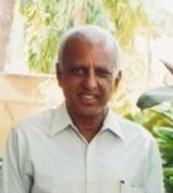 Bangalore based Satish Suri is an avid dance rasika besides being a life member of the Music and Arts Society. |
