
|     |
|
| |

REVIEW / REPORTAn intimate tapestry of Kuchipudi: Grace, devotion, and contemporary resonance- Rachana Raoe-mail: rachanamadhavp@gmail.com July 2, 2026 The 2nd chamber series by Natyanjali Kuchipudi took place on June 6, 2026 at Natyanjali studio, Frisco, Texas. These series, envisioned by Guru Srilatha Suri, continues to cultivate a rare artistic ecosystem, one in which intimacy enhances intensity, and proximity deepens perception. In this thoughtfully curated evening, the chamber format dissolved the distance between performer and rasika, allowing each nuance of rhythm, expression, and narrative to unfold with striking immediacy. The repertoire showcased both classical fidelity and contemporary imagination, tracing a rich emotional arc through devotion, love, and feminine voice. 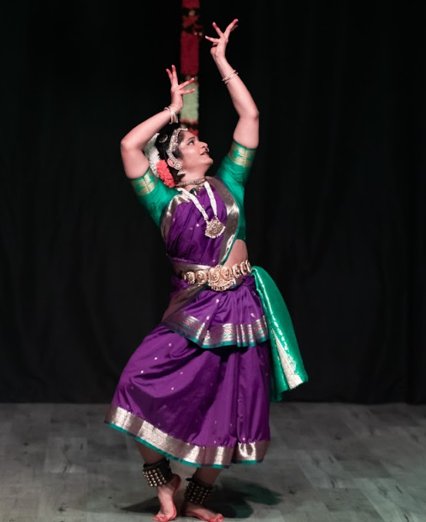 Satya Sivani Kaja The recital opened with Satya Sivani Kaja's interpretation of "Ananda Tandavam," a composition of C. Narayana Reddy, brought to life through the choreography of Guru Vempati Chinna Satyam. Portraying the cosmic interplay of Shiva and Parvati, Satya Sivani anchored her performance in a robust command of tandava interwoven with delicate lasya. Her energetic nritta passages displayed clarity and vigor, while sculptural poses evoked the iconography of divinity. Though grounded in traditional vocabulary, her interpretation gleamed with an earnest vitality that set an auspicious tone for the evening. Manaswini Avari followed with "Natavara taruni saharasa vilasa," the evocative composition of Oothukaadu Venkata Subba Iyer. What distinguished this rendition was its imaginative narrative lens. The peacock feather as storyteller, witnessing Krishna's joyous raasakrida. Manaswini's abhinaya rippled with freshness and ingenuity, attuned to the musical metaphors: the flute emerging as Krishna's presence and konnakol defining rhythmic interplay. Her performance seamlessly bridged narrative clarity with aesthetic charm, leaving a lingering sense of delight. 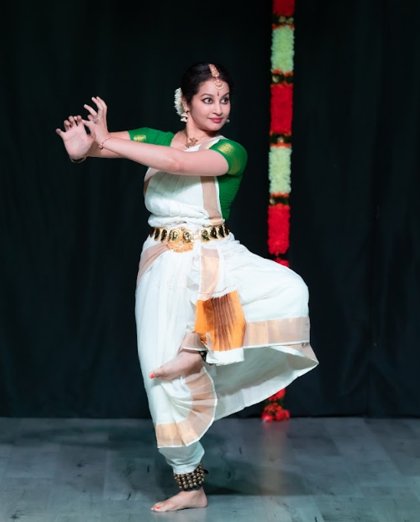 Dr. Pranamya Suri The stage then welcomed Dr. Pranamya Suri, whose artistry stands as a luminous confluence of scholarship, tradition, and deeply internalized aesthetics. Her presentation of "Natesha Kauthvam" was both invocation and revelation, a deeply immersive homage to Nataraja, the eternal source of rhythm and cosmic order. What distinguished her performance was the effortless harmony between grace and dynamism: every movement flowed with a silken continuity, yet pulsed with an unmistakable inner vitality. Her adavus were executed with crystalline precision, each rhythm etched so clearly that the geometry of Kuchipudi came alive before the audience. Her abhinaya did not merely illustrate but illuminated, revealing the transcendental stillness within the dynamism of Shiva's Ananda Tandava. The audience responded with palpable admiration, their engagement deepening with each measured movement. In Aasish Cherukupalli's "Paluku tenela talli," the devotional lyricism of Annamacharya found gentle expression. The piece, portraying the divine romance of Alamelumanga and Venkateshwara, was rendered with sincerity and quiet grace. Aasish approached the composition with reverence, allowing its traditional beauty to unfold without excess ornamentation, reminding the audience of the enduring elegance of classical repertoire. A notable shift in spatial and emotional dynamics emerged in the duet by Sreeragini Ghantasala and Priyanka, who presented Tyagaraja's "Koluvai unnade." Their choreography captured the regal splendor of Rama's court while sustaining a devotional undercurrent. The dancers exhibited commendable synchronization, their movements mirroring each other with cohesion and clarity. Their portrayal of the devotee's yearning and humility was articulated with balanced restraint, ensuring that the grandeur of the darbar did not overshadow its spiritual essence. Medha Srigiri's "Rusli Radha" introduced a textured emotional departure. Drawing from Marathi poetic tradition, this abhinaya-centric piece navigated Radha's wounded pride and emotional distance. Medha's portrayal was sensitive and nuanced, her silences as expressive as her movements. She captured the fragility of love caught between ego and longing, suggesting that emotional dissonance reverberates beyond the individual, affecting the very fabric of Brindavan. Her interpretive maturity lent the piece a contemplative depth. The crescendo of the evening arrived with Katyayani Kanak, whose commanding stage presence and exceptional abhinaya rendered her the undeniable highlight. Presenting a trilogy of pieces centered on feminine experience, Katyayani threaded classical idiom with contemporary relevance. 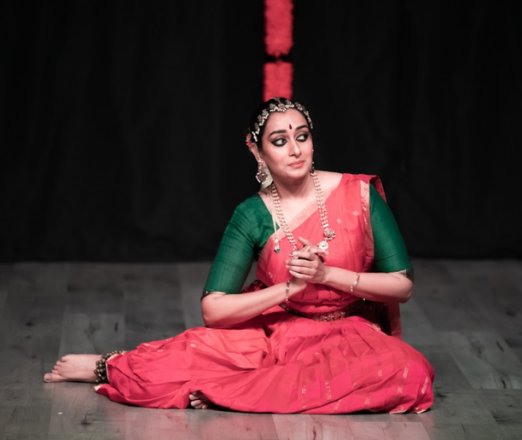 Katyayani Kanak In "Krishnabha," she infused humor and realism into the depiction of a lovelorn nayika disrupted by an all-too-human ailment, a migraine, transforming the familiar trope into a refreshing, relatable vignette. Her timing and improvisational flair elicited both laughter and recognition. Her second piece, "It's Only Words," shifted tone to one of assertive introspection. With wit and subtle sarcasm, she embodied a woman unpersuaded by hollow romantic overtures. Katyayani's abhinaya dissected the illusions of marital promises, articulating a distinctly modern sensibility without compromising classical form. In "Onsra," she delivered a deeply moving portrayal of love's impermanence. As the nayika confronted the inevitability of separation, Katyayani navigated a spectrum of emotions from yearning, resignation, and quiet despair with remarkable sensitivity. The performance unfolded as an emotional crescendo, drawing the audience into an empathetic space where personal and universal longing converged. It was a poignant conclusion that lingered long after the final gesture. The evening, as a whole, was a compelling journey through the landscape of Kuchipudi rooted in tradition yet unafraid to explore contemporary resonance. From vigorous nritta to introspective abhinaya, from divine narratives to human vulnerabilities, each performance contributed to a cohesive artistic experience. Under the visionary framework of the Natyanjali Chamber Series, this recital affirmed that classical dance remains not only preserved but continually reimagined, alive, responsive, and profoundly relevant.  Rachana Rao is a Bharatanatyam and Kuchipudi dancer based in Dallas. |
