
|     |
|
| |

REVIEW / REPORTGuru Smaran: Celebrating the centenary of Guru Kelucharan Mohapatra- Manjari Sinhae-mail: manjari@sinha.com Photos courtesy: Kalpa Vriksha June 27, 2026 This year marks the Birth Centenary of Guru Kelucharan Mohapatra. For the Odissi world, it is not merely an anniversary but a moment to reflect upon the life and legacy of the visionary who shaped the very grammar, aesthetics, and soul of the dance form as we know it today. To commemorate this historic occasion, Kalpa Vriksha Centre for Performing Arts, founded by Guru Arpita Rakshit Sabud in Potomac, Maryland, inaugurated its year-long centenary celebrations with a deeply engaging event titled 'Remembering Guruji'. The intimate 'Baithak' featured an insightful conversation with the eminent Odissi exponent Sujata Mohapatra conducted by the senior dancer-scholar Jayanti Ganguly. Sujata Mohapatra occupies a uniquely privileged place in Guruji's legacy - not only as one of his foremost disciples but also as his daughter-in-law. This dual relationship endowed her with an extraordinary wealth of memories, both artistic and personal, which she shared with warmth, affection, and remarkable candour. 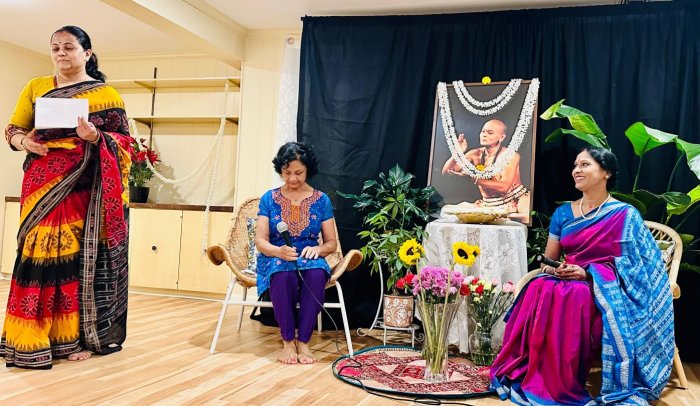 Arpita Rakshit Sabud, Jayanti Ganguly, Sujata Mohapatra Recalling her early years, Sujata spoke of her childhood in the small town of Balasore, Odisha, where both her parents were schoolteachers. Her mother, Kumudini Mohanty, herself her first dance teacher, recognized her daughter's inclination towards dance and enrolled her at Nritya Sangeet Kala Mandir under Guru Lingaraj Behera and Guru Sudhakar Sahu. Later she trained under Raghunath Dutta, a disciple of Guru Kelucharan Mohapatra, at Kala Vikash Kendra in Cuttack. Her long-cherished dream was fulfilled when she finally met Guruji at the Odissi Research Centre in Bhubaneswar, where he was teaching. That marked the beginning of a lifelong journey under one of India's greatest dance masters. Recognizing Sujata's sincerity, dedication, and unwavering commitment, Guruji nurtured her with exceptional care and eventually welcomed her into his own family. She fondly remembered Guru Maa Lakshmipriya Mohapatra, acknowledged as one of the earliest women to perform Odissi on the public stage, and reflected upon how fortunate she felt to have received both her artistic and personal upbringing within such an extraordinary household. Every moment spent with Guruji, she said, remains a divine blessing. When Jayanti Ganguly asked what distinguished Guru Kelucharan Mohapatra's bani from all others, Sujata explained that his teaching rested upon an uncompromising foundation of technique. Absolute precision in the basic postures such as chauka, tribhanga, and the correct distribution of body weight - formed the cornerstone of his pedagogy. He paid meticulous attention to torso movement, alignment, and balance, often cautioning his students that excessive flexibility would rob Odissi of its classical dignity and reduce it to folk dance. Preserving the innate grace and discipline of the classical dance, she recalled, was always paramount for him. His insistence on veracity extended equally to abhinaya. "Do not remain yourself," he would tell his disciples. "Become the character." 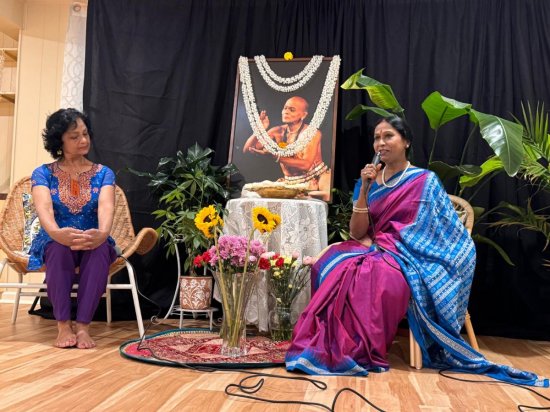 Jayanti Ganguly & Sujata Mohapatra Sujata illustrated this through memorable anecdotes. During the Kevata Prasanga from the Ramayana, Guruji portrayed the humble boatman while Sujata performed the role of Rama. As Guruji bent to wash Rama's feet before ferrying him across the river, he noticed her foot trembling. Immediately he stopped and gently reprimanded her: "You are still thinking of yourself as Sujata. Forget that. At this moment you are Rama. Live the character you are portraying." On another occasion, while rehearsing the episode of Krishna and Sudama, Guruji enacted the impoverished Sudama and Sujata played Krishna. As Krishna affectionately pulls away the humble bundle of flattened rice hidden under Sudama's arm, Guruji was happy to see her entering completely into the emotional world of the character. Such moments, Sujata observed, revealed how profoundly Guruji believed that authentic abhinaya arose not from imitation but from total identification with the role. Speaking about Guruji's choreographic process, Sujata revealed a fascinating glimpse into his creative world. His most inspired moments often came after everyone had retired for the night. Working into the early hours alongside violin maestro Bhubaneswar Mishra and vocalist Raghunath Panigrahi, he would first shape the musical composition before translating it into movement with the incomparable Sanjukta Panigrahi. Often, he would sketch visual ideas on paper before embodying them through dance. Sujata also recalled his memorable workshop at Gandharva Mahavidyalaya, Delhi, where he choreographed the celebrated Hansadhwani Pallavi and interpreted the Odia lyric Kede Chhanda, leaving an indelible impression upon generations of dancers. Equally fascinating were her recollections of Guruji's attention to aharya. She narrated how he personally guided Bhagirathi Tailor of Bhubaneswar in mastering the distinctive cutting and stitching of the now iconic Odissi costume. Such anecdotes revealed Guruji's extraordinary involvement in every aspect of the art form - from movement vocabulary and music to costume, presentation, and aesthetics. With humour, affection, and remarkable detail, Sujata painted a portrait of Guruji not merely as an incomparable choreographer and performer, but as a meticulous teacher, visionary creator, and compassionate human being. Her reminiscences transformed the conversation into an invaluable learning experience, particularly for the young students present, who were able to glimpse dimensions of the legendary guru seldom found in books or archival recordings. Following Sujata's reflections, Pratap Das, Sukanya Mukherjee, and I were also invited to share our own cherished memories of Guru Kelucharan Mohapatra. Together, these recollections offered rare and deeply personal insights into the immense contribution of a master whose artistic vision transformed Odissi into one of India's most celebrated classical dance traditions. The session left everyone present enriched, inspired, and profoundly moved. 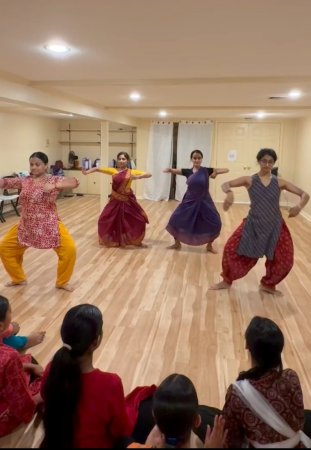 Odissi workshop Earlier that weekend, Kalpa Vriksha Dance Studio had also organised an intensive Odissi workshop under Sujata Mohapatra's guidance. Students travelled not only from across the DMV region but also from Philadelphia, Boston, Texas, and even Canada to learn from one of the world's foremost exponents of the dance. Over two days of rigorous training, participants immersed themselves in refining technique, deepening their understanding of Guruji's bani, and absorbing the subtle nuances that define authentic Odissi. Their enthusiasm, discipline, and eagerness to learn made the workshop an outstanding success. Arpita Rakshit Sabud and the Kalpa Vriksha family expressed heartfelt gratitude to Sujata Mohapatra for her extraordinary generosity in sharing her knowledge with every student who had travelled from near and far to participate in this unique learning experience. Dedicated to preserving, promoting, and propagating the rich heritage of Odissi, Kalpa Vriksha has emerged as a vibrant centre for the dance form in the Washington metropolitan region. Remembering Guruji marked the first in a series of thoughtfully curated events celebrating the Birth Centenary of Guru Kelucharan Mohapatra. Through these year-long commemorations, Guru Arpita Rakshit Sabud and her institution seek not only to honour the memory of the legendary maestro but also to ensure that his timeless artistic vision continues to inspire future generations of dancers and rasikas across the world. 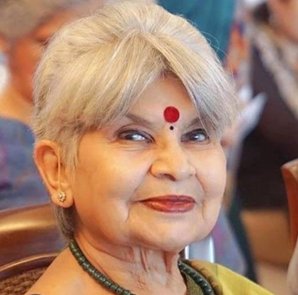 Manjari Sinha is a musicologist and an acclaimed classical music and dance critic. She has an MA in Sanskrit from Allahabad University, MA in Music from Vikram University, Ujjain; Sangeet Prabhakar in Hindustani Vocal, Tabla, Sitar and Kathak dance from Prayag Sangeet Samiti, Allahabad; and further training in Sitar under Guru Pt. Arvind Parikh in the lineage of Ustad Vilayat Khan. She has authored a book on Ustad Bade Ghulam Ali Khan, commissioned & published by Roli Books. She has contributed the chapter on Kathak for 'Indian Dance: the Ultimate Metaphor'. Her articles in English and Hindi on Music, Dance, Art & Culture are regularly showcased in a variety of leading journals and periodicals. |
