
|     |
|
| |

REVIEW / REPORTKalatarka - The thread that time weaves- Satish Surie-mail: satishism@yahoo.co.in Photos: Prof. K.S.Krishnamurthy June 24, 2026 Some performances entertain, and some performances unsettle you into wisdom. 'Kalatarka', literally Time's Enigmatic Thread, belonged decisively to the second category. Presented on the 7th of June at Bangalore's Medai under the aegis of Alapana Curated Cultural Experiences, and conceptualised, choreographed, and performed entirely by Sandhya Udupa, this ambitious full-length Bharatanatyam solo was an act of philosophical reckoning, a sustained meditation on mortality, the soul's passage through existence, and the possibility of liberation. It made the personal cosmological and the cosmological achingly personal. Drawn from the loss of her grandmother and the cascade of questions that grief unleashed, the work bore the gravity of someone who had stood before life's most unanswerable door and chosen, rather than to look away, to dance her way through it. The production opened with Bhadrakali on the cremation ground. Sandhya entered the performance space spinning in broad, sweeping arcs, her body borrowing the kinetic idiom of Yakshagana, that ancient theatre of Karnataka with its bold spatial dramaturgy and its appetite for the elemental. The image was at once terrifying and orienting, a declaration that this was not going to be a conventional margam. Kalatarka unfolded instead as a thematic odyssey, tracing the soul's emergence from the universal source through its passage across non-living matter, immovable and movable beings, into the particular and irreplaceable fact of human life, and finally toward that confrontation with time, karma, and bereavement that either breaks a soul or refines it toward liberation. The narrative moved in a non-linear and introspective arc, weaving mythological episodes alongside philosophical inquiry, personal reflection alongside cosmic sweep, without allowing any strand to become merely decorative. It was structured not as an argument but as an experience, asking the audience to inhabit its questions rather than await its answers. Sandhya's technical command was never in doubt. Her formation under Acharya Indira Kadambi was palpable in the vibrancy and precision of the rhythmic passages, jatis and adavus executed with a crystalline clarity that never hardened into mechanical display. These sections crackled with an almost percussive aliveness, providing essential energetic counterpoint to the production's more inward and reflective moments. Yet what truly distinguished Sandhya was her abhinaya. Expressions of inner turmoil, longing, ferocity, serenity, and transcendence were not arranged sequentially like a catalogue of prescribed moods. They inhabited one another, the fierce shading into the grief-stricken, the serene shadowed by an older knowing. Sandhya allowed each emotional state its full weight and duration. There was no rushing of feeling here, and that patience was itself a philosophical statement. The work insisted, in its very tempo, that depth could not be hurried. The episode of Sage Vashishta's curse upon the eight Vasus was among the production's most viscerally arresting passages. Here, Sandhya rendered with extraordinary depth the moment of divine wrath and its terrible consequence: eight celestial beings condemned to mortal birth, to the weight of flesh, suffering, and death, as the price of even a minor transgression against a sage's sanctity. The themes the episode carried - karma, the inexorability of consequence, divine intervention in human affairs, the power of a curse to reshape an entire cosmic trajectory - resonated with particular force within Kalatarka's larger meditation on the soul's passage through existence. Sandhya's body seemed to expand to fill the mythological scale demanded of the moment, and yet the choreography resisted spectacle for its own sake. The anguish of the Vasus, their descent from the celestial to the mortal, was held in tension with the serene implacability of cosmic law, the ferocious and the contemplative revealed as two faces of a single reality, not opposites in conflict but complements in an ancient, unresolvable dialogue. 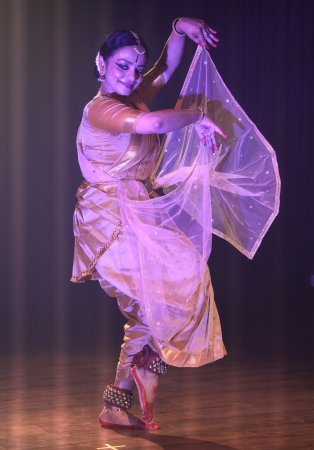 Spoken word was deployed with notable intelligence throughout the evening. Rather than explaining the dance or glossing its symbolism, these interjections served to illuminate the dancer's internal monologue, making accessible the layers of meaning the body was already expressing. They bridged classical form with contemporary narrative sensibility and arrived with the precision of a well-placed breath, never intruding, never merely ornamental, but surfacing precisely at those moments where pure movement risked tipping into abstraction. The costume dramaturgy deserved its own extended attention, for it constituted a choreographic language in itself. Sandhya moved through the performance bearing an organza veil that periodically became something else entirely, the softly billowing wings of a soul in transit between states of being. A shoulder stole, in one startling and wholly unexpected instant, transformed into a noose, a flash of the terrifying that arrested the audience before the image dissolved back into grace. Most powerful of all was the overcoat, red and substantial, carrying the full weight of bodily existence, which Sandhya removed to reveal white beneath. The gesture was simple and total. The body shed. The soul made legible. It was one of those rare moments in performance when a change of costume ceased to be a practicality and became instead a philosophical event, the kind that stays resident in the mind long after the house lights have come up. 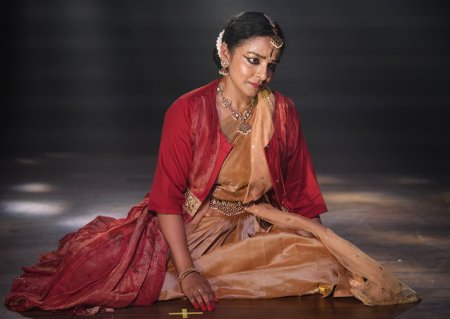 The stagecraft bore throughout the refined imprint of Sandhya's background in interior design. Her spatial awareness was acute, her use of the performance space deliberate rather than habitual. Lighting did not merely illuminate the dancer but modulated the emotional temperature of each passage, mythological sequences and contemplative interludes differentiated not only by movement quality but by the particular world of light and shadow they were made to inhabit. The overall aesthetic was polished without being cold, immersive without being overwrought. The musical ensemble, on a recorded track that accompanied the evening, was no mere backdrop. Rohith Bhat Uppoor's composition and vocals built a sonic architecture of considerable range, moving between the ruminative and the fierce with a fluency that mirrored the choreography's emotional arc. Vinay Nagarajan on mridangam anchored the rhythmic foundation with assurance and sensitivity, while Giridhar Udupa on ghatam deepened the earthen quality of the more elemental passages. Pramath Kiran on morsing and uduke widened the palette toward the primal and the folk, and the flutes of Shashank Jodidar and Nithish Ammannayya lent the contemplative sequences a lyrical longing that words alone could not have carried. Pradesh Achar and Srinidhi Mattur on violin held the ensemble together through its many shifts of register, and Suma Rani on sitar contributed a searching, classical warmth throughout. Together, these musicians did not merely accompany the dance. They elevated it. Sandhya brought to Kalatarka a rare convergence of inheritances - Bharatanatyam, Kuchipudi, Yakshagana, and Carnatic music - each tradition present not as an eclectic borrowing but as a thread woven into a single integrated artistic language. The musicality in her footwork, the suppleness of her gestural vocabulary, the ease with theatrical scale that Yakshagana had given her, all of it coalesced into a choreographic vision that was coherent, emotionally resonant, and philosophically rigorous, stitching the cycles of birth, passage, death, and liberation into a whole that made of grief not a wound but a threshold. Kalatarka did not resolve the questions it raised. It was not designed to. What it offered instead was something considerably rarer: the experience of having lived fully inside those questions, held there by a dancer whose artistry proved equal, in every measure, to the weight she had chosen to carry.  Bangalore based Satish Suri is an avid dance rasika besides being a life member of the Music and Arts Society. |
