
|     |
|
| |

REVIEW / REPORTA journey between three worlds- Sonya Wynne Singhe-mail: sonya.s.wynne@gmail.com June 21, 2026 On the evening of 10th June, nearly 300 hearts danced the cosmic dance of Shiva. The dancers aligned, their movements precise and studied, their bodies mimicking a heartbeat. A contraction and expansion. The boundaries between dancer and audience gently dissolved. Everyone watching was performing Shwasam, becoming part of a shared rhythm. Rama Vaidyanathan and her disciples were the only ones dancing on stage, but though immobile, we were breathing with them. We were dancing with them. Shwasam was the final act of Nirantara, the night's performance, but in some fleeting moments, this went beyond art, to a profound journey inwards, where every heart resonated with the eternal spirit of Shiva. On that warm evening on June 10th, it was not only Rama Vaidyanathan's Shwasam that captivated the audience. It was her respect for tradition and her sharp, innovative eye, seeking ways to weave in the old and new that gave birth to her latest spectacle Nirantara: An Unending Voyage, inspired from Indian literature across multiple languages. 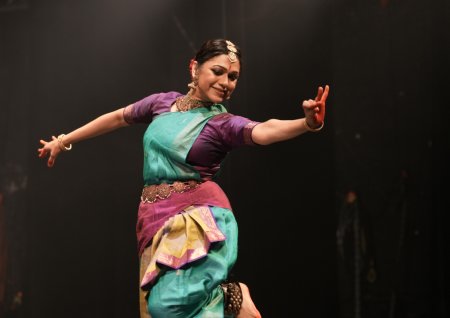 Rama Vaidyanathan performing at Theatre Dejazet, Paris Rama Vaidyanathan, accompanied by her four disciples and live musicians, presented the work at the mythical Theatre Dejazet. This is one of Paris' oldest and most storied theatres--though its reputation was not always impeccable. In the 19th century it stood on the «boulevard du crime», a nickname given to Boulevard du Temple because of the many crime melodramas staged nightly in its many theatres. Dejazet alone survived, reinventing itself first as a cinema in the 1970's and later as a theatre. Mozart and Offenbach performed there; so did many elite thespians of the Comédie-Francaise; it saw performances from anarchist singers, popular French-African comedians and nominated actors. The traditional and the modern; the place where boundaries cease to be barriers and start becoming invitations. The venue seemed particularly fitting for an artiste like Rama Vaidyanathan who has never shied away from innovation, continually evolving while remaining firmly rooted in tradition. I had met Rama Vaidyanathan prior to her big evening in Paris, and she reflected on her creative process, explaining that although her body had been trained exclusively in Bharatanatyam, it did not confine her. On the contrary, it liberated her, enabling her to experiment, "enlarge the spectrum, widen the boundaries" and create another style, her style. I asked her whether venturing into doing something on the lines of French choreographer Annette Leday's work of using Kathakali to depict King Lear would appeal to her and the answer was an enthusiastic, "Yes, absolutely. The possibilities in Indian dance are immense because contrary to what people think, it's very versatile"! The versatility of Rama Vaidyanathan was well displayed with Mayur alarippu, conceived nearly two decades ago. Alarippu, the first piece all Bharatanatyam dancers learn, symbolises the dancer's awakening, and the literal flowering of the body to the rhythms of dance. Rama Vaidyanathan thought of linking the image of the blooming flower with that of the Mayur (peacock); she and her very talented disciples, Shubhamani Chandrashekar, Reshika Sivakumar,Vaishnavi Dhore and Nilava Sen, evoked the vibrant spirit of this resplendent bird by giving a new shape to a traditional vocabulary. 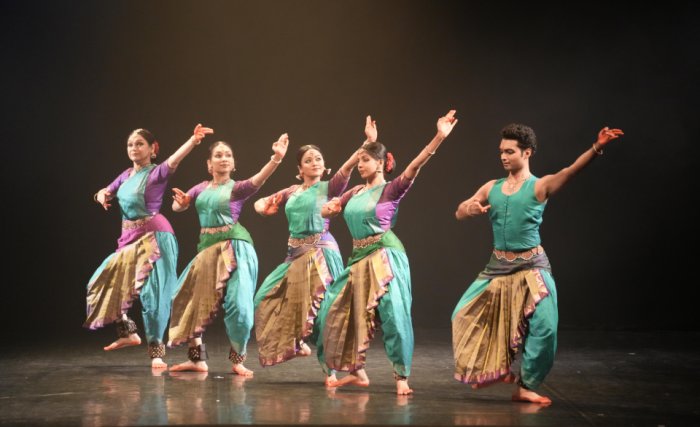 Rama Vaidyanathan performing with her disciples Looking around me that evening, I understood why so many Indian artistes felt strong links with France and vice-versa. Rama Vaidyanathan had confessed having sensed this interest and enthusiasm each time she has performed for the French public. The spirit of innovation along with tradition appeals strongly to them, and they have a deep appreciation for Bharatanatyam along with other Indian art forms. She attributes this sustained interest to the pioneering efforts of guru M.K. Saroja, who first planted the seeds of Bharatanatyam in France during the 1970s, thus helping to nurture a vibrant audience interested in Indian dance. Inspired by this legacy, Rama Vaidyanathan hopes to further expand the reach of Bharatanatyam in France. She envisions returning regularly to undertake long-term artistic and pedagogical work, capitalizing on the connection she has with French audiences, a connection illustrated by the nearly ten minute long standing ovation after her performance in Lille. 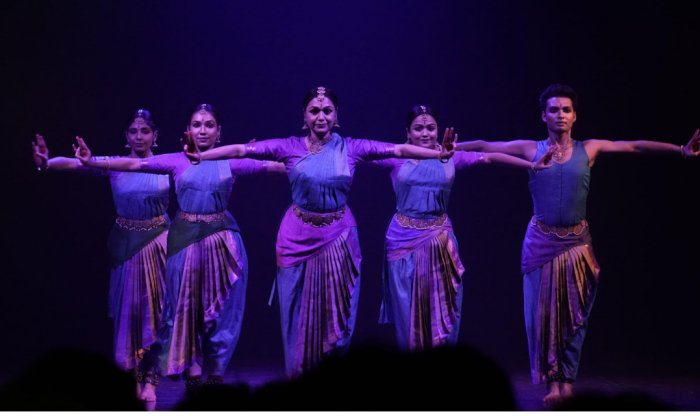 Nirantara: An Unending Journey The second tableau of Nirantara, Jeeva Dashavastha, was inspired from the teachings of Guru Nanak exploring the cyclical journey of human existence. Through its ten stages, the work traces the soul's passage from birth to death, each entwined with desire, attachment and suffering. If dance can transmit emotion this was the surest example. And what an astonishing performance by the guru! Through her movements and her face alone, she embodied each of the ten stages of life, from the child begging for his mother's milk, to the teenager longing for acceptation, to the young adult lusting for pleasures, then power, until he simply wants his youth back, all the while bull-riding Yama is coming inexorably. Teary eyes, wide, sad smiles, hands on mouths: no translation was needed. The act broke all cultural and language barriers. After an intense piece, the next item, Himalaya was a refreshing and beautiful innovation by the ensemble, celebrating this majestic mountain range. The celebration culminated with a silent prayer to one day ascend the holiest of them all - Mount Kailash, the eternal abode of Lord Siva. Once again, it was evident that Rama akka, as her students affectionately call her, combined exacting standards and rigorous discipline with the warmth of an elder sister and trusted confidante. Every dancer rose to the occasion and delivered their best, contributing significantly to the success of Nirantara. Over the course of our two-hour conversation, what emerged was not only a celebrated Bharatanatyam dancer but a woman of remarkable substance. Rama Vaidyanathan has managed a demanding artistic career with family life, generously crediting her parents and her guru and mother-in-law, Saroja Vaidyanathan, for their support. Her mantra for dancers-"resting inspired"-captures that spirit. It also resonates with her portrayal of Janabai in Abhang, the medieval saint-poet who challenged the misogyny of her time and embraced her devotion to Vithala on her own terms. As Janabai, Rama danced with love, pride, and exhilarating abandon. As expected, the soirée concluded with standing ovations for Rama Vaidyanathan, her disciples, and the accompanying live musicians. Vishwesh Swaminadhan on vocals, Madan Mohan on the violin, and Sannidhi Vaidyanathan on the mridangam added a rich and compelling dimension to the performances, enhancing the overall artistic impact. Since March 2026, the French public have had the opportunity to see eminent Indian artistes. This enriching journey, a real example of enduring cultural ties between the two nations, has been made possible through the encouragement and support of H.E.Ambassador Sanjeev Singla, the Embassy, the ICCR, Abhishek Bakolia 2nd Secretary Press and Culture, and Anup Das, the dedicated Director Centre Culturel Swami Vivekananda in Paris. A special word of appreciation is due to Romi Takyar, Sabine Pandaredattil, and Rajiv Takyar of Association Khushi. Their dedication and hard work transformed an invitation into reality, with every aspect expertly organized in just two months. The Association generously supported the performances in Lille and Paris. A bravo to all those who made these evenings possible. 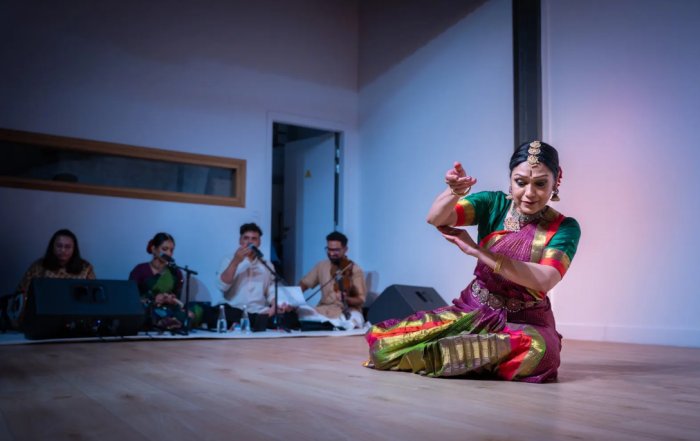 Rama Vaidyanathan performing at The Centre Culturel Swami Vivekananda de Paris As part of this initiative, Rama Vaidyanathan presented a lecture-demonstration on 8th June at the Centre Culturel. The four tableaux were varied and enlightening. Ratnagarbha was inspired by a seal from the Indus Valley Civilization depicting a plant emerging from a womb, symbolizing Mother Earth. Prem Gatha was based on an emotional and poignant poem by Rabindranath Tagore capturing the anguish of lovers facing an imminent separation. Rama Vaidyanathan's nuanced interpretation portrayed this delicate sentiment with sensitivity, beautifully expressing the lover's yearning to linger a little longer before the farewell. After this, her students competently performed a traditional piece depicting young Krishna's time with the gopis. The final piece was Ardhanareeshwara, a hymn composed by Adi Shankaracharya, depicting the divine union of Shiva and Parvati as a single cosmic entity. Rama Vaidyanathan joined her disciples, and together they enthralled the audience. Their artistry was rewarded with an applause that continued for nearly five minutes. An interactive session followed. That evening, however, had one final surprise in store for the public. Guru Sucheta Chapekar, who was in the audience, was requested by Anup Das, the Director of the Centre, to grace the stage. It was a rare and memorable moment to see two legendary dancers standing side by side, leaving the audience with a memory to cherish. This article would not be complete without a special mention of Rama Vaidyanathan's young troupe, whose passion and dedication brought a unique energy to the performances. For Shubhamani, art was always a calling. Reshika discovered early on that dance came more naturally to her than any other subject. Vaishnavi was fortunate to have a mother who recognized her spark and guided her towards Rama akka. Nilava fondly recalls dancing around the house since childhood, while Vishwesh-the voice of the troupe-grew up surrounded by music in a family steeped in musical traditions. Violinist Madan Mohan began his musical journey at the age of nine, and percussionist Sannidhi was quite literally raised amidst the sounds of instruments, rhythm, and dance. Their hard work, discipline, and commitment was evident but they were equally eager to experience Paris in their own way. Sannidhi was determined to savour authentic crêpes, while Nilava found himself captivated by the city's magnificent architecture. Yet, above all, they were fascinated by something less tangible: the celebrated art of ‘slow living' of the Parisians. Three days in Paris with Rama Vaidyanathan and her ensemble felt like an emotional roller-coaster. Visually captivating, the performances went beyond aesthetic beauty, drawing audiences into a deeply introspective journey that reflected the essence of Nirantara-the unending flow that transcends time and space. 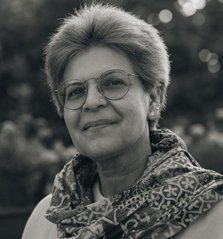 Sonya Wynne Singh is a senior talent in art books publishing from 1980's and recently guest-edited 'Indian Dance in France' for attenDance 2025. She lives and reports for various publications from France. |
