
|     |
|
| |

REVIEW / REPORTCarrying forward a legacy: Sourav Mohanty's Odissi recital at IIC- Ratna Bharati Acharyae-mail: ratnabharati@gmail.com June 17, 2026 As part of its Summer Festival of Dance, the India International Centre presented an Odissi recital by Sourav Mohanty of Bhubaneswar on 12 June at the C.D. Deshmukh Auditorium, Delhi. A disciple of Guru Durga Charan Ranbir and Rahul Acharya, Sourav Mohanty is a promising young exponent of the Guru Deba Prasad style of Odissi. The evening commenced with Mangalacharan, a composition dedicated to Harihara, the unified form of Shiva and Vishnu. Based on raga Bhatiyar and tala Eka Tali, the original piece was choreographed by Guru Deba Prasad Das and it was reworked by Guru Durga Charan Ranbir. It provided an auspicious and dignified opening to the recital, setting the tone for the evening. The second presentation was a Pallavi in raga Shankarabaranam and tala Eka Tali, choreographed by Adi Guru Pankaj Charan Das. A hallmark of Guru Pankaj Charan Das's choreographic vision is his ability to create movements that, despite their apparent simplicity, are profoundly impactful and graceful. Particularly memorable was the concluding section, in which the dancer traversed the stage in circular patterns, gliding gracefully with subtle footwork. As the tempo increased, Sourav handled the increasingly complex nritta passages with clarity and precision. 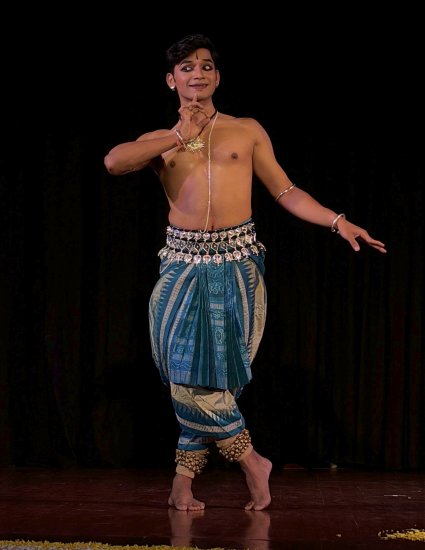 Sourav Mohanty (Photo: Aaditya Singh) The third item was the ashtapadi "Priye Charusheele", the refrain of the nineteenth song from the tenth chapter of Jayadeva's Geeta Govinda. Based on raga Desh and tala Rupaka, it was choreographed by Rahul Acharya. Several moments in the choreography stood out for their poetic beauty, particularly the captivating scene in which Krishna adorns Radha's face with sandalwood paste. Equally evocative was the sequence in which Krishna writes Radha's name upon the sand, erases it, and then applies that very sand to his body in longing and devotion. The subsequent moment in which he pleads with Radha to place her lotus-like feet upon his head was beautifully conceived. There was, however, one transition that could perhaps have been developed further to strengthen the dramatic continuity. During the opening section, Krishna repeatedly looked towards his right while conversing with Radha. The focus then shifted to the left, like the shloka clearly asks Radha to shift from the right to the left. It was a subtle choreographic indication of the transition. His portrayal of Krishna's emotional world and body language shows considerable potential and will undoubtedly gain further depth with continued artistic maturity. The poetry of the Geeta Govinda is layered with profound emotional and spiritual nuances, and such compositions invite a highly detailed and sensitive approach to abhinaya. A deeper engagement with the text will further enrich his interpretative expression. The concluding item was Suryashtak, choreographed by Guru Durga Charan Ranbir and set to raga Bairagi and tala Jati. It was a vibrant and energetic composition filled with dynamic movement and striking visual imagery. Each stanza of the hymn was thoughtfully interpreted through movement while remaining true to the majestic character of Surya. The choreographic imagery—from Surya riding his chariot drawn by seven horses to his role as the central force among the celestial bodies—was rendered with clarity and conviction. The depiction of Lohita Ratha was particularly effective. The final sequence was executed with impressive control; each pose was balanced, clear, and confidently sustained. It is often through the dancer's performance that a choreographer's imagination becomes fully visible to the audience, and Sourav succeeded in bringing many of the work's strengths vividly to life. Overall, Sourav Mohanty demonstrates a strong ability to embody the stylistic principles of the Guru Deba Prasad Das tradition. His chouka and tribhangi—the cornerstones of Odissi—were consistently well executed. The technical precision of his movement vocabulary was especially evident in both the Pallavi and Suryashtak. At times, the footwork could have carried slightly greater audible resonance. The stamping occasionally appeared somewhat restrained. The Pallavi was choreographed by Guru Pankaj Charan Das so the torso movement appeared more expansive than is generally associated with Guru Deba Prasad style. In Suryashtak, a strong embodiment of the sun's radiance, power, and intensity added greater dramatic force to the presentation. One additional observation concerns performance presentation. When a solo dancer performs to recorded music, the performance represents the collective contribution of numerous artistes. As a gesture of acknowledgement, it would have been meaningful to mention the musicians, vocalists and mardala artistes whose artistry formed the foundation of the recital. Sourav Mohanty possesses sound technique, discipline, and a strong grounding in the tradition. As he continues to evolve as an artiste, a more nuanced understanding of the poetry and the characters he portrays will further enrich his abhinaya and bring even greater depth and soul to his artistry.  Ratna Bharati Acharya is an Odissi practitioner with a deep passion for the classical, folk, and traditional art forms of India, particularly those of Odisha. Her current focus involves an in-depth exploration of these artistic traditions, researching into their origins and subtle intricacies. Through her writing and storytelling, she strives to share these narratives with children as well as international audiences, especially dancers living beyond India's borders. |
