
|     |
|
| |

REVIEW / REPORTA Parikrama of Tradition, Memory and Devotion:Aavishkar's fortieth year celebration- Bijoy Shivrame-mail: bijoyshivram@gmail.com Photo credits: Rajdip Bhatti June 16, 2026 Some performances entertain. Some evoke nostalgia. A rare few become a journey through collective memory, culture, devotion and artistic evolution. The 40th anniversary celebration of Aavishkar, Ahmedabad's renowned academy of performing arts, belonged to this rare category. For four decades, Aavishkar has stood as one of Gujarat's most respected cultural institutions, nurturing generations of dancers and performers while preserving the vibrant folk traditions of the state. Yet, what has distinguished the institution throughout its journey is its refusal to remain confined within a single artistic identity. While deeply rooted in the folk dances of Gujarat, Aavishkar has continually explored contemporary movement, semi-classical idioms, theatre, aerobics and even Kalaripayattu inspired body conditioning, enabling its dancers to understand not merely choreography, but the very kinetics of movement, balance, energy and spatial flow. The evening's celebration reflected this artistic philosophy beautifully. The program commenced with an atmosphere of festivity and reverence. As the musicians who had been integral to Aavishkar's journey over the decades were ceremoniously ushered into the auditorium, the resonant sounds of the shehnai, dhol and nagara transformed the venue into a living celebration. It was not merely an entrance; it was a tribute to those whose music had breathed life into countless performances through the years. From this festive beginning emerged a moment of profound stillness. The evening then travelled into one of Aavishkar's most ambitious creative explorations. In 1995-96, after listening to Pt. Vishwa Mohan Bhatt's evocative album Relaxation, Director of Aavishkar, Kalpesh Dalal envisioned a choreographic work inspired by the Panchamahabhutas - the five primordial elements. Revisiting this significant milestone in the institution's history, the dancers presented excerpts that revealed Aavishkar's engagement with contemporary and semi-classical vocabulary through four of these elements. The segment representing Aakash (Ether), choreographed by Dr. Uma Anantani, explored expansiveness, stillness and infinity through fluid movement patterns. The remaining elemental segments - Prithvi (Earth), Jal (Water) and Vayu (Air) - choreographed by Kathak exponents Maulik Shah and Ishira Parikh, demonstrated contrasting textures of movement, ranging from grounded strength to flowing lyricism and dynamic momentum. The final contemporary segment carried another chapter of Aavishkar's evolving artistic journey. Choreographed by Santosh Nair during his visit from Delhi in 2009, it reflected the institution's willingness to embrace newer movement languages while retaining its essential cultural sensibility. Through these presentations, the audience witnessed how Aavishkar had consistently encouraged dancers to move beyond stylistic boundaries while developing a deeper understanding of the body as an expressive instrument. Yet, if the first part celebrated artistic exploration, the next became an act of gratitude. A moving audio-visual presentation paid homage to the many musicians, singers and creative collaborators who had walked alongside Aavishkar since its inception in 1976. Faces appeared on screen; memories resurfaced; voices and melodies seemed to return to life. Particularly poignant were the tributes to those who were no longer alive. The legendary duo Raju and Vijay were remembered with affection, especially Vijay, whose brilliance as both singer and choreographer continues to influence performers even today. The untimely loss of the gifted singer Dharmendra Shah, affectionately known as "Bavo," was recalled with emotion. The infectious rhythms of dhol and dholak maestro Dhanji Shikari, whose beats could compel anyone to dance, were celebrated. Veteran flautist Nattubhai Basidhar, who contributed for nearly eighteen years, was remembered with gratitude. The tribute extended equally to those who continue to remain connected with Aavishkar's artistic journey: Nayan Pancholi, Kamlesh Jhala, Vipul Trivedi, Gopan Bhatt, Asit Dhanak, Ketuman Dave, Diptiben Raval, Payal Vaidya Chavda, Shraddha Hatangadi Mehta, Namrata Soni, Aditi Vasavada, Nilaben Dholakia, Kajal Ramani, Vishwa Ojha and many others whose voices and instruments have enriched countless productions. Special acknowledgement was accorded to Nishith Mehta, whose musical and creative support became invaluable. Above all stood the immense support of Shri Gaurang Vyas, revered as the Bhishma Pitamah of Gujarati music, whose contribution to Gujarat's cultural landscape remains immeasurable. The evening also highlighted Aavishkar's enduring association with theatre. Through its connection with Rangbahar and its founder Rajendra Bhagat, Aavishkar has played a significant role in fostering meaningful theatrical dialogue in Gujarat. The institution's continuing association with the Rajendra Bhagat Rashtriya Natya Mahotsav stands as testimony to this commitment. The remembrance of Rajendra Bhagat also recalled an era when stalwarts such as B. V. Karanth, Ranjit Kapoor, Ratnakar Matkari and Jashwant Thaker enriched Ahmedabad's cultural landscape through their presence and participation. 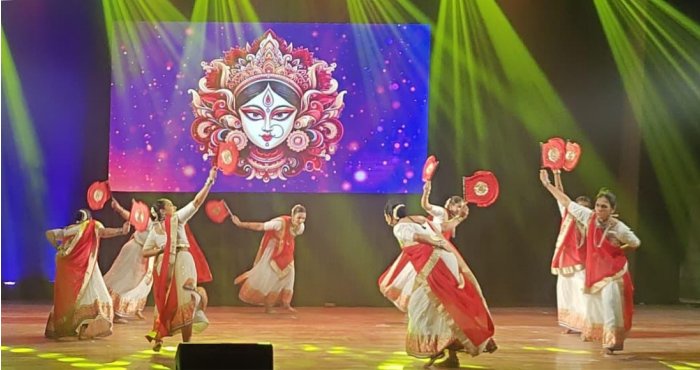 Vinjano 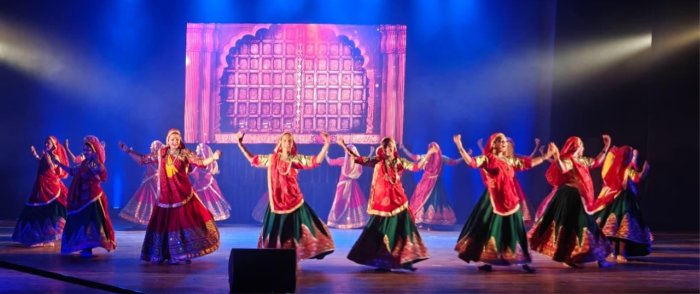 Garba And then came the segment for which Aavishkar is most widely celebrated. The auditorium transformed into a vibrant pilgrimage of devotion through Gujarat's sacred geography. Titled as an Aadhya Shakti Parikrama, the production was both a celebration of Gujarat's folk dance traditions and an artistic homage to the many manifestations of the Divine Mother worshipped across the state. Set entirely to the magnificent musical compositions of maestro Gaurang Vyas, the presentation traversed temples, legends, communities and devotional traditions through an uninterrupted flow of dance and music. The transition into the folk dance segment was marked by a captivating audio-visual presentation featuring the vibrant voice of renowned Dayro artist Yogesh Gadhvi. As images of Gujarat's revered Shakti shrines and sacred landscapes unfolded on screen, his evocative narration and devotional singing created an atmosphere of faith and anticipation, preparing the audience for the spiritual and cultural journey that followed. 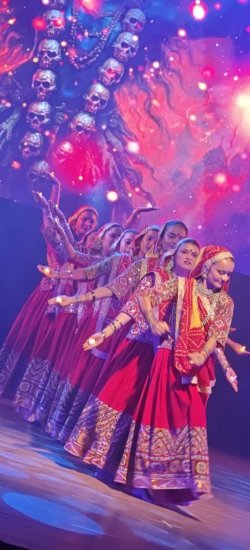 Bhadrakali The audience was taken from Ambaji to Pavagadh, from Bahucharaji to Chotila, from village shrines to sacred hills, encountering the many forms of Shakti revered across Gujarat - Amba, Mahakali, Bahuchara Mata, Meldi Maa, Khodiyar Maa, Chamunda Maa, Randal Maa, Ashapura Mata, Sonal Maa and countless other beloved manifestations of the Divine Feminine. The choreography seamlessly integrated some of Gujarat's most beloved devotional songs. Familiar melodies emerged one after another, instantly drawing audiences into shared cultural memory. Whether it was "Have Mandirana Baran Ughado Mori Mata," "Maa Taro Garbo Zaakam-Zol Ghoome Gol Gol," "Bahuchar Ma Na Dera Pachhal Kukade Kuk Bole," "Chotile Dakla Vagya Chamunda Maa Na," "Bol Mari Ambe," "Ranga Taali," or "Madi Tara Mandiriya Ma Ghantarav Gaje," each composition became a portal into a specific sacred landscape. The production was particularly remarkable for its rhythmic richness. The dancers navigated intricate patterns of garba, raas and regional folk variations with extraordinary precision. The changing rhythmic cycles, accented by dhol, nagara, manjira, damaru and temple bells, created constantly shifting textures. At times the rhythms surged with warrior-like energy; at others they became devotional, celebratory or deeply meditative. The performers demonstrated not only technical competence but also a keen understanding of the nuanced rhythmic vocabulary that forms the heartbeat of Gujarat's folk traditions. 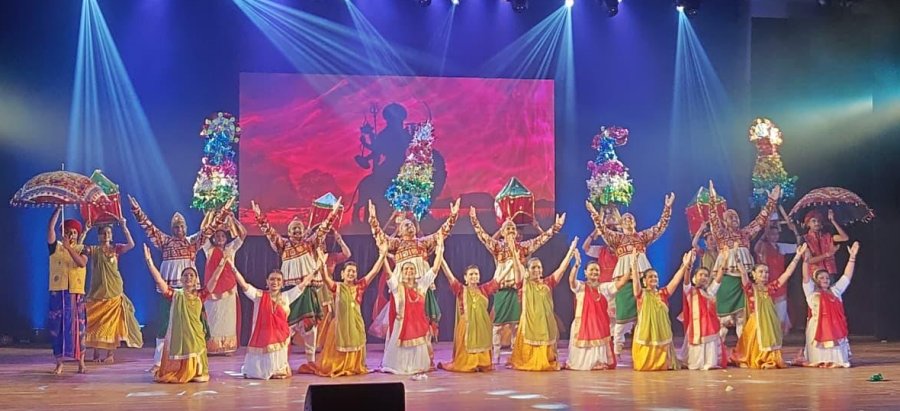 Finale Equally striking was the visual authenticity of the presentation. Traditional costumes, meticulously researched and aesthetically designed, reflected the regional identities and devotional contexts of the various goddess traditions being portrayed. The vibrant colours, intricate textiles, jewellery, turbans and folk accessories enhanced the authenticity of the performance without ever overwhelming it. Both the male and female dancers performed with remarkable enthusiasm, precision and commitment, embodying the spirit of each sequence with confidence and grace. One of the greatest achievements of the production was its seamless flow. There were no awkward pauses, no disruptive transitions. Entries and exits merged effortlessly into one another, creating the sensation of an uninterrupted pilgrimage. Props appeared and disappeared with fluid efficiency; dancers transformed spaces instantly; musical transitions connected one sacred destination to the next. The audience was gently carried through an ever-unfolding parikrama of devotion, rhythm and celebration. As lamps flickered, swords flashed, manjiras rang, temple bells echoed and garbas circled in ever-expanding patterns, one realised that the performance was far more than a dance presentation. It was a living archive of Gujarat's cultural memory. The evening ultimately revealed the essence of Aavishkar itself which rested equally on the dedication and artistry of the dancers - Shirali, Shailvi, Pearl, Sujal, Bansari, Shlok, Bansi, Dilip, Ayushi, Khwaish, Dhanshree, Harshvadan, Morli, Vedanshi, Alpesh, Khushi, Dinesh, Himali, Meenu, Yoshita, Ami, Kinjal, Ganesh, Vrishti, Aashna, Sohini and Urvi - who performed with remarkable energy, precision and commitment, bringing every segment of the program vividly to life. An institution that has never hesitated to explore contemporary aesthetics, theatre and experimental movement; yet one that remains firmly anchored in the folk traditions that define Gujarat's cultural soul. Forty years later, Aavishkar continues to innovate without abandoning its roots, creating performances that are at once educational, entertaining, aesthetically sophisticated and culturally meaningful. The 40th anniversary celebration was therefore not merely a commemoration of a milestone. It was a reaffirmation of a vision - one that honours the past, embraces artistic evolution and carries forward the enduring spirit of Gujarat's rich performing arts heritage.  Son of journalists K Shivram and Amni Shivram, the first Malayali woman English journalist, Bijoy Shivram is an accomplished Indian classical dancer trained in Bharatanatyam and Kuchipudi. A passionate promoter of the arts and a skilled graphic designer, he currently serves as the Vice Principal of JG College of Performing Arts and the Assistant Director (Operations) overseeing 17 JG colleges. He is also the founder of Preksha, an organization dedicated to the promotion of art and culture in Ahmedabad. Since 2020, Bijoy has curated the YouTube series 'Gurudakshina - An Ode to our Gurus,' celebrating the legacy of mentorship and tradition. |
