
|     |
|
| |

REVIEW / REPORTĀRŪRE: Through the lens of Muthuswami Dikshitar- Satish Surie-mail: satishism@yahoo.co.in Photos: Anup Vishwanathan June 13, 2026 Jagadishwar Sukumar, disciple of Ramaa Venugopalan, with earlier training under Renjusha Nair and Parshwanath Upadhye presented ĀRŪRE, an immersive lecture demonstration exploring the sacred and cultural landscape of the Thyagaraja Temple at Thiruvarur through the compositions of Muthuswami Dikshitar, on the 15th of May at Sabha Bangalore. There was a particular kind of courage required to build a Bharatanatyam production around a single sacred geography: to stake an entire evening not upon the breadth of a dancer's margam, but upon the depth of one temple's cosmos. Jagadishwar Sukumar's ĀRŪRE was precisely such an act of artistic conviction. Framed as an immersive pilgrimage to the grand Thyagaraja Temple at Thiruvarur and anchored in the musical edifice of Dikshitar's kritis, the production emerged as one of the more conceptually ambitious Bharatanatyam presentations. 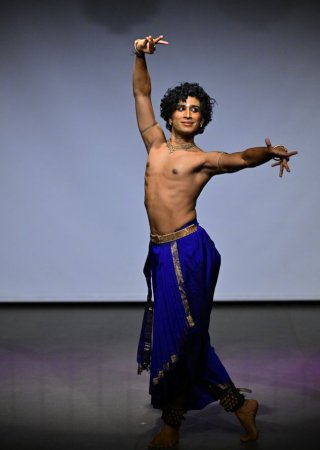 Jagadishwar Sukumar To understand what ĀRŪRE undertook, one had first to appreciate the magnitude of the terrain it charted. The Tiruvarur Thyagaraja Temple, spread across approximately twenty-five acres in the Kaveri delta of Tamil Nadu, stood among the most architecturally complex and mythologically layered Shaiva shrines in the subcontinent. Its nine gopurams, eighty vimanas, and thirteen halls constituted not merely a religious complex but an entire sacred city. Its seven-tiered principal gopuram rose to thirty-six metres. The Kamalalayam tank, vast and luminous, anchored the temple's spiritual geography. Within its precincts, three-hundred-year-old murals survived in restored splendour, and the Achaleswarar temple at Arur Araneri added yet another devotional layer to an already richly stratified complex. The presiding deity was Vanmikinathar, Shiva emerging from an anthill, enshrined in the innermost sanctum. But it was Thyagarajar, the processional deity in his Somaskanda manifestation, who lent the temple its particular choreographic and cultural identity. His consort was Nilothpalambal, the blue lotus goddess worshipped as Neelotpalambika. The temple was revered as one of the Pancha Bootha Sthalams, representing the element of earth, and was widely regarded as the birthplace of the Thyagaraja cult that shaped Carnatic music's devotional character for centuries. Its grand chariot festival, the Azhi Ther, drew thousands of pilgrims and remained one of Tamil Nadu's most celebrated annual observances. Into this vast world, Sukumar led his audience with the music of Dikshitar as both lamp and map. The production's governing concept, to use Dikshitar's kritis as both musical and cartographic devices, was shrewdly conceived. Dikshitar was, among his many identities, a temple wanderer whose compositions carried within them the memory of specific shrines, their presiding deities, their iconographic peculiarities, and their ritual traditions. To choreograph a journey through Thiruvarur using this music as the guide was therefore not a metaphorical exercise but an almost literal one. The composer himself had made precisely this pilgrimage, and his words mapped the terrain with theological and architectural precision. Sukumar's production excelled as an immersive temple tour rather than a conventional margam. It blended dance, live Carnatic music, narration, and visual elements, including projected imagery and life-size paintings, to map the temple's architecture, deities, legends, and spiritual geography. The multiple prakaras and gopurams were navigated in sequence, each with its presiding deity and associated lore, so that the audience experienced the performance as a procession through sacred space rather than a concert hall presentation. Sukumar and his collaborators deployed the lecture demonstration format with intelligence and generosity. The narration neither condescended to the uninitiated nor abandoned them. Audiences unfamiliar with the Saptha Vidangam tradition, the legend of Muchukunda, or the significance of the temple's multiple theerthams were gently furnished with context, including the Vatapi Ganesha legend historically linked to the region. Those already schooled in these matters found that the explanations enriched rather than interrupted the performance. This was a delicate tonal calibration, and it was largely sustained throughout. The production opened with Dikshitar's celebrated "Vatapi Ganapatim Bhajeham" in raga Hamsadhvani, and the choice proved deft on multiple registers. The composition honoured the Vatapi Ganesha idol historically linked to the Thiruvarur region, lending the invocation a site-specific resonance that a more generic Ganesha vandana would have lacked. Sukumar rendered the Hamsadhvani with jatis that were crisp and rhythmically confident. There was an elasticity to his footwork, modelled on the traditional temple dancers, that suggested not mere technical facility but an internalised musical grammar, and his abhinaya in the subsequent passages brought the elephant-headed lord to life with warmth and play. The opening sequence functioned precisely as it should have: it announced the terrain, cleared the air, and deposited the audience in a state of alert receptivity. As a male dancer, Sukumar demonstrated assured command over both lasya and tandava, navigating the full tonal spectrum of Bharatanatyam with conviction and clarity. His footwork remained clean and grounded, and his bhakti-oriented abhinaya carried a sincerity that never tipped into sentimentality. It was, however, in his engagement with the karanas, the Shiva-inspired movement vocabulary drawn from the Natya Shastra, that the production found its most distinctive sculptural register. When Sukumar evoked the temple carvings of Thyagarajaswami, the dancing Shiva in his Somaskanda manifestation, his body took on a quality of arrested stone. The karanas were not merely referenced but inhabited, lending the abhinaya a three-dimensional authority that transformed the performance into a kinetic reading of temple sculpture. The Ajapa Natanam, Shiva's eternal breath, like a dance of cosmic sustenance, was rendered with particular gravity. Here, the devotional and the formal converged: one sensed a dancer who had studied both the iconographic tradition and the living bhakti current that animated it. The Varnam and the heart of the pilgrimage The Daru Varnam "Nee Saati Deivamenduleni" formed the structural and emotional spine of the evening. Here, Sukumar was called upon to sustain extended passages of both nritta and abhinaya, and it was here that the full range of his training became apparent. The nritta sequences carried genuine sculptural authority: lines remained clean, transitions unhurried yet propulsive, and the relationship between body and beat conveyed inhabited certainty rather than anxious precision. The abhinaya in the passages evoking Nilothpalambal and Kamalambika was handled with a sensitivity that avoided both the overemotive and the merely decorative. These compositions, in which Dikshitar's layered Telugu remained dense with iconographic reference, posed formidable choreographic challenges. Sukumar did not simplify. The abhinaya remained nuanced and considered, and one sensed genuine interpretive labour behind each gesture. A concert within a production: The Navavarna Kriti as living triptych The evening's most audacious and resonant sequence centred upon Dikshitar's Navavarna kriti "Tyagaraja Mahadwaja Aroha", one of the composer's most exalted compositions in praise of the processional deity at Thiruvarur. What distinguished this presentation from any conventional rendering was a decision of rare formal daring: the music ensemble did not treat the varnam merely as accompaniment to dance but expanded it into a fully realised concert, threading through a complete Ragam Tanam Pallavi. Srividya Ramnath's vocals unfurled the raga with leisurely authority, supported by the ensemble in full concert disposition, giving the Navavarna kriti its own independent musical life. For the duration of this sequence, the performance became something genuinely unprecedented: a Carnatic concert and a Bharatanatyam production occupying the same space simultaneously, neither subordinate to the other. The tani avartanam by Mithun Shakthi on mridangam and kanjeera emerged as a centrepiece in its own right. Freed into the full scope of the solo percussion interlude, Shakthi demonstrated a breadth of vocabulary and compositional intelligence that elevated the evening's percussive dimension well beyond the supportive. His konnakol-inflected passages and the interplay between the two instruments produced a rhythmic architecture of considerable intricacy, one that the attentive ear could appreciate as its own argument, complete and self-sufficient. 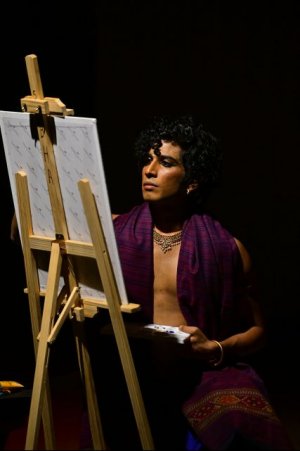 What made this sequence truly extraordinary, however, was what unfolded in parallel. While the music ensemble sustained the full arc of the Ragam Tanam Pallavi and the tani avartanam, an artist took brush to canvas and began, in real time and in full view of the audience, to paint a visual interpretation of the Nava Varnam. The painting was not illustrative in any simple sense. It was an act of creative translation, the painter responding to the same musical and devotional impulse that had generated Dikshitar's composition, externalising an inner vision of what the varnam's praise of Thyagarajar might look like, rendered in pigment and line. Audience members found themselves witnesses to three concurrent acts of interpretation: the musician's, the dancer's, and the painter's, each independent, each in conversation with the others, each arriving at its own reckoning with the same sacred subject. The cumulative effect resembled a genuine triptych: music, movement, and image unfolding together in devotional time. It remained the production's most original conception and its most successful realisation of the evening's central argument, that a single Dikshitar composition held within it an entire world capable of generating multiple simultaneous artistic responses, each legitimate, each illuminating, none exhaustive. One left this sequence with the sense of having witnessed something that the conventional formats of classical performance, whether concert, recital, or lecture demonstration, did not ordinarily permit. ĀRŪRE, at its most ambitious, made a persuasive case that they should. If the Navavarna Kriti sequence represented the production's most radical formal gesture, the concluding piece became its most ceremonially complete. Sukumar chose to bring ĀRŪRE to its close with the "Dwaja Arohanam", Dikshitar's composition describing the solemn hoisting of the sacred flag at the Thiruvarur temple. The choice proved masterly. The Dwaja Arohanam was not merely a descriptive composition; it was a ritual act rendered in sound. The hoisting of the temple flag marked the formal commencement of a festival, the moment at which the divine presence was publicly proclaimed, and the devotional congregation summoned. To end the pilgrimage that was ĀRŪRE with this composition brought the evening's journey to its logical and spiritually resonant conclusion. Sukumar's rendering of the "Dwaja Arohanam" carried the accumulated devotional weight of everything that had preceded it. The abhinaya in the flag hoisting passages possessed a quality of ceremonial stillness, each gesture arriving with the deliberateness of ritual rather than the urgency of performance. The body, which had moved through karanas, tandava, and the intricate nritta of the varnam, here found a different register: one of elevation, offering, and a moment in which the sacred and the temporal briefly coincided. The composition's upward momentum, both melodic and imagistic, was rendered through an ascent that felt earned rather than imposed, the natural culmination of a pilgrimage consciously undertaken. It was, in the end, the Dwaja Arohanam that most clearly declared what ĀRŪRE understood itself to be. This was not a production that merely studied a temple or celebrated a composer. It was a production that staged a festival, with everything a festival implied: a beginning, a procession, a moment of awakening, a community gathered in shared attention, and finally, the raising of a flag to announce to the world that the deity was present and the celebration had begun. The audience that filed out after the Dwaja Arohanam had not simply watched a performance. They had, for the duration of the evening, become pilgrims. No pilgrimage proceeded in silence, and the live music ensemble that accompanied ĀRŪRE remained central to the evening's success. The musicians did not merely support the dancer; they constituted a second simultaneous act of devotion, building around Sukumar a tonal architecture that was at once exhilarating and precise. 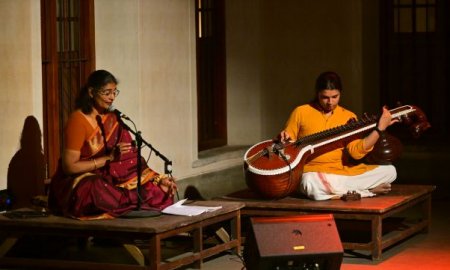 Srividya Ramnath and Achyutha J 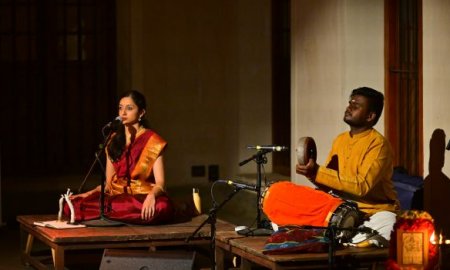 Keerthana Jaiprakash and Mithun Shakti Srividya Ramnath's vocals anchored the ensemble with commanding authority. Her voice carried the elaborate melodic geography of Dikshitar's kritis with clarity and depth, illuminating the rasas embedded in each composition without sacrificing the structural rigour that the repertoire demanded. Keerthana Jayaprakash on nattuvangam provided the rhythmic scaffolding of the performance, her syllabic precision and intuitive attunement to the dancer's body lending the production a rhythmic confidence that was felt as much as heard. Mithun Shakthi, performing on both mridangam and kanjeera, brought percussive intelligence and versatility to the ensemble, sustaining the tala framework across the evening's shifting tempi and moods with an effortlessness that bespoke deep musicianship. Achyutha J on the veena contributed a quality of resonant interiority to the texture. The veena's characteristic timbre, at once meditative and luminous, proved a particularly fitting voice for the temple world being evoked, as though the instrument itself were speaking from within the stone corridors of Thiruvarur. Together, the five artists, Sukumar included, created a collaborative sound world in which no single element dominated. Mention was made during the performance of Sumathy Mathiazhagan and the family tradition of Shuddha Mandalam, and it was a mention that carried considerable cultural resonance. Shuddha Mandalam represented a lineage of classical practice in which the purity of form, the integrity of transmission, and the fidelity of devotional intent were held as foundational values. That Sukumar's production should invoke this tradition was not incidental. It situated ĀRŪRE within a broader continuum of classical guardianship, reminding the audience that what they witnessed was not merely a contemporary artistic project but a link in a long chain of custodianship. Sumathy Mathiazhagan's association with this lineage lent the production an additional layer of traditional sanction, and the acknowledgement reflected a commendable awareness on Sukumar's part of the living inheritance within which his own work had to be understood. 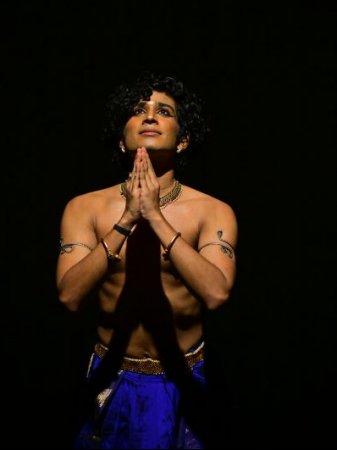 Jagadishwar Sukumar One of ĀRŪRE's most instructive dimensions lay in its capacity to illuminate the Saptha Vidangam tradition, the seven Shiva shrines of the Kaveri delta that Dikshitar documented so faithfully in his music, by approaching it through the body rather than solely through the text. Watching Sukumar inhabit a Dikshitar kriti was to understand viscerally what it meant for music to carry a place within it. The stotra-like character of these compositions, their tendency to layer mantra, iconography, raga bhava, and architectural description into a single melodic utterance, became kinetically legible through dance in ways that even the finest musicological exegesis could not entirely replicate. This, ultimately, remained the production's most significant contribution. It argued convincingly and with artistic seriousness that Bharatanatyam was not merely an ornament to the Carnatic musical tradition but one of its most capable interpreters. When movement, lyric, raga, and tala converged in ĀRŪRE, one glimpsed the possibility of a dance practice that was also an act of scholarship, devotion, and genuine cultural stewardship.  Bangalore based Satish Suri is an avid dance rasika besides being a life member of the Music and Arts Society. |
