
|     |
|
| |

REVIEW / REPORTTarangini's Sangraha captures the eternal soul of Kathak- Archi Sarkar-Goyale-mail: sarkar.archi@gmail.com Photos: Prasanna Narayanan June 13, 2026 There are performances that entertain, and then there are those that breathe - that carry devotion and cultural resilience in every movement. It is in the latter that art finds its true power. On a warm spring evening on May 9, the Tarangini School of Kathak Dance presented its sold-out production 'Sangraha' - an exquisitely curated anthology of rhythm, movement, expression, and deep-rooted lineage that left its audience spellbound. As the lights dimmed at the Smithwick Theater, Los Altos Hills, CA - over two hundred dancers awaited in bated breath in the wings for their moment with the audience to celebrate the heritage of storytelling encoded in physical posture through the spine, heel and outflung wrist. Elementary school girls barely past their first set of ghungroos, seasoned practitioners, and veteran performers formed the ensemble cast that brought 'Sangraha' to life from the very first beat of the tabla. Founder and Artistic Director Anuradha Nag - who trained under the unparalleled Pandit Birju Maharaj and his foremost disciple Pandit Vijai Shankar and further deepened her abhinaya under Kalanidhi Narayanan - has been building Tarangini in the Bay Area since 1992. The school's very name was gifted and blessed by Birju Maharaj himself, a benediction that carries the weight of an entire lineage. Three decades on, Sangraha proves the lineage is not merely preserved - it is vibrantly, joyfully alive. 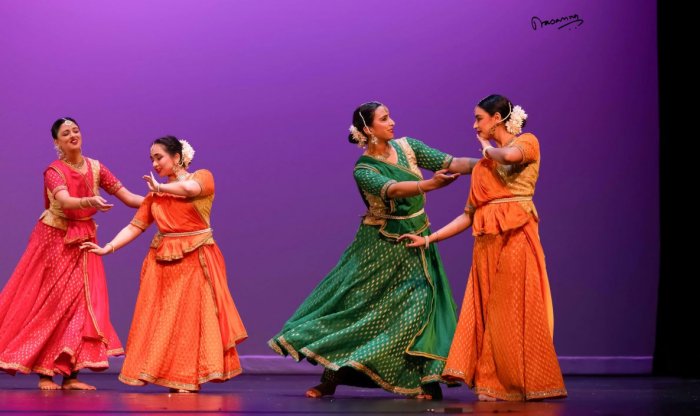 "Each piece has been thoughtfully selected from various Tarangini collections, with musical modifications and fresh choreography to adapt to the needs of each group," noted Anuradha Nag. Nag's brilliant choreography was vividly apparent in how she structured the evening's program arc into a carefully calibrated emotional and temporal journey. It opened at dawn invoking the Hindu trinity Brahma, Vishnu, and Mahesh through a melodious composition in raga Bhairav and was performed by the youngest students executing the basics of Kathak technique. The dawn mood deepened with Pancha Tattva, where Tarangini's young performers paid homage to the five elements - earth, water, air, fire and space. What was equally remarkable was the training that enables these young students to hold their abhinaya with stoic composure. It is as much a pedagogical achievement as it is an artistic one. From here, the program steered through the ragas from dawn to midnight with architectural precision. Jogia (early morning), drawn from Tarangini's celebrated 'Ragangikam' collection - which pairs Kathak with Hindustani ragas across the cycle of a full day - was followed by Gunkali (a mid-morning tarana), Shuddha Sarang (noon), Puriya Dhanashree (late afternoon), Gorakh Kalyan (late evening), and - after the intermission - Malkauns and the raga Darbari finale, both belonging to the deep realms of the night. The effect of watching a single day with all its moods, light and shadows unfurling through dance was nothing short of surreal. Sangraha's uniqueness stemmed from its refusal to be confined to a single devotional language and what emerged was an expertly crafted genuinely pluralist evening. Sundar Gopalam - Vallabhacharya's Nandkumar Astakam, set to music by Birju Maharaj himself - brought the attributes of Krishna that culminated in a joyous celebration that lifted the audience's energy with it. 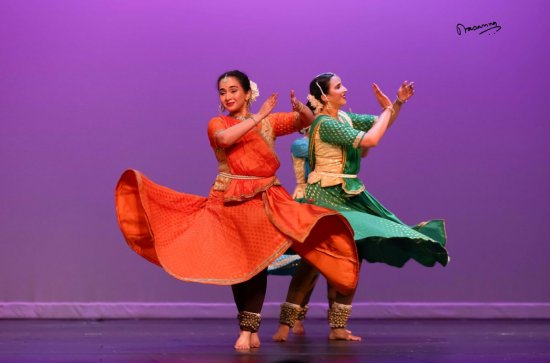 Tyag transitioned from Hindu to Sikh tradition: Guru Nanak's "Sadho man ka maan tyago" rendered an expressive exhortation to release worldly attachment and was followed by Sant Kabir's Sufi piece depicting the annihilation of the ego: "Man laago yaar fakiri mein." Christina Rossetti's Victorian English poem, 'A Green Cornfield' was a delightful showcase of Kathak's universal grammar of gesture through a dancer's trance as a skylark playfully takes flight to catch the summer air. The gravitational center of the program was Nachata Sudhanga, Nag's choreographic masterpiece- a 16th-century composition by the poet Surdas, set to music by her guru Pandit Vijai Shankar. Though it was recorded during the time she emigrated to the US between 1992-94, she waited decades for the right moment to choreograph it - and the wait has been worth every year. The Maha Raas depicted the supreme cosmic dance of Krishna and the devotion of Radha and the gopis of Vrindavan where the divine Shiva and Brahma descended from the heavens to witness a joyous harmony of beat and melody in perfect, ecstatic conversation. The senior ensemble of seasoned students, who have been honing the craft for decades, performed with a technical authority and emotional depth where the bhakti rasa, the emotion of pure devotion, does not merely illuminate the stage; it radiates into the seats. 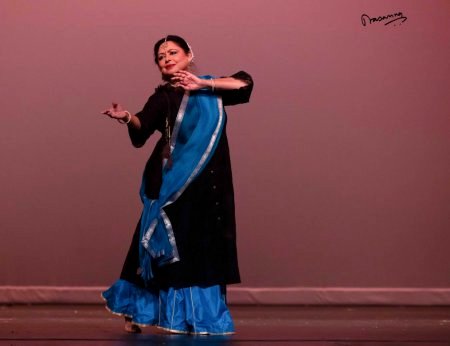 Anuradha Nag In a rare surprise treat, and despite several enduring injuries, Anuradha Nag herself took the center stage next to inspire her students by showcasing an ultimate devotion to the art form where the being and the soul become one with dance. Undoubtedly the most emotionally charged performance of the night, Nag performed 'Aaji jhorer raatey tomar obhishar' in honor of Rabindranath Tagore's birthday. The composition from Tagore's Nobel prize winning poetic anthology 'Gitanjali', gives voice to a courageous heroine who ventures out into a dark and stormy night to reach her beloved. The profound and elegant presentation moved the audience to tears. For those attending Kathak recitals for the pure intoxication of nritta - the unadulterated technical display of footwork, spins, and rhythmic architecture - Sangraha delivered majestically. Gorakh Kalyan's tarana in the 12-beat ektaal was a masterclass in group synchrony; seventeen dancers moved as a single organism; their ghungroos producing a rolling thunder that vibrated through the audience. Nag saved her most technically demanding gauntlet, Tarana Tirvat, for the grand finale. Set in raga Darbari - a raga of deep, contemplative midnight - the piece was performed by the senior ensemble at a pace that seemed to defy the capacity of the human body. Pirouettes multiplied into long cascading sequences; the tatkar (footwork) becomes a percussion instrument, communicating directly with Debashish Ghosh's superbly arranged musical score. The exemplary musical arrangement mirrored the dancers with the reciprocity of a true baithak. There is a particular poignancy in witnessing a classical art form thrive robustly in diaspora - far from the courts and temples that first shaped it, on a stage in Silicon Valley, performed by the daughters and students of immigrants who chose to carry the torch of inheritance across oceans. Sangraha celebrated this reality. In Anuradha Nag's hands, Kathak is not a relic to be preserved under glass; it is a living practice flexible enough to render a Victorian English poem, sincere enough to carry Tagore's depiction of a storm, and technically rigorous enough to thunder through a midnight tarana with unparalleled intensity. The reflections of Pandit Birju Maharaj's genius - channeled through Anuradha Nag's thirty-three years of teaching was fathomable, in every mudra, every whirring chakkar and in every student who held the stillness at the end of a composition and knew, somehow, that the silence after the last beat was an integral part of the dance. A seasoned technology operations leader in Silicon Valley, Archi Sarkar-Goyal balances driving large-scale organizational rhythms with a passion for creative storytelling. As a senior executive and freelance journalist, she bridges the world of data-driven business strategy and cultural narrative. |
