
|     |
|
| |

REVIEW / REPORTSilambam Phoenix presents 'Waves of Resistance'- Shyla Ganesane-mail: shygan@gmail.com Photo credit: Keshava Reddy Konatham June 8, 2026 Choreography & Direction: Dr. Srimathy Mohan, senior disciple of Guru Sudharani Raghupathy Dates: May 31 and June 1, 2026 Venue: ASU Kerr Cultural Center, Arizona Silambam Phoenix's 'Waves of Resistance' charts a compelling historic parallel. In a contemporary Bharatanatyam landscape heavily saturated with thematic explorations of the Puranas and deep dives into Devi mythology - genres that remain vital to the art form - witnessing a narrative rooted firmly in global political history is a profound breath of fresh air. Silambam Phoenix's first iteration of 'Waves of Resistance' marks a courageous and necessary departure from traditional repertoire, stepping into the lineage of major historical dance-dramas like Mythili Kumar's 'Gandhi', the pioneering works of the Dhananjayans, and Shantha Bhaskar's historic productions. Using the classical vocabulary of Bharatanatyam, 'Waves of Resistance' seeks to draw structural and philosophical parallels between two monumental acts of non-violent defiance separated by oceans and eras: the Boston Tea Party of the 1700s and the 1930 Salt March in India. 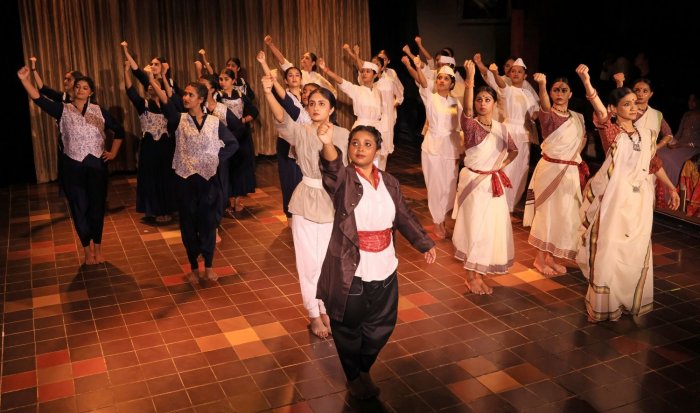 Setting the historical context: Pre-show and structure The educational intentionality of the production was evident before the curtains even drew. The pre-show experience featured a curated set of pop-up posters provided by the ASU Center for the Study of Race and Democracy. By detailing the precise historical timelines leading up to both the Boston Tea Party and the Salt March, these displays offered invaluable context. For audience members who may not be voracious history buffs or scholars, this thoughtful addition provided an accessible entry point, framing what to expect and anchoring the historical scope of the evening. Choreographic identity and cross-cultural score Musically, the production boasts an intelligent, cross-cultural sonic landscape. The blending of colonial-era melodies with South Indian classical music was seamlessly executed, creating an evocative bridge between East and West. This musical cohesion was further illuminated during a post-show feedback session moderated by the writer and co-composer Vaibu Mohan. During the discussion, composer and orchestrator Greg Paladino shared a fascinating musicological insight: both genres naturally share the same foundational instrumentation - specifically the flute, the violin/fiddle, and percussion. This organic commonality is precisely what made the synthesis of the two musical worlds feel so harmonious and enjoyable rather than forced. 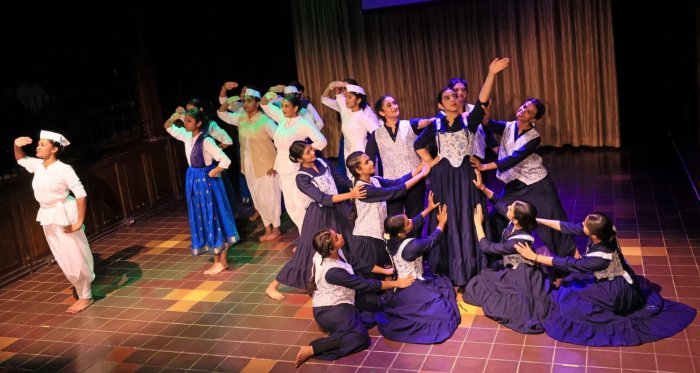 Choreographically, the production carries the structural signature that long-time followers of the choreographer, Srimathy Mohan, are familiar with. The clarity from the Preshow posters, carried directly into the performance itself with clear, spoken narration preceding each scene and the contextual framing beautifully mapped out the chronological parallels between colonial America and British-occupied India. This was a thoughtful, educational, and highly effective way at anchoring the audience. The other feature is the undeniable stamp of the classic Thanjavur stylistic lineage. The choreography utilizes crisp sarukkal adavus (sliding steps) and complex jathis (rhythmic sequences) that gave the ensemble moments of brilliant technical cohesion. This classical rigor was mirrored by a minimalist approach to costuming; the simplicity allowed the audience to immediately distinguish between the historical characters of the American and Indian resistance movements without much distraction. During the post show feedback, the choreographer also shared the adrenalin to change the choreography, to match the final tracks of the music which had grand finale endings, and which were sent to the team about 2 weeks before the performance! Considerations for the next iteration As Waves of Resistance continues its developmental trajectory, certain structural refinements could elevate the production from excellent regional work to a touring-caliber masterpiece. Sustaining narrative flow via score: While the jathis were executed with precision, their traditional rhythmic structure occasionally disrupted the theatrical narrative. Replacing these stark rhythmic segments with melodic swara (musical note) passages or instrumental transitions could prevent the audience from subconsciously shifting into a standard "classical recital" mindset, thereby maintaining the historic and theatrical tension. A grander canvas: The sheer scope of this production demands a larger proscenium stage for the performers in an intimate setting for audience. ASU Complex staging elements - such as the interfaith prayer sequence, the intricate weaving of dancers between scenes, and the climactic throwing of tea into the harbor - require greater spatial depth to achieve their full visual and emotional impact. Sonic texture: The integration of salangai acoustic design needs to be in the next iteration onwards. Introducing these acoustic textures selectively could heighten the dramatic gravity of the protest sequence and the joy when the aim of the protests was fulfilled. 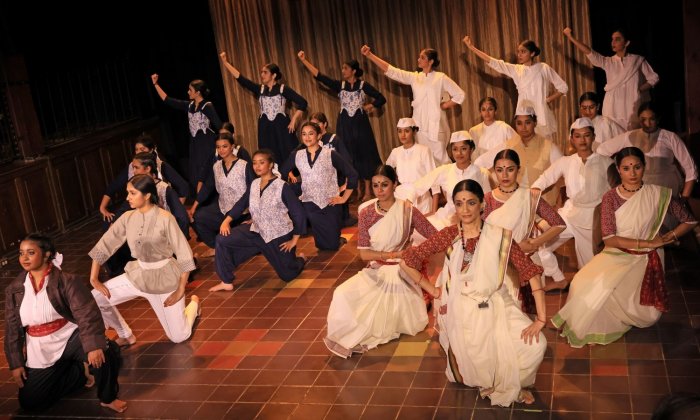 Conclusion By fostering community dialogue and integrating academic partnership with artistic expression, Silambam Phoenix has laid a stellar foundation with this initial presentation. 'Waves of Resistance' proves that Bharatanatyam remains a potent, elastic medium capable of addressing complex historical and socio-political themes. This is a highly necessary and refreshing piece of dance theater, and the community will undoubtedly look forward to its next fully realized iteration.  Shyla Ganesan, an engineer by profession, is a Bharatanatyam teacher, choreographer and curator based in Chandler, Arizona, and is the founder of Nrityalaya Aesthetics Society, Phoenix, a branch of Bhaskars Arts Academy, Singapore. |
