
|     |
|
| |

REVIEW / REPORTNrityarpanam II - Kalabhivyakti 2026Celebrating the legacy of Late Guru Bhanumathi- Satish Surie-mail: satishism@yahoo.co.in Photos: Bheemesh Savanth June 2, 2026 The second edition of Nrityarpanam, presented under the aegis of Bhanumathi Nrityakala Mandiram as part of Kalabhivyakti 2026, opened on the 9th of May at the venerable Indian Institute of World Culture, Bengaluru, with an evening that placed thought at the centre of art. Conceived as a tribute to the enduring legacy of Late Guru Bhanumathi, the festival paid homage not merely through performance but through the very pursuit of knowledge that she so deeply embodied. The Panel Discussion: Research and the Joy of Dance The evening commenced with a panel discussion of rare intellectual richness, a dialogue on the relationship between scholarly research and lived practice in classical dance. The conversation brought together two distinguished voices: Dr Karuna Vijayendra, whose academic rigour and artistic sensibility have long informed her engagement with the classical tradition, and Guru Padmini Ravi, recipient of the prestigious Shantala Award, a practitioner whose decades of teaching and performance carry within them the weight of deep inquiry. 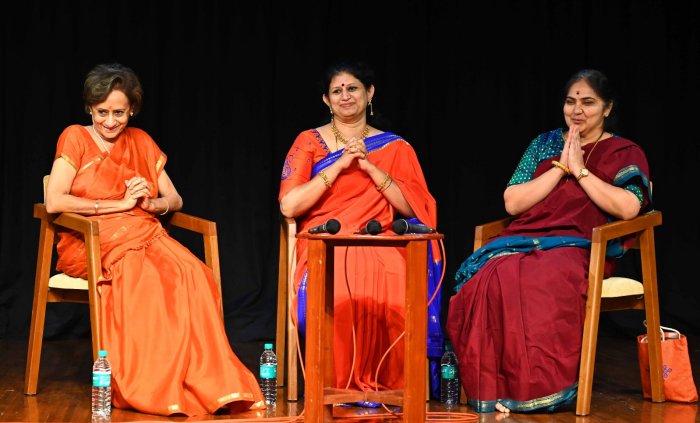 Padmini Ravi, Shobha Shashikumar, Karuna Vijayendra Together, they explored how research, far from being the exclusive province of the scholar, finds its truest expression in the studio, the rehearsal, and the final illuminated moment of performance. The discussion moved across questions of textual sources and their translation into living movement, the responsibilities of the guru in transmitting knowledge with integrity, and the joy, spontaneous, irreducible, that arises when rigorous understanding meets the freedom of artistic expression. The dialogue was moderated with grace and intellectual dexterity by Dr Shobha Shashikumar, who steered the conversation with well-chosen questions, allowing space for both reflection and spontaneity, drawing the audience into a shared contemplation. That Nrityarpanam II should begin this way, not with the stage lights but with the lamp of inquiry, felt entirely fitting as a tribute to Guru Bhanumathi, whose own contribution to the classical arts was inseparable from her commitment to understanding. The panel discussion was followed by performances by Gopika Varma and Padmini Ravi. Mohiniattam by Gopika Varma Gopika Varma, one of the most accomplished exponents of Mohiniattam, delivered a deeply moving and intellectually layered performance that opened with a presentation marking the 165th birth centenary of Rabindranath Tagore. Rather than a conventional invocation, Gopika Varma chose to centre the opening on Tagore's probing, empathetic interrogation of the Ahalya episode from the Ramayana, the result a standout presentation that blended classical rigour with modern philosophical resonance. 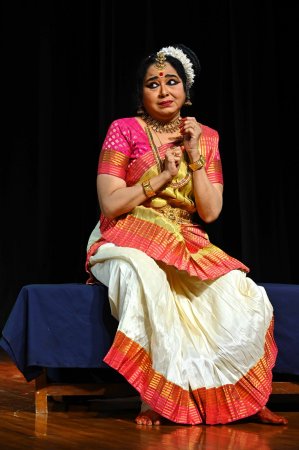 Gopika Varma The piece began with a sensitive Malayalam translation of Tagore's verses by Shankar Kurup, which set both the emotional and intellectual tone. As the translated lines unfolded, questioning whether Ahalya felt stone within and without, whether she witnessed the coming and going of seasons, whether she waited for a man to grant her liberation. Gopika Varma's abhinaya transformed the stage into a meditative space. Her portrayal was not that of a passive victim awaiting redemption, but of a woman reflecting on isolation, agency, time, and societal judgment. In Mohiniattam's characteristic fluid grace, Varma conveyed the cold immobility of stone through restrained, almost statuesque postures that gradually melted into subtle, introspective gestures. The slow circular sway of the torso, delicate mudras, and expressive eyes captured the passage of seasons, the weight of unjust punishment, and the quiet strength of a consciousness that exists beyond male intervention. The contrast between the form's inherent lasya and the existential gravity of Tagore's questions created a compelling tension that held the audience spellbound. Gopika Varma's rendition avoided melodrama; instead, it offered quiet dignity and restrained sorrow that felt profoundly contemporary. From this introspective intensity, Gopika Varma shifted with equal mastery to "Kuchela Upakhyanam", a luminous depiction of the eternal bond between Lord Krishna and his childhood friend Sudama. This segment brought a warm, affectionate glow to the recital, highlighting the dancer's remarkable range in navigating contrasting emotional palettes. The narrative unfolded through the touching recollection of gurukula days and the profound simplicity of their friendship. Gopika Varma eloquently portrayed Krishna fondly reminding Kuchela of boyhood pranks, cutting wood in the forest, sharing carefree moments, and the poignant incident where Kuchela, overcome by hunger, slept on Krishna's lap and unknowingly ate his friend's share of the puffed rice. In a moment of divine playfulness and unconditional love, Krishna later teases him: now you have come to repay the debt. Her abhinaya was a masterclass in subtlety: the mischievous sparkle in the eyes during childhood pranks, the gentle, grounded stances evoking the forest, and the tender expression as Krishna offered his lap. The sequence depicting Kuchela eating the puffed rice, hesitant at first, then innocently devouring it, was rendered with delightful realism and humour, never tipping into caricature. One moment, she was the humble, hesitant Kuchela approaching Dwarka; the next, she embodied Krishna's radiant, all-encompassing affection. The graceful adavus, undulating torso movements, and delicate hand gestures perfectly captured the intimate, lyrical essence of this bhakti-tinged friendship. Gopika Varma brought her recital to a serene close with a soulful rendition of the Hindi bhajan "Suno Sakhi," composed by Maharaja Swati Tirunal. Steeped in shringara rasa, the piece offered a perfect emotional resolution to the evening. The heroine pours out her heart to her sakhi, describing the unbearable pangs of separation, a restless mind, and the ache of longing for her lord. Gopika Varma's abhinaya captured every shade of this emotional landscape with refined elegance: the quiet torment and dreamy longing conveyed through her eyes, the soft undulating movements mirroring the ebb and flow of love's pain and hope. Her controlled restraint prevented the piece from tipping into sentiment, maintaining the classical dignity and poetic sophistication inherent in Swati Tirunal's composition. Bharatanatyam by Padmini Ravi The ebullient Padmini Ravi lit up the stage with a vibrant and well-rounded Bharatanatyam recital that showcased her boundless energy, impeccable technical command, and remarkable expressive range. Known for her lively stage presence and ability to seamlessly blend power with poetry, Ravi delivered a performance that moved fluidly across diverse moods, from majestic devotion to tender sensuality and profound spiritual upliftment. 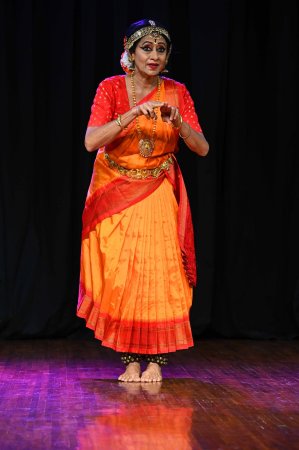 Padmini Ravi She opened with a powerful rendition of Papanasam Sivan's keerthanam "Para Para Parameshwara" in the grand Vachaspati raga. With sparkling enthusiasm and commanding authority, Ravi celebrated the glory of Lord Shiva as the supreme cosmic dancer. Her abhinaya was expansive and majestic as she vividly portrayed Shiva's iconic attributes, the matted locks flowing in the wind, the third eye radiating fierce compassion, the serpent coiled around his neck, and the rhythmic beat of the damaru signalling the cycles of creation and destruction. The pure nritya sequences were marked by crisp jatis, powerful footwork, and strong sculpted lines that perfectly captured the awe-inspiring grandeur of Parameshwara, radiating both bhakti and veera rasas in equal measure. She followed this with a refined and sensuous interpretation of Purandara Dasa's composition "Saddu madalu bedavo", in which the nayika gently pleads with Lord Krishna not to disturb her hard-earned peace, asking him to walk softly. Padmini Ravi explored the delicate sensuality of the composition with admirable grace and restraint. Through expressive eyes conveying quiet yearning, subtle torso movements, and evocative mudras, she drew out the intimate shringara rasa, a beautiful blend of playfulness, longing, and gentle admonition. Her nuanced abhinaya offered a striking contrast to the majestic intensity of the opening, demonstrating the breadth of her interpretive reach. Padmini Ravi concluded her recital on a deeply spiritual note with the soul-stirring bhajan "Achutam Keshavam Krishna Damodaram", rendered through vibrant Nama Sankeertana, weaving in the philosophical essence of the Upanishads and the path of surrender. She seamlessly incorporated the sanchari of Shabari Moksham, eloquently depicting the tribal devotee Shabari's unwavering faith, her humble offering of fruits to Lord Rama, and her ultimate liberation through his compassionate grace. Ravi's sincere devotional fervour elevated the bhajan into a spiritually uplifting finale that left the audience in a state of quiet reverence. In a passing remark during the programme, Padmini Ravi shared a personal anecdote that spoke volumes about her artistic humility. A great admirer of the Asthapadis from Jayadeva's Gita Govindam, she had once approached the legendary Guru Kalanidhi Narayanan to learn them. With characteristic frankness, the maestro told her she was not yet ready for those profound pieces, a candid assessment that Ravi recalled with warmth and gratitude, underscoring a lifelong commitment to rigorous training and growth. Padmini Ravi's performance stood out for its dynamic emotional contrasts, from the majestic bhakti of Shiva to the tender romance of the nayika, culminating in profound devotion and philosophical depth. Through her recital, she demonstrated not only technical brilliance and artistic versatility but a sincere emotional engagement that resonated deeply with the rasikas. It was a memorable evening that reaffirmed her place as a dynamic and accomplished exponent of Bharatanatyam.  Bangalore based Satish Suri is an avid dance rasika besides being a life member of the Music and Arts Society. |
