|     |
|
| |

REVIEW / REPORTKalanidhi's Nritya Vahini: A celebratory flow of Kuchipudi excellence- Manjari Sinhae-mail: manjari@sinha.com Photos: Siva Sottallu May 27, 2026 For over three decades, Kalanidhi Dance has remained a steadfast torchbearer of Kuchipudi in the Washington metropolitan region. Founded in 1991 by Anuradha Nehru, senior disciple of the legendary Guru Vempati Chinna Satyam, the institution has consistently upheld a commitment to the preservation, promotion, and pedagogy of this classical dance tradition. Today, under the stewardship of a board of directors, Kalanidhi continues this legacy through its branches in Bethesda and Ellicott City, Maryland, and Ashburn, Virginia, nurturing students of all ages and levels with disciplined training and artistic vision. The school's annual student showcase, held this year on May 17, 2026, at the Cultural Arts Centre in Silver Spring, Maryland, was a vibrant testimony to this sustained commitment. Aptly titled Nritya Vahini - a flowing stream of dance - the production unfolded as an uninterrupted celebration of movement, melody, rhythm, and youthful enthusiasm. The title proved most appropriate, for what the audience witnessed was indeed a seamless vahini of choreography that moved gracefully between devotional fervour, pure dance virtuosity, and expressive storytelling. Thoughtfully composed music, imaginative choreography, thematic backdrops, and polished stagecraft enhanced each presentation, underscoring aesthetic richness and the versatility of Kuchipudi. The evening commenced with the invocatory Ganesh Vandana, "Mushika vahana...", a Sanskrit prayer seeking the blessings of Lord Vinayaka, remover of obstacles. Performed by a large ensemble of young dancers, the opening set the devotional tone with sincerity and visual symmetry. This was followed by Harivarasanam, based on the Hari-Haratmika Ashtakam, popularly rendered as a lullaby to Lord Ayyappa. The young dancers brought admirable poise and grace to this meditative composition, dancing with a composure that belied their years. 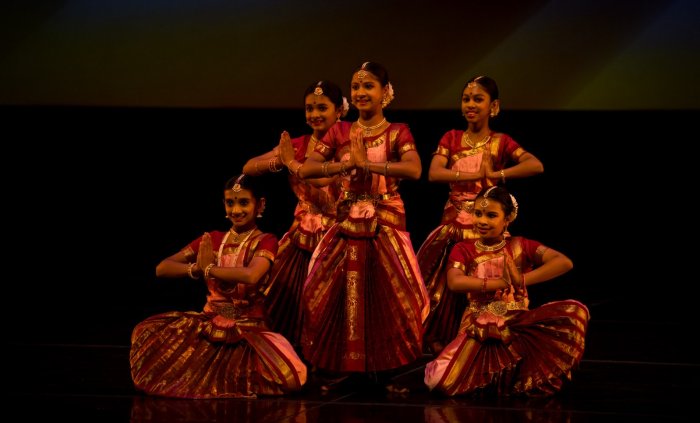 Hindolam Jathiswaram The Hindolam Jathiswaram offered a pleasing contrast, shifting from bhava to pure nritta. Here, the intricate swara patterns of raga Hindolam were translated into rhythmic movement with clarity and precision, showcasing the dancers' grounding in technique. The devotional mood continued with the Shiva Panchakshara Stotram, each verse built around the sacred syllables of Om Namah Shivaya. The dancers approached this composition with appropriate reverence, combining controlled movement with expressive devotion. Among the memorable highlights was the spirited rendering of Thillana in Mohana Kalyani, composed by the illustrious violin maestro Lalgudi Jayaraman. The scintillating rhythmic architecture of this beloved composition was executed with confidence and energy. This was followed by Lingashtakam, Adi Shankaracharya's celebrated hymn in praise of Lord Shiva, performed with devotional earnestness, and later, the elegant Brindavani Thillana, composed by M Balamuralikrishna, sustained the evening's rhythmic momentum. 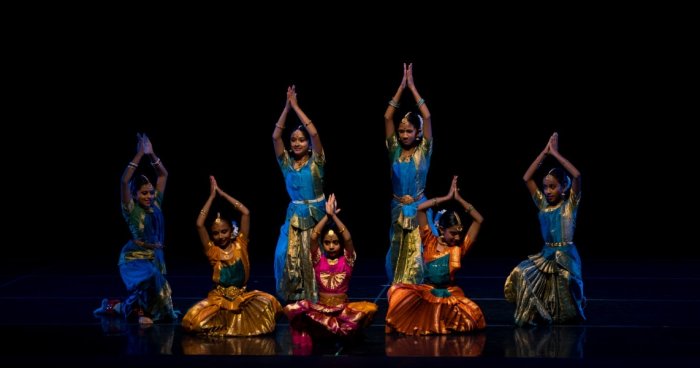 Leela A particularly delightful interlude came in Leela, a choreography celebrating rhythmic exuberance and the playful joy of movement. The dancers approached it with visible delight, their buoyant energy proving infectious. Oothukadu Venkata Subbaiyer's timeless Swagatham Krishna brought expressive storytelling to the forefront. Celebrating Krishna's playful heroism - including his conquest of the serpent Kalinga - the dancers demonstrated commendable abhinaya, balancing narrative clarity with graceful movement. 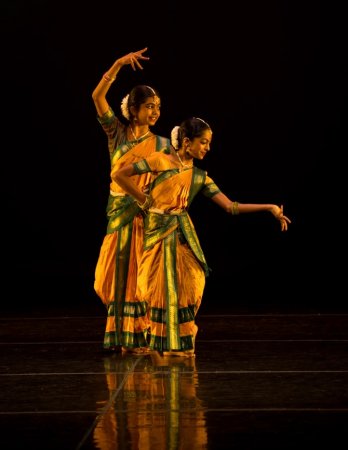 Bhindumalini Thillana The Bhindumalini Thillana stood out for its rhythmic intricacy and brisk footwork while Vara leela ganalola, the Tyagaraja composition in praise of Krishna, offered a lyrical and somewhat unexpected devotional perspective from the saint-composer more commonly associated with Lord Rama. The program's breadth was further enriched by pieces such as Malhar Jam Thillana, the Shiva stuti Nagendra Haraya, and a Swarajathi in raga Vasantha, all reflecting the school's intent to expose students to a broad Kuchipudi repertoire. 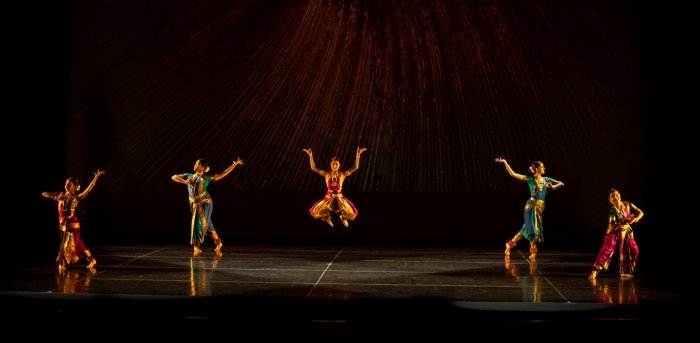 Malhar Jam Thillana 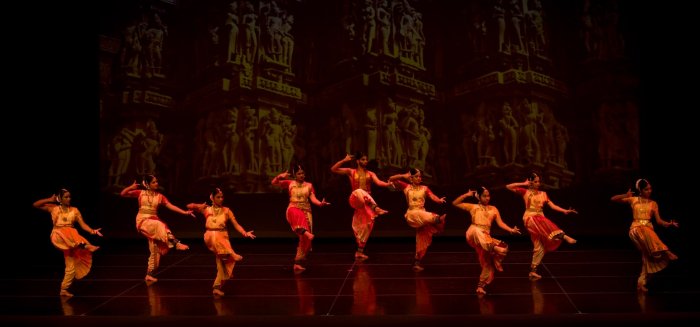 Dashavatharamulu One of the evening's most compelling presentations was Dashavatharamulu. Beginning with Jayadeva's celebrated Dashavatara verses from the Geeta Govinda -"Vedanudhdharate..."- this item was imaginatively conceived in the traditional Kalapam style of Kuchipudi. The inclusion of a male dancer added visual variety and lent authenticity to the ensemble treatment, making this one of the more distinctive choreographic offerings of the evening. Equally engaging was Sringaarinchukoni, a charming depiction of sringara rasa, where the youthful heroine adorns herself in anticipation of meeting her beloved, expressing playful longing through subtle gestures, sidelong glances, and feminine grace. The program concluded on a triumphant note with a solo performance of the famous Kuntalavarali Thillana by Sriyuktha Ganipineni, whose assured stage presence, dynamic energy, and statuesque freezes brought the evening to an exhilarating close. Her performance suggested the emergence of a dancer of notable promise. What remained evident throughout Nritya Vahini was the disciplined training that underpins Kalanidhi's pedagogy. Good posture, alignment, strength, rhythmic awareness, and stage confidence were consistently visible across age groups - clear indicators of a thoughtfully structured curriculum and rigorous mentorship. Credit must also be given to the production team - Daniel Singh, Lavanya Thamire, Pragnya Thamire, Christopher Campanella, and Vikram Nehru - for ensuring a smooth and professionally mounted presentation. 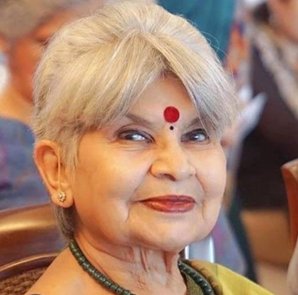 Manjari Sinha is a musicologist and an acclaimed classical music and dance critic. She has an MA in Sanskrit from Allahabad University, MA in Music from Vikram University, Ujjain; Sangeet Prabhakar in Hindustani Vocal, Tabla, Sitar and Kathak dance from Prayag Sangeet Samiti, Allahabad; and further training in Sitar under Guru Pt. Arvind Parikh in the lineage of Ustad Vilayat Khan. She has authored a book on Ustad Bade Ghulam Ali Khan, commissioned & published by Roli Books. She has contributed the chapter on Kathak for 'Indian Dance: the Ultimate Metaphor'. Her articles in English and Hindi on Music, Dance, Art & Culture are regularly showcased in a variety of leading journals and periodicals. |
